
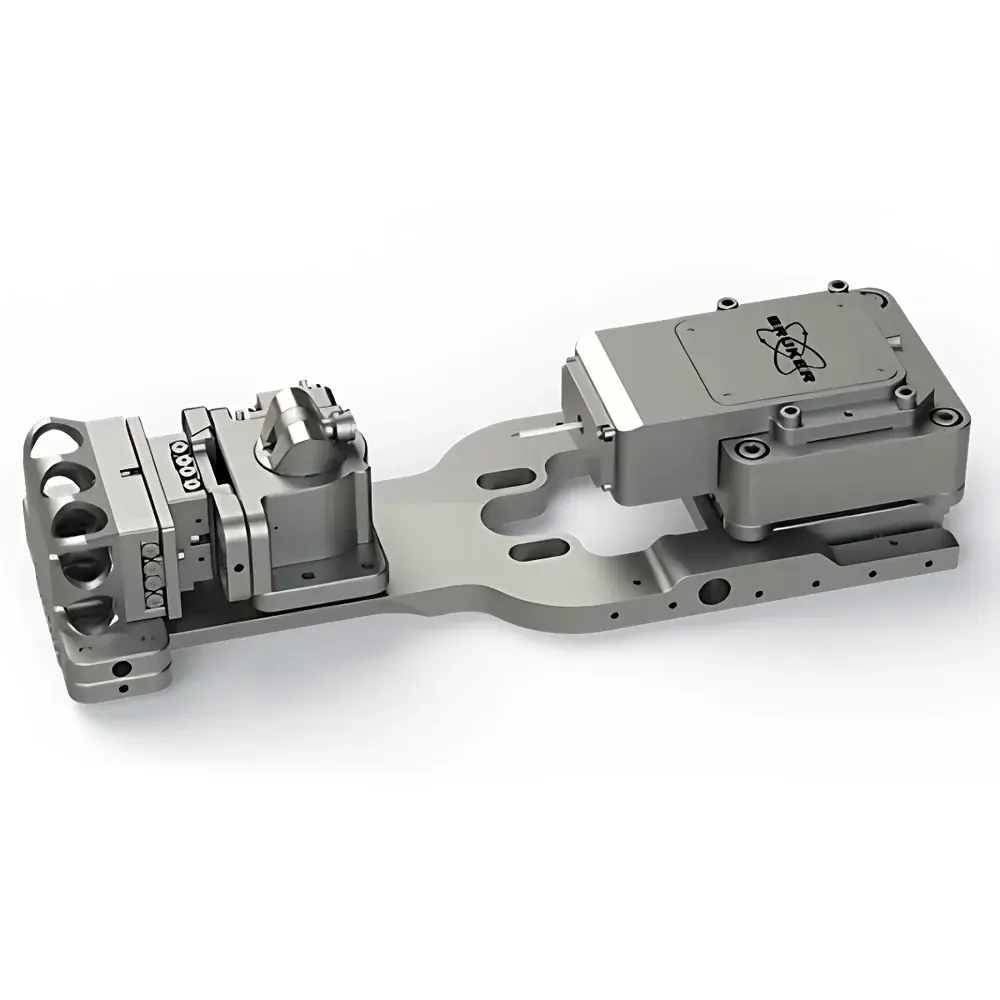
Bruker PI89 AUTO High-Throughput In Situ Nanomechanical Testing System with Automated Co-Localized SEM/EBSD/EDS Imaging & Analysis
| Brand | Bruker |
|---|---|
| Origin | USA |
| Model | PI 89 AUTO |
| Application Domain | In situ SEM-integrated nanomechanical characterization |
| Automation Level | Fully motorized stage + patented dual-axis rotation/tilt (R/T) mechanism |
| Software Platform | TriboScan Auto v5.0+ |
| Compliance Framework | Designed for GLP-compliant workflows |
| Sample Environment | Compatible with standard high-vacuum and low-vacuum SEM chambers (FEI, Thermo Fisher, Zeiss, JEOL) |
| Maximum Load Resolution | Sub-100 nN |
| Displacement Resolution | < 0.05 nm |
| Stage Precision | ±50 nm positional repeatability over 10 mm × 10 mm travel range |
Overview
The Bruker PI89 AUTO is a purpose-engineered in situ nanomechanical testing platform designed for quantitative, spatially resolved mechanical property mapping inside scanning electron microscopes (SEM). It operates on the principle of continuous-load-displacement sensing via electrostatically actuated piezoresistive transducers, enabling real-time force feedback during indentation while maintaining sub-nanometer displacement resolution. Unlike conventional ex situ nanoindenters, the PI89 AUTO integrates directly into the SEM chamber—allowing concurrent acquisition of topographic SEM images, crystallographic EBSD patterns, and elemental EDS spectra at precisely the same location where mechanical loading occurs. This co-localization eliminates registration errors inherent in post-test relocation and enables direct correlation between microstructure (grain orientation, phase distribution, defect density) and local mechanical response (hardness, modulus, pop-in behavior, creep kinetics). The system is engineered for high-reproducibility quantitative nanomechanics under controlled vacuum conditions and is routinely deployed in R&D laboratories requiring traceable, standards-aligned material performance assessment.
Key Features
- Fully automated co-localized workflow: Motorized XYZ linear stage with optical encoder feedback (±50 nm repeatability) synchronized with patented dual-axis rotation/tilt (R/T) mechanism for precise tip-to-sample alignment and multi-angle EBSD indexing.
- In situ load-displacement control: Real-time closed-loop force regulation down to 100 nN resolution, with displacement feedback from integrated capacitive sensors offering < 0.05 nm resolution.
- TriboScan Auto software suite: Enables script-driven batch testing across user-defined grids (up to 10,000 indents per session), automatic SEM image capture pre/post-indentation, and synchronized EBSD/EDS data tagging by physical coordinate.
- Modular probe compatibility: Supports Berkovich, cube-corner, flat-punch, and custom geometry tips; interchangeable cantilevers calibrated per ISO 14577-1 Annex B protocols.
- SEM chamber agnosticism: Mechanical and electrical interface kits available for Thermo Fisher Helios/Quanta, Zeiss Sigma/Auriga, JEOL JSM-IT800, and FEI Nova/Nanolab platforms.
- Thermal drift compensation: Active temperature stabilization subsystem maintains < 0.1 °C stability during multi-hour test sequences, critical for long-duration creep or relaxation measurements.
Sample Compatibility & Compliance
The PI89 AUTO accommodates bulk metallic alloys, ceramics, thin-film stacks, intermetallics, and irradiated nuclear materials—provided samples meet standard SEM mounting constraints (diameter ≤ 30 mm, thickness ≤ 15 mm, conductive coating optional). All mechanical calibration procedures adhere to ISO 14577-1:2015 and ASTM E2546-18 guidelines. Data acquisition logs include full metadata stamping (timestamp, vacuum pressure, stage coordinates, beam kV/current, tip serial number, calibration certificate ID), satisfying GLP documentation requirements. Audit trails generated by TriboScan Auto are configurable to comply with FDA 21 CFR Part 11 electronic record integrity standards, including user authentication, action logging, and immutable data archiving.
Software & Data Management
TriboScan Auto serves as the central orchestration engine—integrating instrument control, image acquisition, and analytical quantification within a single GUI. Raw load-displacement curves are stored in HDF5 format with embedded metadata; processed results (HIT, Er, pile-up ratio, SPM-derived plasticity index) export to CSV, MATLAB .mat, or MTEX-compatible EBSD map overlays. Batch analysis modules support statistical mapping (e.g., hardness vs. grain boundary character, modulus gradient across phase interfaces) and machine-learning–ready feature extraction (indent shape asymmetry, discontinuous displacement bursts). Data provenance is preserved through hierarchical project folders linked to LIMS identifiers, enabling full traceability from raw curve to publication-grade figure.
Applications
- Multi-scale metallurgical validation: Correlating EBSD-determined grain boundary misorientation with local yield onset in advanced high-strength steels (AHSS) for automotive crashworthiness modeling.
- Nuclear materials qualification: Quantifying radiation-induced hardening gradients in Zr-alloy cladding cross-sections via depth-resolved indentation arrays aligned to TEM lamella positions.
- Semiconductor interconnect reliability: Measuring elastic recovery and stress relaxation in Cu/low-k BEOL stacks under thermal cycling, co-registered with FIB-SEM tomography.
- Additive manufacturing process optimization: Mapping anisotropic modulus variation across LPBF Ti-6Al-4V build layers, tied directly to melt pool morphology from backscattered electron imaging.
- Thin-film adhesion assessment: Using progressive load cycling combined with in situ SEM crack propagation imaging to quantify interfacial fracture energy in DLC coatings.
FAQ
Is the PI89 AUTO compatible with variable-pressure or environmental SEM modes?
Yes—mechanical and signal interfacing supports both high-vacuum (< 1×10⁻⁴ Pa) and low-vacuum (10–200 Pa) operation, though EBSD acquisition requires high vacuum; TriboScan Auto automatically disables EBSD triggers outside specified pressure thresholds.
Can existing PI85 or PI88 systems be upgraded to PI89 AUTO functionality?
No—PI89 AUTO incorporates a redesigned stage architecture, proprietary R/T actuation module, and firmware-level integration with SEM column control signals; retrofitting is not supported.
What level of SEM operator training is required to deploy PI89 AUTO workflows?
Operators must hold certified SEM proficiency (including beam alignment, working distance optimization, and EBSD/EDS parameter tuning); Bruker provides 3-day on-site installation and protocol validation training, including GLP documentation practice.
Does TriboScan Auto support third-party Python or MATLAB scripting for custom analysis pipelines?
Yes—TriboScan Auto exposes a documented COM/ActiveX API and includes native Python bindings (pip install tribo-scan-api) for external automation, statistical modeling, and integration with open-source EBSD toolkits such as MTEX or EMsoft.





