
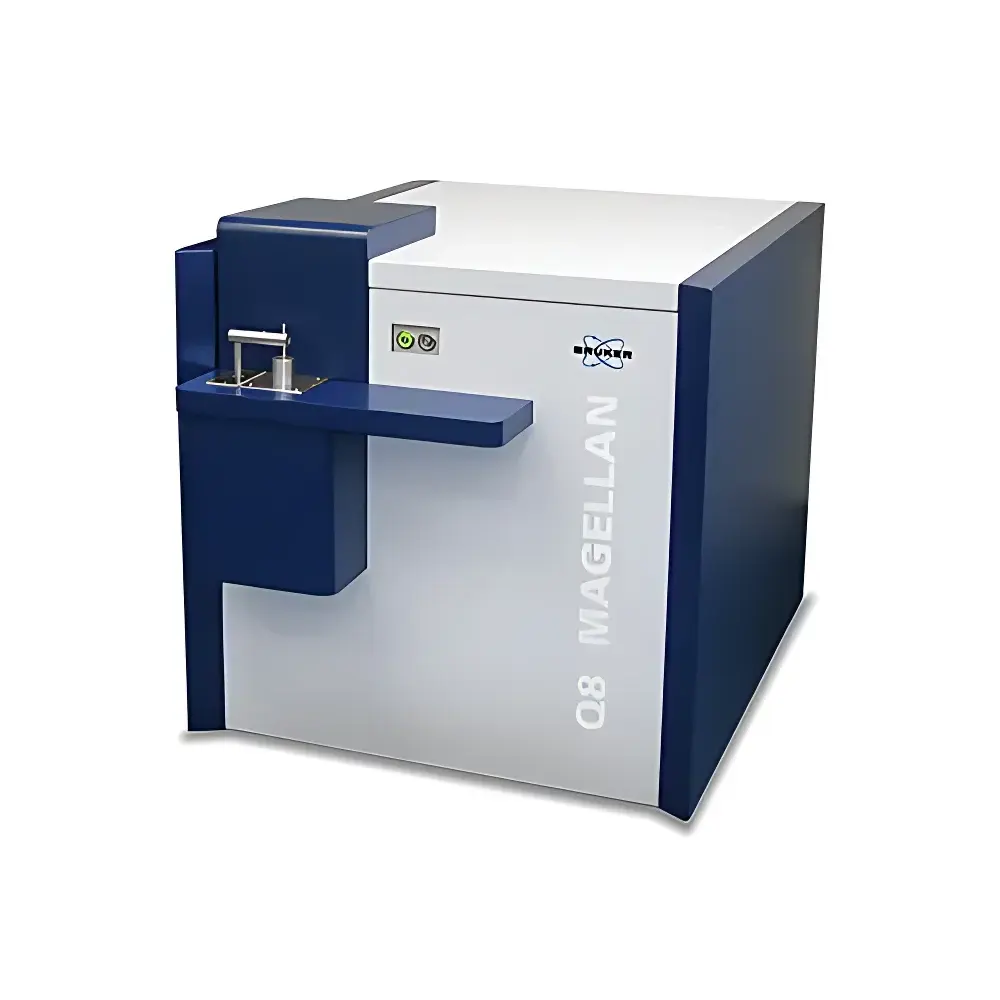
Bruker Q8 MAGELLAN Direct-Reading Spark Optical Emission Spectrometer
| Brand | Bruker |
|---|---|
| Origin | Germany |
| Instrument Type | Benchtop |
| Excitation Method | Spark |
| Detector Type | Photomultiplier Tube (PMT) |
| Focal Length | 1000 mm |
| Grating Groove Density | 3600 lines/mm |
| Wavelength Range | 110–800 nm |
| Number of Channels | 128 |
Overview
The Bruker Q8 MAGELLAN is a high-performance benchtop direct-reading spark optical emission spectrometer (OES) engineered for precise, reproducible elemental analysis of metallic materials in demanding industrial and laboratory environments. It operates on the fundamental principle of spark-induced atomic emission spectroscopy: a controlled high-energy spark excites atoms in a solid metal sample, causing them to emit characteristic wavelengths of ultraviolet and visible light. These emissions are dispersed by a high-resolution Czerny-Turner optical system featuring a 1000 mm focal length vacuum spectrometer housing and a 3600 lines/mm holographic grating—enabling spectral resolution down to 0.2 nm/mm in second-order dispersion. The instrument maintains optical stability through active temperature control and ultra-high vacuum conditions (<10⁻⁵ mbar), achieved via a turbomolecular pumping system that eliminates hydrocarbon contamination from oil-based vacuum pumps—a critical requirement for long-term signal fidelity in UV spectral regions below 190 nm.
Key Features
- Full-digital solid-state spark generator with adjustable energy delivery and pulse shaping, delivering stable, repeatable excitation at up to 1000 Hz spark frequency.
- Single-pulse spark detection architecture: each analytical channel acquires 1000 individual spark pulses per measurement, enabling robust statistical evaluation and outlier rejection.
- Time-resolved spectral acquisition with four independently configurable temporal integration windows per channel—optimized for matrix-specific emission kinetics (e.g., early continuum suppression, late-line intensity maximization).
- 128 fixed-channel PMT array with low-dark-current, high quantum-efficiency photomultipliers, offering superior signal-to-noise ratio across the full 110–800 nm range—including challenging VUV lines (e.g., C 165.7 nm, P 178.3 nm, S 180.7 nm).
- Maintenance-free reinforced spark stand with coaxial argon flushing, integrated electrode alignment, and automatic surface conditioning—designed for >10,000 analyses without mechanical recalibration.
- Modular electronics architecture incorporating FPGA-based real-time signal processing, synchronized ADCs, and embedded thermal management for long-term baseline stability.
Sample Compatibility & Compliance
The Q8 MAGELLAN supports standardized solid metal samples conforming to ISO 11577, ASTM E415, ASTM E1086, and EN 10315. It accommodates flat, cylindrical, and irregularly shaped specimens (diameter ≥ 10 mm, thickness ≥ 4 mm) across ferrous (steels, cast irons) and non-ferrous matrices (Al, Cu, Ni, Co, Mg, Ti, Sn, Pb alloys). Its vacuum optical path ensures quantitative analysis of light elements (C, P, S, N, B, As) without atmospheric absorption interference. The system complies with IEC 61000-6-3 (EMC), IEC 61010-1 (safety), and supports audit-ready operation under GLP/GMP frameworks via optional 21 CFR Part 11-compliant software modules with electronic signatures, role-based access control, and full audit trail logging.
Software & Data Management
Operating on Bruker’s proprietary WinXRF/OES platform, the Q8 MAGELLAN provides intuitive workflow-driven analysis—from automated calibration verification and drift correction to multi-matrix method switching with zero reconfiguration time. Quantitative results are traceable to certified reference materials (CRMs) from NIST, BAM, and JSS standards. Data export supports ASTM E1359-compliant XML, CSV, and LIMS-integrated HL7/ASTM E1384 protocols. Optional database modules enable trend analysis, SPC charting (X-bar/R, Cpk), and automated report generation compliant with ISO/IEC 17025 requirements for accredited testing laboratories.
Applications
The Q8 MAGELLAN serves as a primary analytical tool in metallurgical process control, foundry QC, aerospace material certification, and scrap sorting operations. It delivers reliable quantification of major, minor, and trace elements—including interstitials (C, N, O), residual impurities (Sn, Pb, Bi, As), and microalloying additions (Nb, V, Ti, B)—in production-critical applications such as: incoming raw material inspection; ladle-to-ladle composition monitoring; heat-treatment validation; weld deposit analysis; failure investigation (e.g., embrittlement root cause); and regulatory compliance reporting for ASME, EN 10204 3.1/3.2, and MIL-STD-1263 documentation.
FAQ
What vacuum level does the Q8 MAGELLAN maintain, and how is it sustained?
The instrument achieves and sustains a base pressure below 1×10⁻⁵ mbar using a clean, oil-free turbomolecular pump—eliminating hydrocarbon backstreaming and ensuring long-term optical throughput stability, especially below 190 nm.
Can the Q8 MAGELLAN analyze coated or painted metal samples?
No—surface coatings must be removed prior to analysis. Spark OES requires direct electrical contact with conductive bulk material; non-conductive layers inhibit plasma formation and introduce spectral interference.
Is multi-matrix analysis possible without hardware reconfiguration?
Yes. The 128-channel fixed optics design supports simultaneous calibration for up to six distinct alloy families (e.g., Fe-, Al-, Cu-, Ni-, Ti-, and Mg-based) within a single instrument configuration—switched via software-selectable excitation parameters and integration windows.
How is calibration stability monitored over time?
The system performs daily automated wavelength calibration using internal Hg/Ne reference lamps and monitors intensity drift against internal standard lines (e.g., Fe II 238.2 nm). Drift correction algorithms apply real-time multiplicative offsets based on reference channel response.
Does the Q8 MAGELLAN support remote diagnostics and service access?
Yes—equipped with secure TLS-encrypted remote maintenance port and integrated diagnostic telemetry, enabling proactive firmware updates, spectral health assessment, and guided troubleshooting by Bruker Field Application Engineers.





