
Bruker QUANTAX FlatQUAD Silicon Drift Detector (SDD) for SEM-Based Energy Dispersive X-ray Spectroscopy
| Brand | Bruker |
|---|---|
| Origin | Germany |
| Model | QUANTAX FlatQUAD |
| Energy Resolution | <129 eV |
| Peak-to-Background Ratio | 20,000:1 |
| Maximum Count Rate | 4,000 kcps |
| Elemental Detection Range | Boron (B) to Californium (Cf) |
| Detector Active Area | 10–300 mm² |
| Window Type | Windowless |
Overview
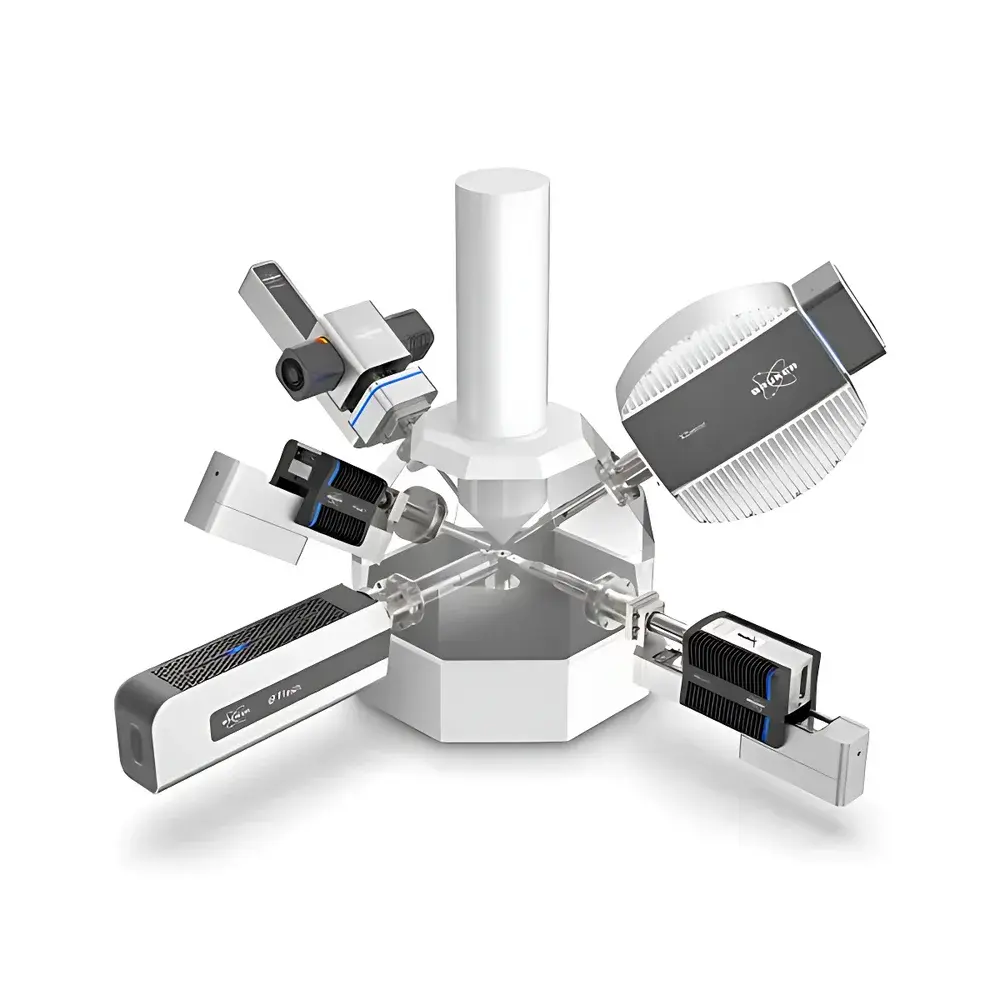
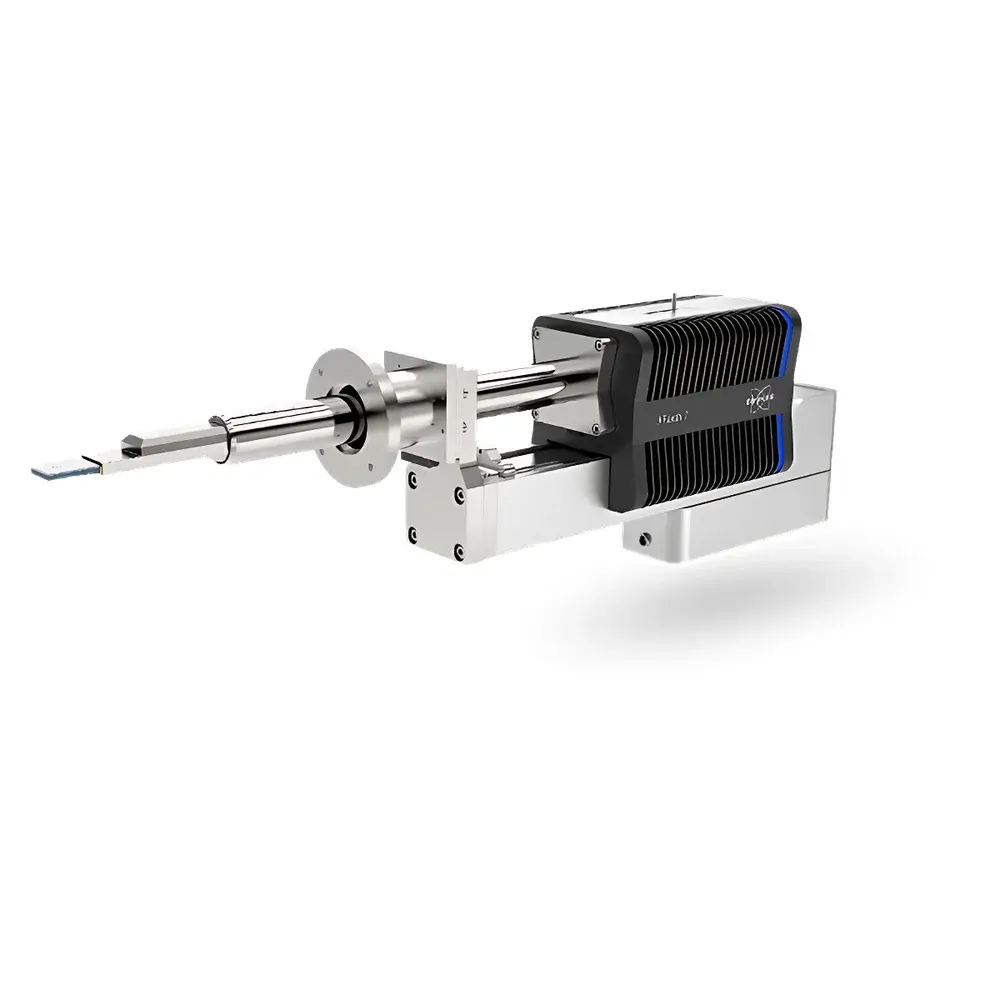
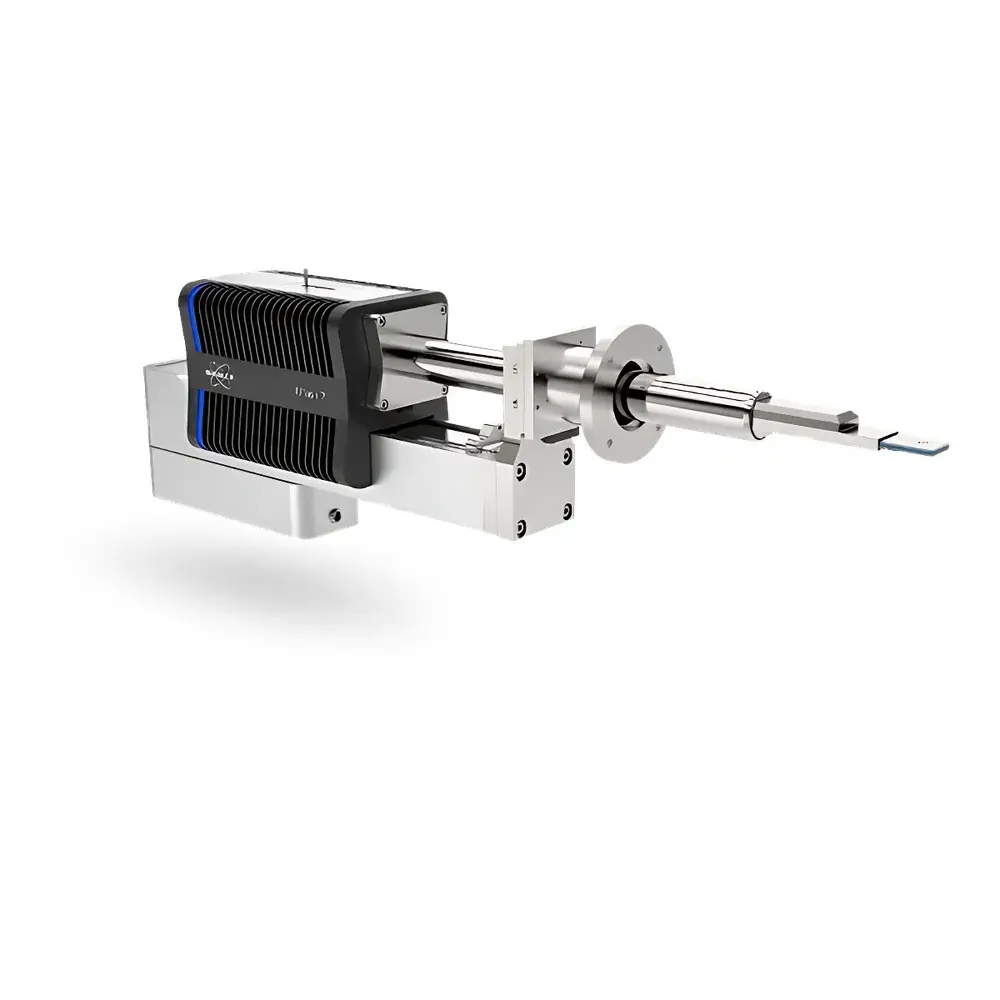
The Bruker QUANTAX FlatQUAD is a high-performance, ring-shaped quad-channel silicon drift detector (SDD) system engineered specifically for integration into scanning electron microscopes (SEM). Unlike conventional single-detector EDS configurations, FlatQUAD positions four identical SDDs in a compact annular geometry directly between the SEM objective lens pole piece and the sample stage—maximizing solid angle collection without compromising working distance or beam alignment. This architecture leverages the fundamental principles of X-ray photon detection via charge carrier drift in high-purity silicon under applied bias, enabling exceptional count-rate capability and energy resolution at low overvoltage conditions. Designed for quantitative microanalysis in demanding research and industrial environments, FlatQUAD delivers robust spectral fidelity across the full detectable elemental range—from light elements (B, C, N, O, F) through transition metals and rare earths up to actinides—without reliance on helium purging or cryogenic cooling. Its windowless configuration ensures optimal transmission efficiency for soft X-rays below 1 keV, critical for accurate light-element quantification in polymers, biological tissues, battery cathodes, and low-Z thin films.
Key Features
- Quad-channel annular SDD design maximizes geometric solid angle (>1.0 sr typical), significantly improving X-ray collection efficiency compared to conventional single-detector setups.
- Energy resolution <129 eV at Mn Kα (5.89 keV) under standard operating conditions, supporting precise peak deconvolution in complex multi-phase materials.
- Peak-to-background ratio of 20,000:1 enables reliable detection of trace elements (<100 ppm) even in matrix-rich samples.
- Real-time maximum count rate of 4,000 kcps per channel (16,000 kcps total), facilitating rapid mapping without spectral distortion or dead-time saturation.
- Modular active area selection (10–300 mm²) allows optimization for specific applications—e.g., high-sensitivity bulk analysis or high-speed nano-scale mapping.
- Windowless detector architecture eliminates absorption losses for low-energy X-rays, essential for accurate B–F quantification in ceramics, catalysts, and organic-inorganic hybrids.
Sample Compatibility & Compliance
FlatQUAD supports analysis of diverse specimen types including beam-sensitive biological specimens (cryo- or room-temperature), semiconductor wafers, cross-sectioned TEM lamellae, rough geological sections, and nanomaterial-coated substrates. Its low-beam-current operation (<10 pA) minimizes charging, thermal damage, and elemental migration—making it suitable for GLP-compliant failure analysis and ISO/IEC 17025-accredited laboratories. The system complies with IEC 62235 (EDS performance standards), ASTM E1508 (quantitative X-ray microanalysis), and supports audit-trail functionality required under FDA 21 CFR Part 11 when deployed with validated ESPRIT software workflows.
Software & Data Management
Fully integrated with Bruker’s ESPRIT acquisition and processing suite, FlatQUAD enables automated spectrum imaging (SI), phase mapping, particle analysis, and stoichiometric quantification using ZAF or φ(ρz) correction models. ESPRIT incorporates real-time background modeling, interactive peak identification, and machine-learning-assisted spectral deconvolution for overlapping L- and M-lines. All raw spectra, map metadata, and processing parameters are stored in vendor-neutral HDF5 format, ensuring long-term data integrity and interoperability with third-party analysis tools such as HyperSpy or DigitalMicrograph. Software validation packages—including IQ/OQ documentation and electronic signature support—are available for regulated environments.
Applications
- Nanoscale compositional mapping of catalyst particles, quantum dots, and heterostructured thin films at accelerating voltages from 5–30 kV.
- Light-element distribution analysis in Li-ion battery electrodes (Li, F, P, O) and solid electrolytes without carbon contamination artifacts.
- Trace contaminant identification in pharmaceutical excipients and medical device coatings per USP guidelines.
- Phase discrimination in multiphase alloys, intermetallics, and additive-manufactured components using integrated backscattered electron (BSE) and EDS correlation.
- Quantitative analysis of ultra-thin TEM sections (<50 nm) where X-ray yield is inherently limited.
FAQ
What is the minimum detectable element with FlatQUAD?
Boron (B, atomic number 5) is routinely detected and quantified under optimized low-kV conditions (5–8 kV) with appropriate standards and matrix correction.
Can FlatQUAD be retrofitted to existing SEM platforms?
Yes—FlatQUAD is compatible with major SEM manufacturers (Thermo Fisher, Zeiss, JEOL, Hitachi) via custom mechanical and electrical interfaces; installation requires OEM collaboration and vacuum compatibility verification.
Does FlatQUAD require liquid nitrogen cooling?
No—FlatQUAD operates with Peltier thermoelectric cooling to –30 °C, eliminating the need for LN₂ refills while maintaining stable spectral calibration over extended acquisitions.
How does FlatQUAD mitigate shadowing effects on rough topography?
The annular geometry provides near-isotropic X-ray collection, reducing angular dependence and minimizing intensity variation caused by surface tilt—critical for accurate quantification of fractured metals or porous ceramics.
Is ESPRIT software compliant with 21 CFR Part 11?
Yes—when configured with role-based access control, electronic signatures, and audit-trail logging enabled, ESPRIT meets FDA requirements for regulated analytical workflows.





