
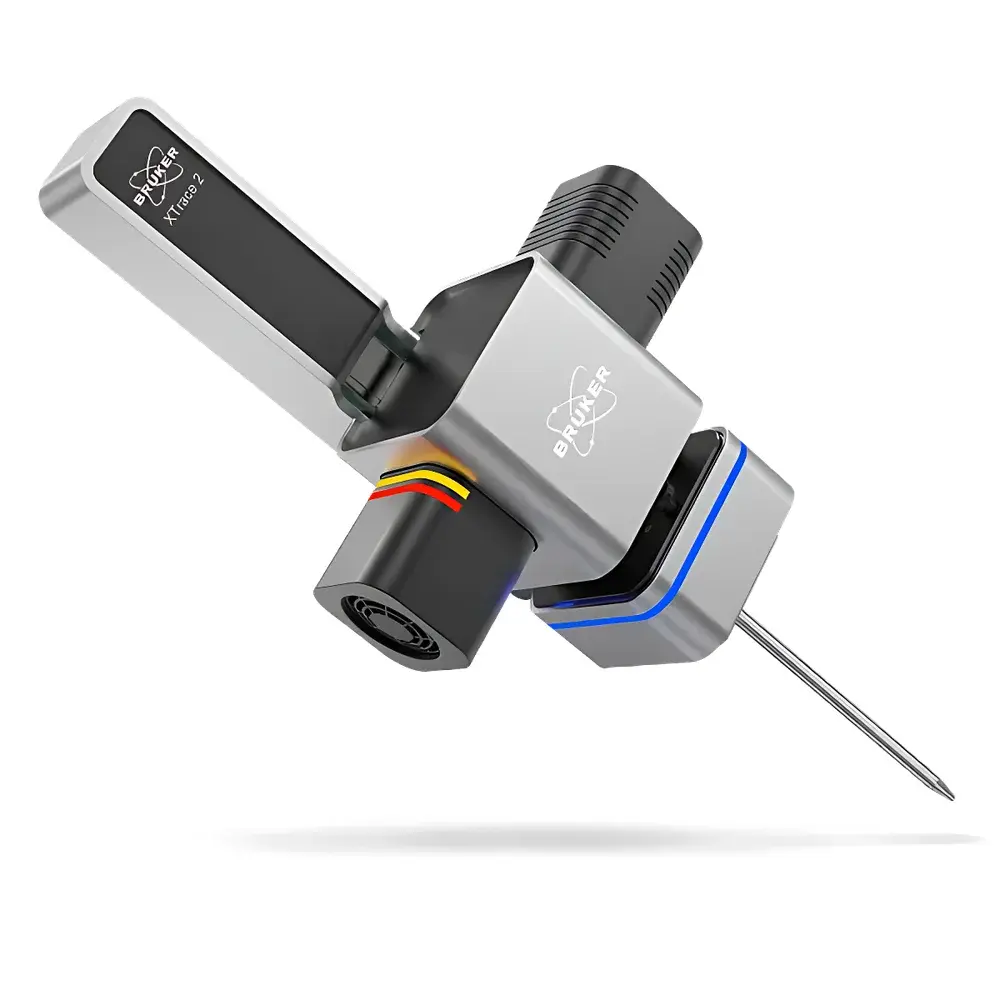
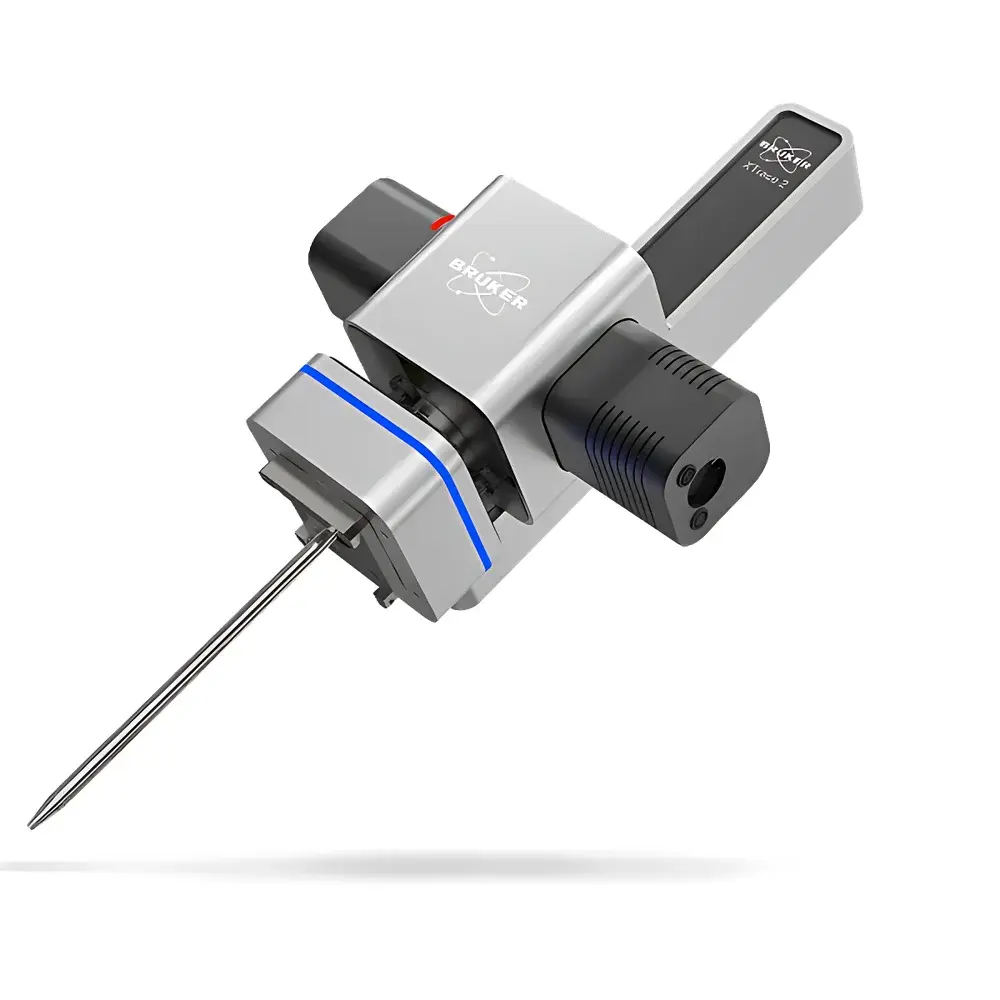
Bruker QUANTAX XTrace Micro-XRF Spectrometer
| Brand | Bruker |
|---|---|
| Origin | Germany |
| Manufacturer Type | Authorized Distributor |
| Origin Category | Imported |
| Model | QUANTAX XTrace |
| Pricing | Available Upon Request |
Overview
The Bruker QUANTAX XTrace Micro-XRF Spectrometer is a high-performance, benchtop-compatible micro-focus X-ray fluorescence (μ-XRF) system engineered for seamless integration with scanning electron microscopes (SEM). Unlike energy-dispersive X-ray spectroscopy (EDS), which relies on electron-induced X-ray emission, μ-XRF employs a focused primary X-ray beam to excite characteristic fluorescence from the sample—enabling non-destructive, matrix-independent elemental analysis across a broad energy range (up to 40 keV). This complementary detection modality extends analytical capabilities beyond the surface-limited penetration of electron beams, delivering quantitative and semi-quantitative data from depths ranging from ~1 nm to ~40 µm—ideal for layered structures, coatings, thin films, and heterogeneous materials where EDS alone yields incomplete depth profiling.
Key Features
- Second-generation microfocus X-ray tube delivering enhanced photon flux density and improved spatial resolution—achieving a minimum beam diameter of 10 µm at the sample surface.
- Simultaneous or sequential acquisition with SEM-EDS, enabling correlative elemental mapping with matched field-of-view registration and synchronized stage control.
- High-energy spectral detection up to 40 keV, facilitating identification and quantification of heavy elements (e.g., Pb, U, Th) and their L- and M-lines, as well as light elements down to Na (11) under optimized vacuum or helium purge conditions.
- Non-destructive analysis requiring no conductive coating, polishing, or sectioning—suitable for insulating, rough, porous, or temperature-sensitive specimens including polymers, ceramics, biological tissues, and geological samples.
- Integrated motorized XYZ stage with sub-micron repeatability and programmable raster scanning for high-resolution elemental distribution imaging (2D/3D).
Sample Compatibility & Compliance
The QUANTAX XTrace supports diverse sample geometries—from bulk solids and irregular fragments to wafers, cross-sections, and mounted particulates—without size constraints typical of vacuum-dependent EDS workflows. Its X-ray excitation mechanism eliminates charging artifacts and topographic shadowing effects common in electron-beam techniques. The system complies with IEC 61000-6-3 (EMC emissions), IEC 61000-6-2 (immunity), and meets CE safety requirements for Class 1 laser products (IEC 60825-1). For regulated environments, optional audit trail logging, user access levels, and electronic signature support align with FDA 21 CFR Part 11 and GLP/GMP documentation standards when paired with Bruker’s ESPRIT software suite.
Software & Data Management
Controlled via Bruker’s ESPRIT platform, the QUANTAX XTrace offers unified workflow management for acquisition, processing, and reporting. Spectral deconvolution uses fundamental parameter (FP)-based algorithms with matrix correction options (e.g., influence coefficients, standardless quantification, and empirical calibration). Mapping data are stored in standardized HDF5 format, supporting interoperability with third-party tools (e.g., Python-based SciPy, ImageJ, or MATLAB). Batch processing, ROI-based quantification, depth-profiling reconstruction (via iterative attenuation modeling), and automated report generation—including ASTM E1508-compliant output templates—are fully scriptable using Python API extensions.
Applications
- Failure analysis of multilayer semiconductor devices, including interconnect stacks, barrier layers, and dielectric films.
- Geochemical stratigraphy and trace-element zoning in mineral grains without destructive ion milling.
- Coating thickness and composition verification in automotive and aerospace components (e.g., Zn/Ni plating, thermal barrier coatings).
- Forensic evidence characterization—e.g., gunshot residue (GSR) particle identification, paint chip layer sequencing, and ink differentiation.
- Environmental particulate analysis (PM2.5/PM10 filters), soil contamination screening, and cultural heritage pigment authentication.
FAQ
Can QUANTAX XTrace be used independently of an SEM?
Yes—the system operates as a standalone μ-XRF instrument with integrated optics, stage, and detector; SEM coupling is optional and enhances correlative microscopy workflows.
What is the typical detection limit for trace elements?
Under optimized conditions (e.g., 1000 s live time, 10 µm beam, vacuum), detection limits reach ~10 ppm for mid-Z elements (e.g., Fe, Cu) and ~100 ppm for light elements (e.g., Mg, Al); values vary with matrix absorption and spectral overlap.
Is helium purge required for light element analysis?
Helium atmosphere or vacuum is recommended for reliable detection of elements below Ti (Z=22), particularly Na through P, due to air absorption of low-energy fluorescence photons.
Does the system support depth profiling of layered structures?
Yes—by combining variable incident angle measurements, multi-energy excitation, and FP-based attenuation modeling, quantitative depth distribution can be reconstructed for films up to ~40 µm thick.
How is calibration performed?
Calibration utilizes certified reference materials (CRMs) traceable to NIST or BAM standards; standardless quantification is available using FP libraries with optional matrix correction based on user-defined or measured bulk composition.



