
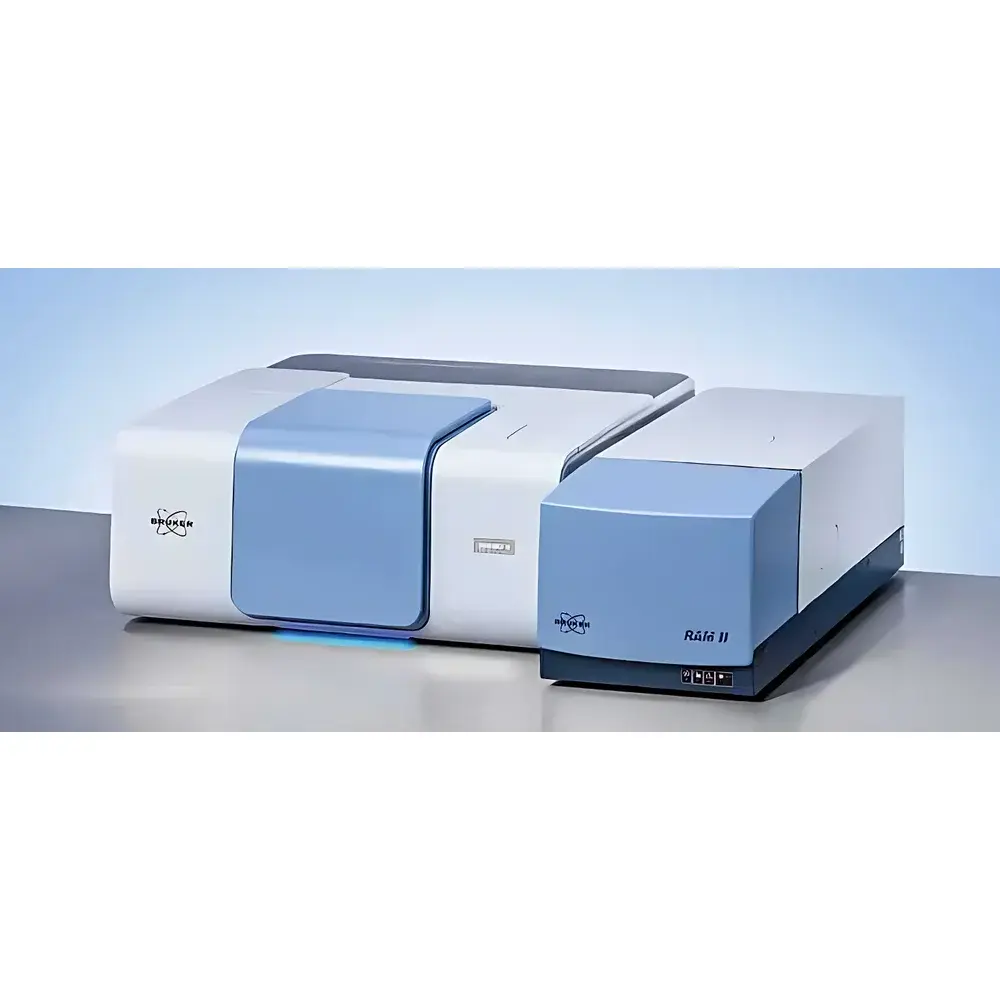
Bruker RAM II Fourier Transform Raman Module
| Brand | Bruker |
|---|---|
| Origin | Germany |
| Model | RAM II |
| Instrument Type | FT-Raman Module |
| Spectral Range | 3600 – 50 cm⁻¹ (Stokes shift) |
| Compatibility | INVENIO, VERTEX 70v, VERTEX 80v, VERTEX 80 vacuum FTIR spectrometers |
| Laser Source | Software-controlled Nd:YAG (1064 nm) |
| Detector Options | Room-temperature InGaAs (1× or 2×), proprietary liquid-nitrogen-cooled Ge photodiode |
| Cooling Duration | Up to 7 days per fill |
| Optical Coupling | Dual fiber-optic ports, 90° scattering geometry, defocusing optics |
| Sample Stage | Motorized XYZ stage with focus control |
| Calibration Source | Integrated spectral response correction lamp |
| Software Platform | OPUS v8.x or later with automated FT-Raman/FT-IR switching |
Overview
The Bruker RAM II Fourier Transform Raman Module is a purpose-engineered, dual-channel accessory designed exclusively for integration with Bruker’s high-end research-grade FTIR platforms — including the INVENIO R, VERTEX 70v, VERTEX 80, and VERTEX 80v vacuum spectrometers. Unlike standalone Raman systems, the RAM II leverages the inherent stability, phase accuracy, and interferometric precision of Bruker’s Michelson-based FTIR architecture to deliver quantitative, high-fidelity FT-Raman spectra via near-infrared excitation. Operating at 1064 nm, the module minimizes fluorescence interference commonly observed in visible-excited Raman measurements — making it particularly suitable for organic compounds, polymers, pharmaceuticals, pigments, and carbonaceous materials. Its optical design conforms to the rigorous mechanical and thermal stability requirements of vacuum-compatible FTIR instrumentation, ensuring long-term baseline integrity and measurement reproducibility across extended acquisition periods.
Key Features
- Seamless hardware and software integration with Bruker INVENIO and VERTEX series FTIR spectrometers via dedicated input/output optical ports
- Software-controlled Nd:YAG laser (1064 nm) with adjustable power output and shutter synchronization through OPUS
- Dual detection pathways: configurable with one or two room-temperature InGaAs detectors or a proprietary liquid-nitrogen-cooled germanium photodiode for ultra-low-noise operation
- Extended spectral coverage from 3600 cm⁻¹ to 50 cm⁻¹ (Stokes shift), enabling full fingerprint region analysis without spectral truncation
- Motorized XYZ sample stage with autofocus capability and integrated spectral response calibration lamp for instrument-specific intensity correction
- 90° scattering geometry and defocusing optics to mitigate local heating and photodegradation in thermally sensitive or highly absorbing samples
- Dual fiber-optic coupling ports and optional polarization accessories for anisotropy studies and orientation-dependent measurements
- Support for cryogenic and high-temperature sample environments via compatible automated sample changers (e.g., Linkam stages)
Sample Compatibility & Compliance
The RAM II accommodates diverse sample forms — solids, powders, gels, liquids, thin films, and micro-regions — when paired with appropriate sampling interfaces such as the RamanScope III FT-Raman microscope or SENTERRA II compact Raman microscope. Its 1064 nm excitation wavelength enables robust analysis of colored, fluorescent, or thermally labile specimens that are incompatible with 532 nm or 785 nm laser sources. The module complies with core spectroscopic data integrity principles aligned with GLP and GMP frameworks; all acquisitions include embedded metadata (laser power, integration time, detector temperature, interferometer status), and OPUS supports audit-trail-enabled workflows compliant with FDA 21 CFR Part 11 when deployed on validated IT infrastructure. While no single international standard governs FT-Raman specifically, method development using the RAM II aligns with ASTM E1840 (Standard Guide for Raman Shift Standards) and ISO 8601–based timestamping for traceable spectral records.
Software & Data Management
Control, acquisition, processing, and reporting are unified within Bruker’s OPUS spectroscopy software suite (v8.5+ recommended). OPUS provides synchronized switching between FT-IR and FT-Raman measurement modes without hardware reconfiguration — critical for correlative vibrational analysis. Real-time spectral preview, automatic baseline correction (e.g., concave rubberband algorithm), peak fitting (Gaussian/Lorentzian deconvolution), and multivariate analysis (PCA, PLS) are natively supported. Raw interferograms and fully phas-corrected spectra are stored in Bruker’s proprietary OPUS format (.0, .1), which preserves full instrument metadata and is exportable to JCAMP-DX, ASCII, and CSV for third-party chemometric tools. Data security features include user-role management, electronic signatures, and encrypted project archives — facilitating compliance with regulated laboratory environments.
Applications
- Pharmaceutical solid-state characterization: polymorph identification, hydrate/anhydrate differentiation, and API-excipient interaction studies
- Materials science: stress/strain mapping in semiconductors, defect analysis in graphene and CNTs, crystallinity assessment in polymeric blends
- Forensic and cultural heritage analysis: non-destructive pigment identification in paintings, ink differentiation, and polymer degradation profiling
- Geosciences: mineral phase quantification in silicates and carbonates under ambient or controlled environmental conditions
- Photoluminescence (PL)-enabled configurations support bandgap analysis in III-V and II-VI semiconductors, quantum dot characterization, and defect-related emission studies
- Quality control in battery electrode manufacturing: cathode/anode composition homogeneity, SEI layer evolution monitoring
FAQ
Is the RAM II compatible with non-Bruker FTIR spectrometers?
No. The RAM II is engineered exclusively for optical and electronic interoperability with Bruker INVENIO and VERTEX-series FTIR platforms. It requires specific interferometer port geometry, vacuum interface specifications, and OPUS-level firmware integration.
Can the RAM II be used for resonance Raman measurements?
No. The fixed 1064 nm excitation wavelength precludes resonance enhancement for most electronic transitions. It is optimized for non-resonant FT-Raman, where fluorescence suppression and thermal stability are prioritized over resonant signal amplification.
What is the typical spectral resolution achievable with the RAM II?
Resolution is determined by the host FTIR spectrometer’s maximum optical path difference (OPD); when used with VERTEX 80v (4 cm⁻¹ unapodized resolution standard), the effective Raman resolution is ~4 cm⁻¹. Higher resolution (e.g., 0.5 cm⁻¹) is attainable using longer scan lengths on compatible vacuum instruments.
Does the RAM II require continuous liquid nitrogen refilling during operation?
The proprietary Ge detector offers >7 days of uninterrupted operation per LN₂ fill under standard laboratory conditions (20 °C ambient), minimizing downtime and enabling unattended overnight acquisitions.
Is remote operation supported?
Yes. OPUS supports secure client-server deployment over LAN/WAN environments, allowing instrument control and real-time data streaming from off-site locations — subject to network configuration and IT security policies.




