
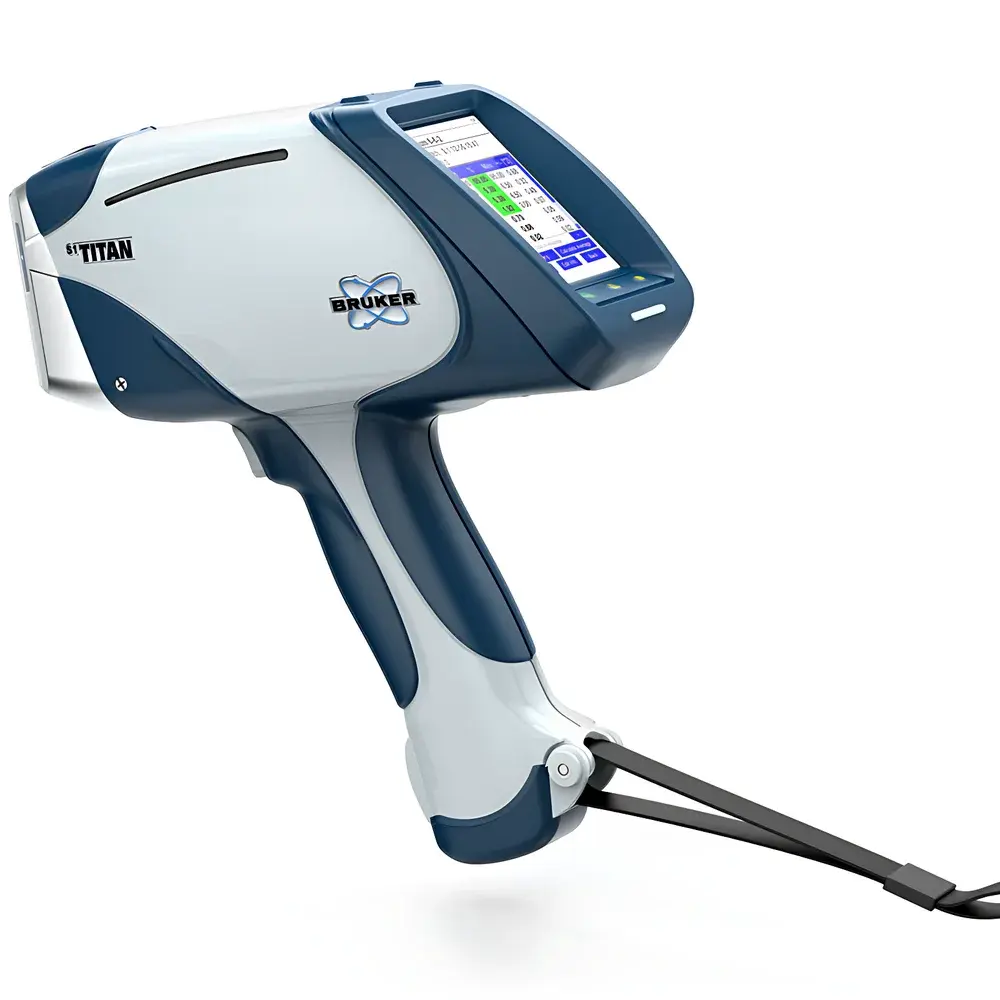
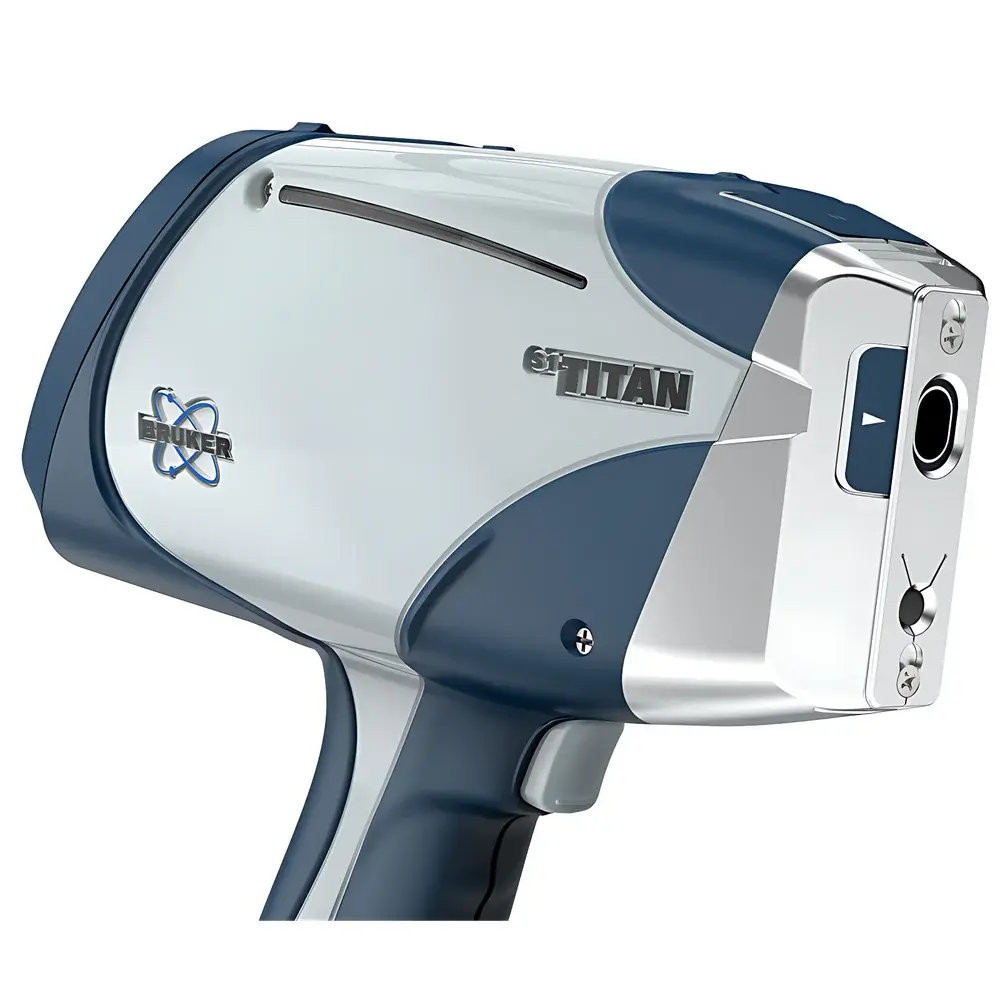
Bruker S1 TITAN Portable Energy Dispersive X-Ray Fluorescence Spectrometer
| Brand | Bruker |
|---|---|
| Origin | USA |
| Manufacturer Type | Authorized Distributor |
| Origin Category | Imported |
| Model | S1 TITAN |
| Application | Handheld / Portable |
| Industry Type | General Purpose |
| Elemental Range | Mg–U |
| Quantification Range | ppm to % |
| Energy Resolution | 145 eV |
Overview
The Bruker S1 TITAN is a field-deployable, handheld energy dispersive X-ray fluorescence (EDXRF) spectrometer engineered for rapid, non-destructive elemental analysis of solid and powdered samples in situ. Based on microfocus X-ray tube excitation (50 kV maximum) and high-performance silicon drift detector (X-Flash® SDD) technology, the instrument operates on fundamental principles of atomic emission spectroscopy: incident X-rays eject inner-shell electrons from sample atoms; subsequent electron transitions emit characteristic secondary X-rays whose energies are element-specific and intensities correlate quantitatively with concentration. Its lightweight design (1.23 kg), sealed IP54-rated enclosure, and integrated Li-ion battery support extended operation in demanding industrial, geological, and regulatory environments—without requiring laboratory infrastructure or vacuum systems.
Key Features
- Optimized beam geometry via Bruker’s proprietary SharpBeam® technology, enabling precise collimation and enhanced signal-to-background ratio without mechanical filters or moving parts
- X-Flash® silicon drift detector (SDD) with 145 eV energy resolution at Mn Kα (5.9 keV), delivering high spectral fidelity and low detection limits for light elements (Mg–Al–Si) through heavy metals (Pb–U)
- Integrated 5-inch color capacitive touchscreen with intuitive icon-driven interface, supporting real-time spectrum visualization, live calibration status, and on-device report generation
- SMART®Grade acquisition logic automatically adjusts counting time per grade or material class to balance precision and throughput—critical for mixed-alloy sorting or heterogeneous environmental matrices
- Ruggedized magnesium alloy housing, conforming to MIL-STD-810G for shock, vibration, and thermal cycling; ingress protection rated IP54 against dust and water splashes
- Battery life up to 8–10 hours per charge under typical analytical conditions, with hot-swappable dual-battery configuration available for continuous operation
Sample Compatibility & Compliance
The S1 TITAN accommodates flat, curved, irregular, and granular samples—including metal alloys, ores, soils, sediments, polymers, electronic components, and consumer goods—without mandatory sample preparation. Its open-beam architecture allows direct analysis of large objects (e.g., pipes, valves, structural components) and small items (e.g., solder joints, jewelry). Method validation aligns with ASTM E1621 (standard guide for XRF analysis of metals), ASTM D7299 (soil screening), and ISO 12885 (environmental sampling). For regulated applications, firmware supports audit trails, user access levels, and data integrity features compliant with FDA 21 CFR Part 11 requirements when paired with Bruker’s Q-Smart™ software suite.
Software & Data Management
Data acquisition, calibration management, and reporting are handled through Bruker’s Q-Smart™ software platform—deployed locally on the device and synchronized with desktop/cloud-based instances. Each measurement stores full spectral metadata (tube voltage/current, live time, detector temperature, ambient conditions), raw spectrum (.spc), processed quantification (.csv/.pdf), and geotagged location data (via integrated GPS). Calibration libraries include pre-validated models for stainless steels (ASTM A240), aluminum alloys (AMS 4027), mining geochemistry (CRMs NIST 2710a, 2711a), RoHS-compliant electronics (IEC 62321-5), and consumer product safety (ASTM F963, CPSIA). All calibrations support matrix-matched standards and empirical correction for inter-element effects (e.g., Fe–Cr–Ni overlaps, Pb–As–Sb deconvolution).
Applications
- Positive Material Identification (PMI) across oil & gas, power generation, and chemical processing facilities—ensuring ASME B31.3 compliance and preventing catastrophic alloy misapplication
- Real-time ore grade estimation and core logging during exploration drilling, supporting resource modeling per JORC/NI 43-101 reporting standards
- Regulatory screening for restricted substances: lead in children’s products (CPSIA), cadmium in plastics (RoHS), brominated flame retardants in textiles, and arsenic in soil (EPA Method 6200)
- Scrap metal sorting and recycling operations, distinguishing between high-value nickel superalloys, titanium grades, and copper-bearing brasses with <2 s measurement cycles
- QA/QC of incoming raw materials and finished goods in aerospace, automotive, and medical device manufacturing—validating composition against AMS, EN, or ISO material specifications
- Environmental site assessment, including contaminated land surveys, landfill leachate solid-phase analysis, and sediment toxicity profiling
FAQ
Does the S1 TITAN require annual recalibration or factory certification?
No routine annual recalibration is mandated; however, Bruker recommends performance verification using certified reference materials (CRMs) before each shift or daily use in regulated environments. Full traceable calibration certificates are available upon request.
Can the instrument analyze light elements such as sodium or oxygen?
The S1 TITAN detects elements from magnesium (Mg, Z=12) upward. Sodium (Na, Z=11) and lighter elements (e.g., O, C, N) fall below its detection threshold due to atmospheric absorption and detector window limitations.
Is operator training required for regulatory compliance?
Yes—Bruker provides certified operator training programs aligned with ISO/IEC 17025 competency requirements. Documentation includes training records, SOP templates, and method validation protocols suitable for GLP/GMP audits.
How is data security managed during field deployment?
All measurements are encrypted at rest (AES-256) and optionally transmitted over TLS 1.2–secured channels. Role-based access control prevents unauthorized modification of calibrations or deletion of raw spectra.
What consumables or replacement parts are needed for long-term operation?
The only scheduled consumable is the X-ray tube anode (rated for >20,000 hours); detector and electronics are solid-state with no moving parts. Optional accessories include ruggedized holsters, external GPS antennas, and CRM verification kits.





