
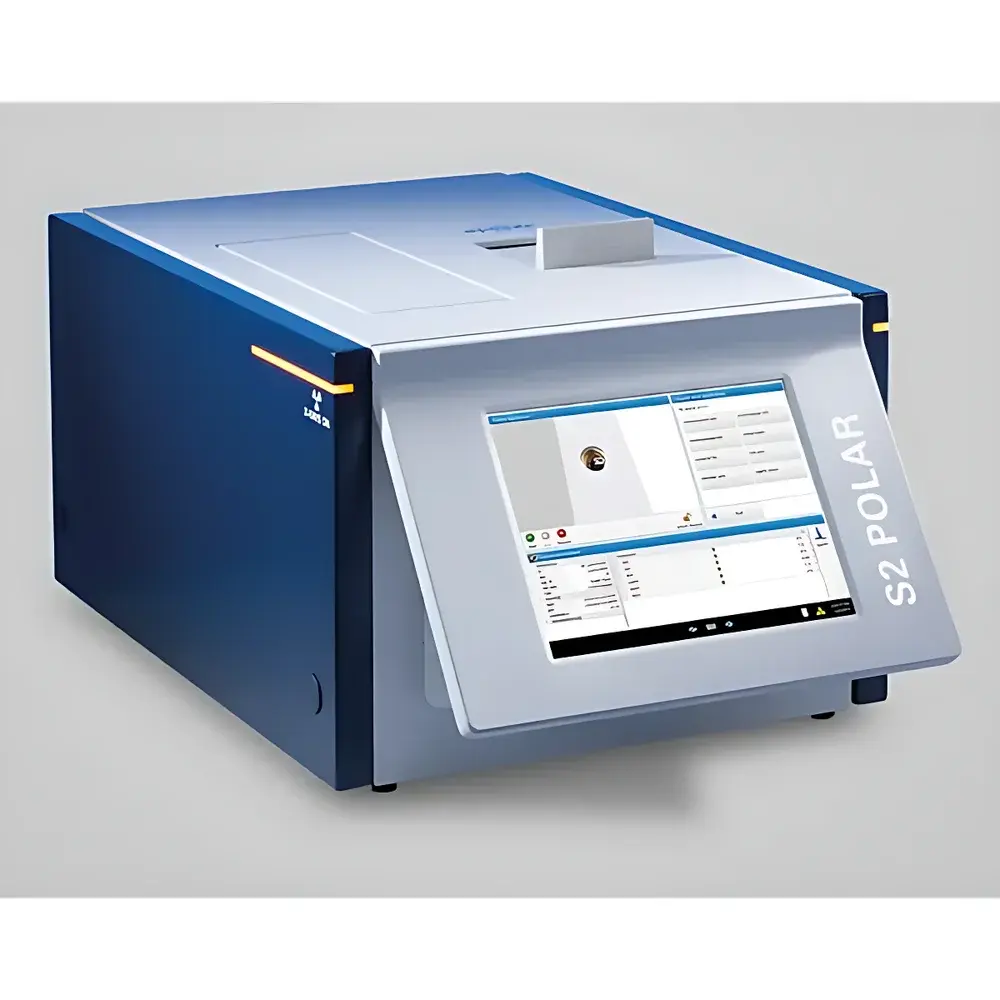
Bruker S2 POLAR Energy Dispersive X-Ray Fluorescence Spectrometer
| Brand | Bruker |
|---|---|
| Origin | Germany |
| Configuration | Benchtop/ Floor-standing |
| Model | S2 POLAR |
| Compliance | ASTM D7220, ASTM D4294, ASTM D6481, ASTM D7751, ASTM D8252, ISO 13032, ISO 20847, ISO 8754, IP 336, IP 496, IP 532, JIS K2541-4 |
Overview
The Bruker S2 POLAR is a high-performance, benchtop-to-floor-standing energy dispersive X-ray fluorescence (EDXRF) spectrometer engineered for precise, multi-element elemental analysis in demanding industrial environments—particularly petroleum refining, lubricant formulation, and edible oil processing. Operating on the fundamental principle of EDXRF, the instrument irradiates solid or liquid samples with a high-stability X-ray tube, inducing characteristic secondary X-ray emission from constituent elements. These emitted photons are resolved by a silicon drift detector (SDD) with high count-rate capability and excellent energy resolution, enabling simultaneous quantification of elements from sodium (Na, Z=11) to uranium (U, Z=92) at trace to major concentration levels. Unlike wavelength-dispersive systems, the S2 POLAR delivers rapid, non-destructive analysis without vacuum requirements for most applications—making it ideal for routine QC/QA labs where throughput, robustness, and regulatory compliance are critical.
Key Features
- True multi-element capability: Simultaneous detection and quantification of up to 25 elements—including S, Cl, P, Ca, Zn, Mg, Mo, Ni, V, Fe, Cu, K—in a single 60–300 second measurement.
- Ultra-low sulfur detection limit: ≤10 ppm in diesel and gasoline matrices, validated per ASTM D7220 and ISO 13032 protocols.
- Wide dynamic range: Accurately measures sulfur from sub-ppm levels in ultra-low-sulfur diesel (ULSD) to >5 wt% in crude oil and heavy feedstocks.
- SampleCare™ technology: Integrated liquid-sample containment system prevents spills and aerosol ingress, protecting the X-ray tube window, detector, and sample chamber—ensuring long-term operational stability and minimizing downtime.
- Dual configuration flexibility: Optimized mechanical design supports both compact benchtop deployment and floor-standing installation with enhanced vibration isolation for refinery lab environments.
- Pre-installed, standards-compliant methods: Factory-loaded analytical workflows for ASTM D7220, D4294, D6481, D7751, D8252, ISO 13032, and IP 336—enabling “Ready-to-Analyze” operation within minutes of commissioning.
Sample Compatibility & Compliance
The S2 POLAR accepts a broad range of sample forms without digestion or dilution: sealed liquid vials (up to 40 mm diameter), solid discs (e.g., pressed pellets, metal coupons), and thin-film filters. It complies fully with internationally recognized test methods for petrochemicals and lubricants—including ASTM D7220 (sulfur in diesel), ASTM D4294 (sulfur in petroleum products), ASTM D6481 (lubricant additives), ASTM D7751 (elemental analysis in used oils), and ISO 13032 (petroleum products—sulfur determination). For regulatory traceability, method parameters—including excitation conditions, calibration curves, and matrix correction algorithms—are stored with full audit trails. The system architecture supports GLP/GMP-aligned data integrity practices, including user authentication, electronic signatures, and secure storage of raw spectra and processed results.
Software & Data Management
Controlled via Bruker’s proprietary PolarQuant software, the S2 POLAR provides intuitive workflow-driven operation—from sample registration to report generation. All preconfigured methods include embedded uncertainty estimation, drift correction routines, and automated flagging of out-of-spec results. Data export conforms to ASTM E1382 and ISO/IEC 17025 reporting requirements, supporting CSV, PDF, and XML formats. Integration with LIMS is achieved through standard ODBC and OPC UA interfaces. Software validation documentation—including IQ/OQ protocols and 21 CFR Part 11 compliance packages—is available upon request for regulated laboratories.
Applications
- Petroleum refining: Real-time monitoring of sulfur across process streams—from crude assay and FCC feedstock to hydrotreated naphtha and ULSD final product—ensuring compliance with global fuel specifications (e.g., Euro 5/6, Tier 3, China VI).
- Lubricant QA: Quantitative analysis of additive elements (Mg, P, S, Cl, Ca, Zn, Mo) per ASTM D6481 and D7751; wear metal detection (Fe, Cr, Al, Cu, Pb) in used engine oils.
- Edible oil & biodiesel: Monitoring of catalyst residues (Ni, Cu), refining indicators (P, Cl, K), and nutritional minerals (Ca, Fe, Zn) in palm oil, soybean oil, and transesterified biofuels.
- Intermediate process control: Rapid verification of desulfurization efficiency, corrosion inhibitor dosing, and catalyst poisoning (V, Ni) in hydroprocessing units.
FAQ
Does the S2 POLAR require helium purge or vacuum for light element analysis?
No—its optimized X-ray optics and high-resolution SDD enable reliable detection of phosphorus (P) and sulfur (S) in air, eliminating the need for gas purging or vacuum pumps.
Can the instrument be reconfigured for different sample types without hardware modification?
Yes—sample holders, collimators, and excitation filters are tool-free swappable; method selection automatically adjusts geometry and acquisition parameters.
Is method transfer between S2 POLAR instruments supported?
Yes—PolarQuant supports full method portability via encrypted .pqr files, ensuring consistent performance across multiple instruments in multi-site operations.
What maintenance intervals are recommended for routine operation?
Detector and tube performance are monitored continuously; scheduled preventive maintenance is recommended annually, with optional remote diagnostics and calibration verification services.
How does SampleCare™ protect against liquid sample exposure?
It employs a dual-seal sample cup holder, leak-detecting capacitive sensors, and an automatic shutdown protocol that isolates the optical path if spillage is detected—preventing contamination of the detector window and X-ray tube.






