
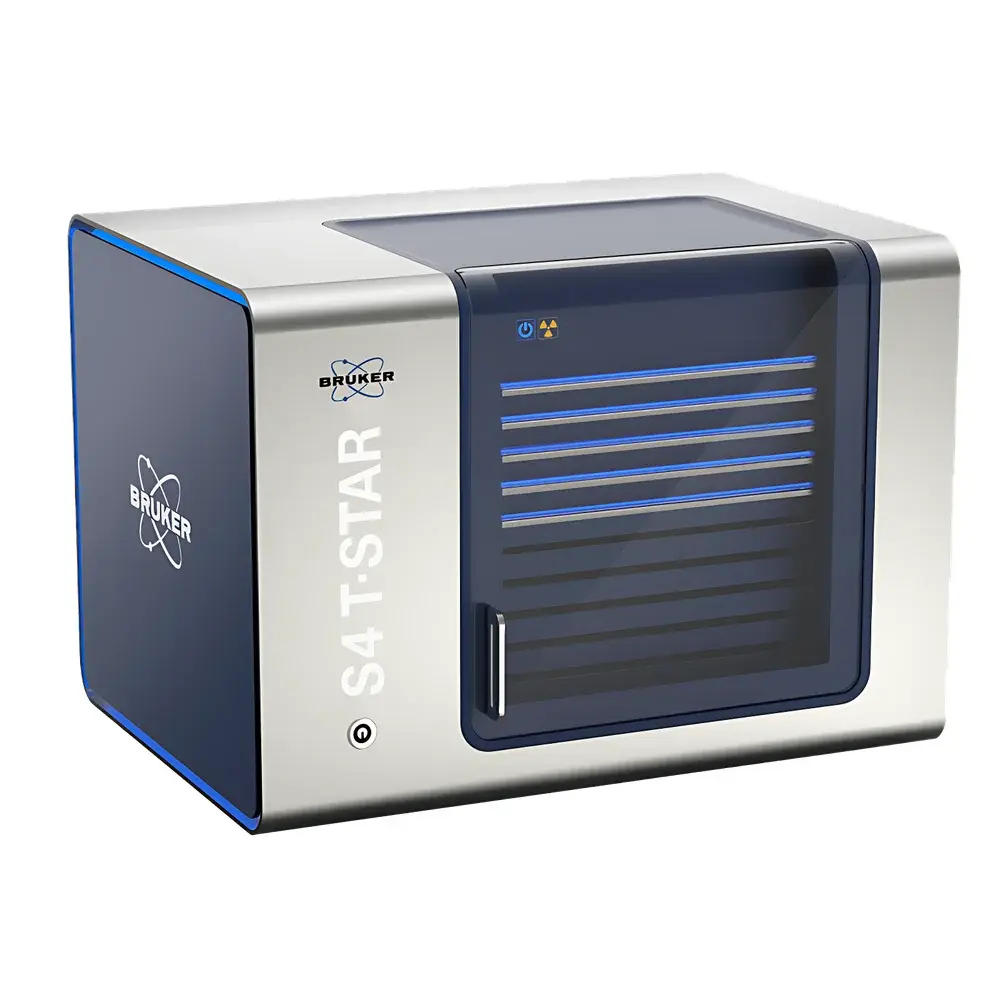
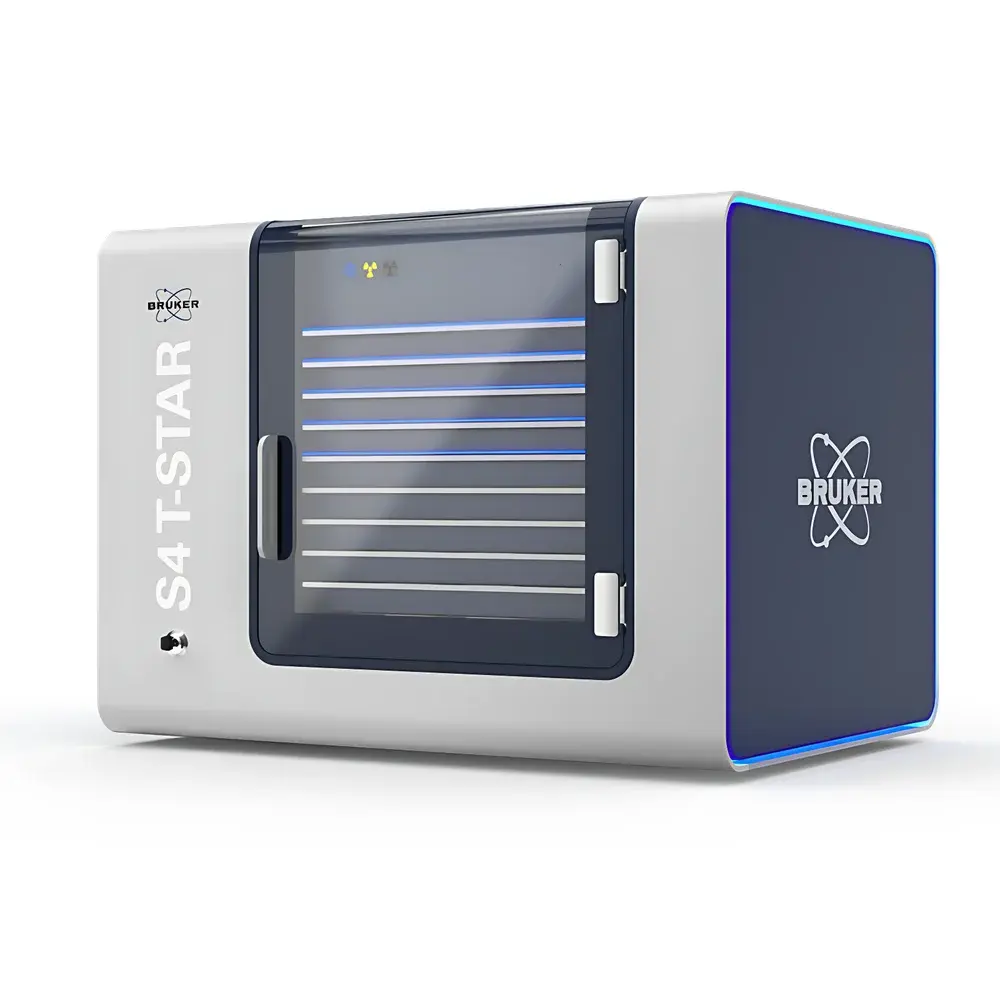
Bruker S4 TSTAR Total Reflection X-Ray Fluorescence Spectrometer
| Brand | Bruker |
|---|---|
| Origin | Germany |
| Model | S4 TSTAR |
| Technique | Total Reflection X-Ray Fluorescence (TXRF) |
| Detection Limit | Sub-ppb for liquid, solid, and thin-film samples |
| Sample Forms | Liquids, suspensions, dried residues, wafers, microscope slides, quartz carriers, membranes, filters, and nanoparticle layers |
| Compliance Context | Supports ISO 17025-compliant workflows |
Overview
The Bruker S4 TSTAR is a high-performance total reflection X-ray fluorescence (TXRF) spectrometer engineered for ultra-trace elemental analysis of micro-volume samples. Unlike conventional energy-dispersive XRF (ED-XRF), TXRF utilizes the principle of total external reflection—where an incident X-ray beam strikes a flat, optically smooth carrier (e.g., quartz glass or silicon wafer) at an angle below the critical angle (~0.1°). This geometry confines the X-ray beam within a nanometer-thin evanescent wave above the surface, dramatically suppressing background scattering from the substrate while enhancing signal-to-noise ratio. As a result, the S4 TSTAR achieves detection limits in the low sub-part-per-trillion (sub-ppt) range for many elements in 10–20 µL sample deposits—making it uniquely suited for applications where sample quantity is limited, matrix interference is severe, or contamination sensitivity is extreme.
Key Features
- Monochromatic Mo Kα excitation source with graded multilayer optics for optimized spectral resolution and minimized Bremsstrahlung background
- Motorized high-precision goniometer enabling automated angle calibration and reproducible incidence angle control (±0.001°)
- Large-area silicon drift detector (SDD) with Peltier cooling, 10 eV FWHM at Mn Kα, and >200,000 cps count rate capability
- Integrated vacuum path option for enhanced light-element sensitivity (Na–F)
- Modular sample stage accommodating carriers up to 54 mm × 54 mm: 30 mm quartz discs, 2-inch Si wafers, standard microscope slides (76 × 26 mm), and custom rectangular substrates
- Robust mechanical design with active vibration damping and temperature-stabilized optical bench for long-term measurement stability
Sample Compatibility & Compliance
The S4 TSTAR supports direct analysis of diverse sample formats without digestion or dilution—critical for preserving speciation integrity and minimizing procedural blanks. Liquid samples (e.g., ultrapure water, pharmaceutical eluates, cell lysates) are deposited and dried under controlled conditions; solid particles (e.g., airborne particulates, nanoparticle dispersions) are suspended and spotted; thin films (e.g., semiconductor wafers, catalytic coatings) are measured in situ. The system complies with analytical frameworks referenced in ISO 8288 (TXRF for trace metal analysis in water), ASTM D7724 (trace metals in ethanol fuel), and USP / (elemental impurities in pharmaceuticals). When configured with Bruker’s ELDI software and optional 21 CFR Part 11 compliance package, it supports electronic signatures, audit trails, and role-based access control required for regulated laboratories.
Software & Data Management
The instrument is operated via Bruker’s proprietary ELDI (Elemental Analysis Data Interface) software, which provides quantitative analysis using internal standard correction (e.g., Ga or Sc), fundamental parameter (FP) modeling, and empirical calibration routines. Batch processing, spectral deconvolution with peak fitting (based on Voigt profiles), and matrix-matched standard generation are fully integrated. Raw data (spectra, acquisition parameters, metadata) are stored in vendor-neutral .tdf format compliant with ASTM E1399 and FAIR data principles. Export options include CSV, PDF reports, and XML for LIMS integration. Optional database modules enable trend analysis across production lots, environmental monitoring campaigns, or clinical trial cohorts.
Applications
- Pharmaceutical Quality Control: Quantification of residual catalysts (Pd, Pt, Ni) and leachables (As, Cd, Pb) in APIs and finished dosage forms per ICH Q3D guidelines
- Environmental Monitoring: Multi-element screening of surface water, wastewater effluents, and nuclear decommissioning solutions at sub-ppb levels—aligned with EPA Method 200.8 and ISO 17294-2
- Food & Agriculture Safety: Rapid arsenic and cadmium screening in rice flour, infant formula, and fruit juices against Codex Alimentarius and EU Commission Regulation (EC) No 1881/2006 limits
- Materials Science: Surface contamination mapping on Si wafers (metallic impurities <1×10¹⁰ atoms/cm²), depth profiling of atomic-layer-deposited films, and nanoparticle composition verification
- Clinical & Life Sciences: Direct elemental profiling of dried blood spots, tissue sections, and cultured cells—enabling metallomics studies without acid digestion-induced loss or contamination
FAQ
What sample volume is required for reliable TXRF analysis on the S4 TSTAR?
Typical volumes range from 5 µL to 20 µL for liquid samples; lower volumes may be used with high-concentration standards or internal standard spiking.
Can the S4 TSTAR analyze halogens or light elements such as sodium or oxygen?
Yes—with optional vacuum path configuration and optimized detector settings, detection of Na, Mg, Al, and Si is routine; F and Cl require specialized calibration and matrix-matched standards.
Is sample digestion necessary prior to analysis?
No—TXRF is inherently a “direct deposition” technique; however, homogenization and filtration (e.g., 0.22 µm PVDF) are recommended for suspended solids or viscous matrices.
How does TXRF differ from conventional ED-XRF in terms of detection limits?
TXRF typically achieves 10–100× lower detection limits than benchtop ED-XRF due to suppressed substrate background and efficient excitation geometry—particularly for elements Z = 11–92 in low-Z matrices.
Does the S4 TSTAR support automated calibration and routine QC checks?
Yes—ELDI software includes scheduled calibration routines, drift correction protocols, and customizable QC templates aligned with ISO/IEC 17025 internal quality control requirements.






