
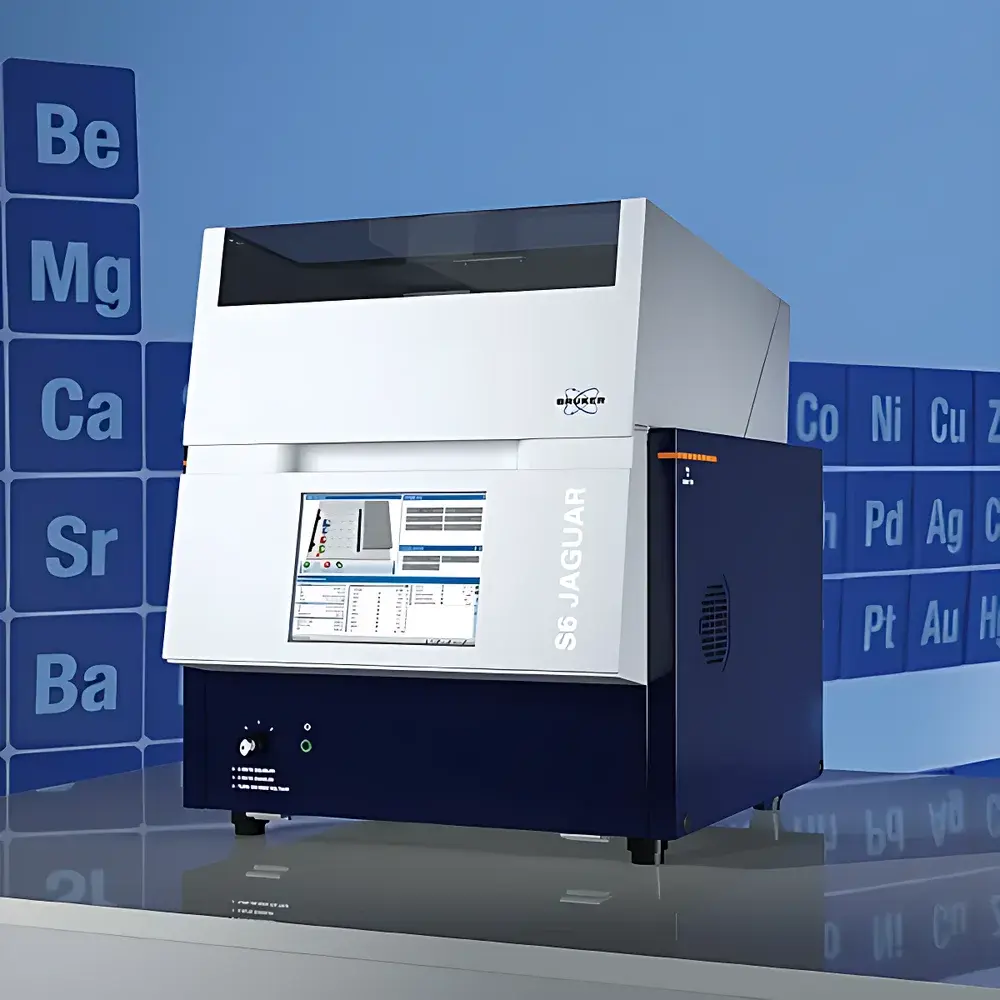
Bruker S6 JAGUAR Benchtop Wavelength Dispersive X-Ray Fluorescence Spectrometer
| Brand | Bruker |
|---|---|
| Origin | Germany |
| Model | S6 JAGUAR |
| Instrument Type | Benchtop |
| Instrument Kind | Scanning |
| X-ray Tube Power | 400 W |
| Analyzable Elements | F to Am (Fluorine to Americium) |
| Detector | High-sensitivity solid-state detector (HighSense XE™) |
| Optical Configuration | Compact WDXRF optical path with up to 4 collimators, up to 4 analyzing crystals, and dual high-sensitivity detectors |
| Software Platform | SPECTRA.ELEMENTS with SMART-QUANT WD fundamental parameters quantification |
| Automation Interface | AXSCOM-compatible |
Overview
The Bruker S6 JAGUAR is a benchtop wavelength dispersive X-ray fluorescence (WDXRF) spectrometer engineered for high-precision elemental analysis across research laboratories, quality control environments, and industrial process monitoring. Unlike energy-dispersive systems (EDXRF), the S6 JAGUAR employs Bragg diffraction from precisely aligned analyzing crystals to isolate characteristic X-ray emission lines—enabling superior spectral resolution, minimal peak overlap, and enhanced detection limits for trace and major elements alike. Its compact yet robust optical architecture integrates a 400 W high-power X-ray tube, optimized for efficient excitation of light elements (starting from fluorine) through heavy actinides (up to americium). This power level—significantly higher than typical benchtop WDXRF systems (e.g., 50 W or 200 W)—directly translates into improved counting statistics, reduced measurement times, and higher reproducibility in routine and method-developed analyses.
Key Features
- 400 W high-stability X-ray tube with programmable voltage (up to 60 kV) and current (up to 100 mA), enabling deep excitation of low-Z elements and high-intensity signal generation for heavy elements.
- Compact WDXRF optical path featuring motorized selection of up to four collimators and four analyzing crystals (e.g., LiF(200), PET, TAP, Multilayer), ensuring optimal dispersion and intensity for each element group.
- Dual high-sensitivity solid-state detectors (HighSense XE™), delivering >2× better energy resolution than conventional scintillation counters and linear count rate capability up to 2,000 kCPS—critical for accurate quantification of complex matrices and overlapping peaks.
- Benchtop footprint (< 0.8 m²) with integrated vacuum and helium purge options, supporting analysis of light elements (F, Na, Mg, Al, Si) without requiring full vacuum chambers or external gas supplies.
- Motorized sample stage with precise XYZ positioning and automatic sample recognition via barcode or RFID interface—designed for unattended operation and integration into GLP/GMP-compliant workflows.
Sample Compatibility & Compliance
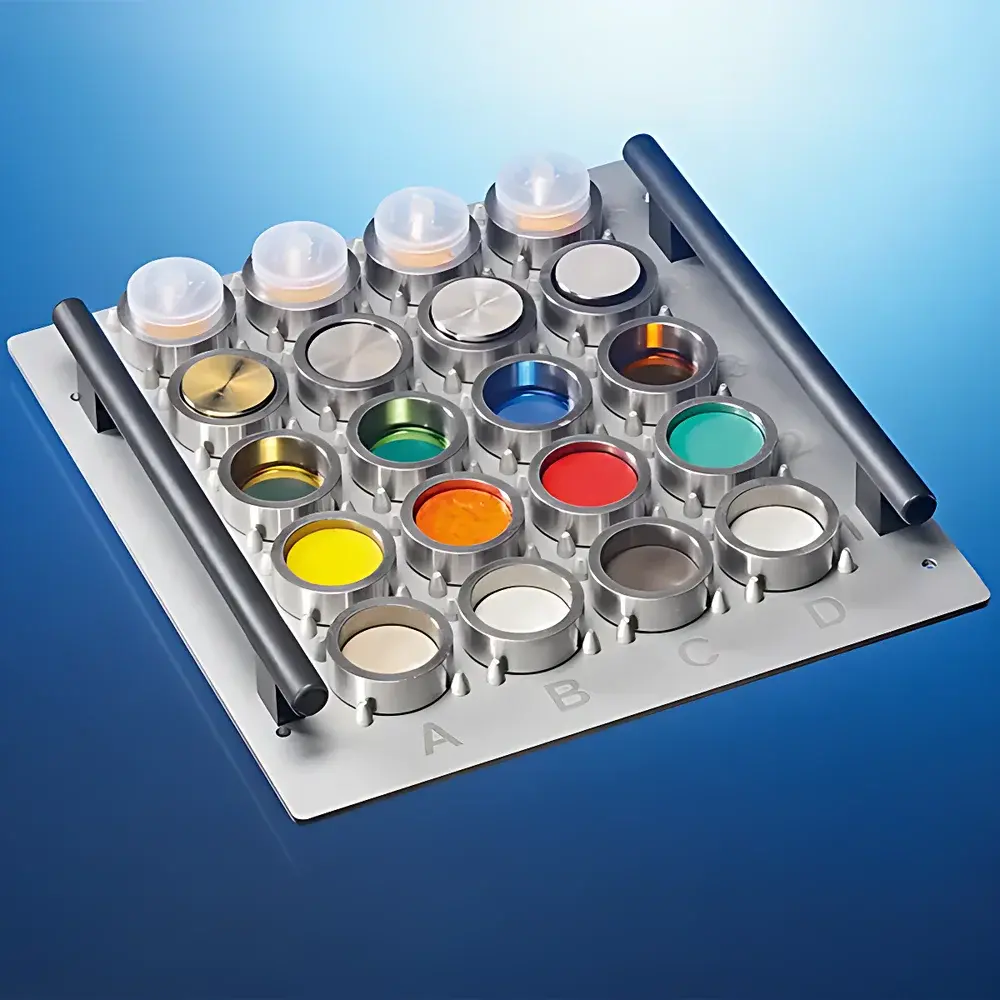
The S6 JAGUAR accommodates solid samples (metals, alloys, ceramics, polymers), pressed pellets, fused beads, and thin films—supporting diameters up to 50 mm and thicknesses up to 40 mm. Its modular sample chamber includes configurable holders for standard 32-mm or 40-mm cups, as well as custom fixtures for irregular geometries. The instrument complies with IEC 61000-6-3 (EMC), IEC 61000-6-4 (industrial emissions), and EN 61000-6-2 (immunity). For regulated environments, firmware and software support audit trails, electronic signatures, and user access levels per FDA 21 CFR Part 11 requirements when deployed with SPECTRA.ELEMENTS in validated configurations. Method development and validation align with ISO 21043 (XRF general principles), ASTM E1621 (standard guide for WDXRF), and ISO 18115-2 (surface chemical analysis—XRF quantification).
Software & Data Management
SPECTRA.ELEMENTS serves as the unified control and data processing platform, offering real-time spectrum acquisition, interactive peak identification, and automated background subtraction. SMART-QUANT WD implements fundamental parameter (FP) algorithms with matrix correction, enabling accurate calibration-free quantification across diverse sample types—including unknown alloys, geological standards, and heterogeneous catalysts—without prior standardization. All quantitative results include uncertainty estimation based on counting statistics, line overlap correction, and inter-element absorption/enhancement modeling. Data export supports ASTM E1347 (tabular format), CSV, and XML schemas compatible with LIMS integration. Full traceability is maintained through timestamped acquisition logs, detector gain history, crystal alignment records, and operator authentication metadata.
Applications
- Metallurgy & Materials Science: Rapid grade identification of stainless steels, aluminum alloys, and superalloys; inclusion analysis in turbine blade materials; coating thickness and composition verification (e.g., Zn/Ni plating).
- Geochemistry & Mining: Quantitative determination of major oxides (SiO₂, Al₂O₃, Fe₂O₃) and trace metals (Ni, Cr, V, REEs) in ores, sediments, and exploration drill cores.
- Environmental & Waste Analysis: Screening of hazardous elements (Pb, Cd, Hg, As, Cr⁶⁺ surrogate) in soils, slags, and electronic waste per RoHS and WEEE directives.
- Cement & Building Materials: Routine analysis of raw meal, clinker, and finished cement according to ASTM C114 and EN 196-2 protocols.
- Pharmaceutical Excipients: Elemental impurity screening (ICH Q3D) for catalyst residues (Pd, Pt, Ni) and elemental contaminants (Al, Fe, Si) in APIs and excipients.
FAQ
What is the lowest detectable concentration for fluorine using the S6 JAGUAR?
Under helium flush and optimized crystal/detector configuration, the typical detection limit for F Kα is ≤100 ppm in homogeneous glass standards (3σ, 1000 s counting time).
Can the S6 JAGUAR analyze liquid samples directly?
No—liquids require containment in sealed X-ray transparent cells (e.g., Mylar or polyimide windows) or conversion to solid forms (evaporation residues, precipitated filters, or fused beads) to maintain vacuum integrity and avoid contamination.
Is SMART-QUANT WD compliant with ISO 21043 for FP-based quantification?
Yes—the algorithm implements full mass absorption coefficient databases, secondary fluorescence corrections, and iterative matrix normalization consistent with ISO 21043 Annex B guidelines for fundamental parameter applications.
How does the AXSCOM interface facilitate automation?
AXSCOM provides standardized RS-232/RS-485 and TCP/IP command sets for remote instrument control, sample queue management, and status reporting—enabling seamless integration with robotic sample handlers, conveyor systems, and central QA/QC servers.
What maintenance intervals are recommended for the X-ray tube and detector?
The 400 W tube is rated for ≥20,000 hours of operation under normal use; annual performance verification (tube output, crystal alignment, detector resolution) is advised per Bruker’s Preventive Maintenance Protocol (PMP-042).
Related Products




