
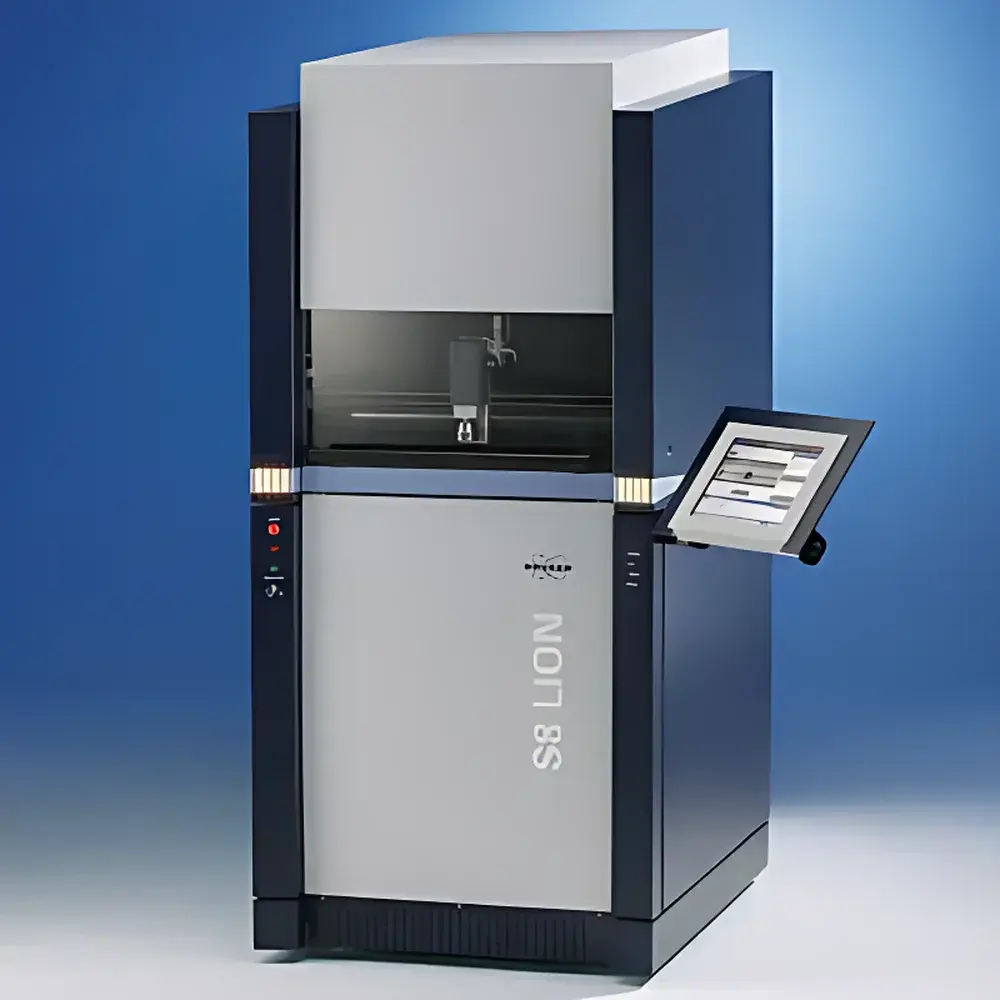
Bruker S8 LION Wavelength Dispersive X-Ray Fluorescence Spectrometer
| Brand | Bruker |
|---|---|
| Origin | Germany |
| Model | S8 LION |
| Instrument Type | Floor-standing |
| X-ray Tube Power | 3–4 kW |
| Analyzable Elements | C (6) to U (92) |
| Instrument Configuration | Simultaneous Multi-channel |
| Compliance | DIN EN ISO 9001:2008, CE, TÜV/PTB certified, radiation dose < 1 µSv/h (H*) |
Overview
The Bruker S8 LION is a high-performance, floor-standing wavelength dispersive X-ray fluorescence (WDXRF) spectrometer engineered for industrial and laboratory environments demanding uncompromising analytical reliability, speed, and metrological traceability. Based on Bragg diffraction principles, the instrument utilizes precisely curved crystals to separate characteristic X-ray emissions by wavelength, enabling simultaneous multi-element quantification with high spectral resolution and minimal peak overlap. Designed for routine quality control in cement, metals, mining, petrochemicals, and environmental laboratories, the S8 LION integrates a high-stability solid-state high-frequency generator, ultra-high-current X-ray tube (3 kW or 4 kW variants), and vacuum-maintained optical path to ensure long-term signal stability and low detection limits. Its top-illumination geometry protects the X-ray tube and beryllium window from sample debris and dust—critical for unattended operation in production settings. The system complies with international radiation safety standards (ICRP, IAEA, EURATOM) and carries full TÜV/PTB certification for electrical safety and radiation shielding.
Key Features
- Top-illumination optical design minimizes contamination risk to X-ray tube and detector windows, enhancing operational uptime in high-throughput facilities.
- Island-mode sealed enclosure with closed-loop water cooling maintains internal cleanliness and thermal stability—eliminating dust accumulation on PCBs and ensuring consistent performance under harsh ambient conditions.
- Integrated 15.6″ industrial-grade touchscreen (TouchControl™) enables fully standalone operation; no external PC required for daily analysis, method execution, or report generation.
- Dual-computer redundancy: both the onboard controller and an external workstation can independently manage measurement sequences, calibration updates, and data evaluation—ensuring continuity during maintenance or software updates.
- Optimized mechanical layout reduces X-ray path length between tube, sample, and detectors, maximizing count rates and reducing typical analysis time to 56 seconds per sample (up to 60 samples/hour).
- Two X-ray tube configurations: 3 kW (60 kV / 150 mA) and 4 kW (60 kV / 170 mA), supporting high-sensitivity detection of light elements (C–F) and trace heavy metals alike.
- Dual-circuit water cooling system cools both anode and tube head—suppressing thermal drift and preserving sample integrity for volatile or low-melting-point materials.
- P10 gas density stabilizer and digital pressure-controlled flow-proportional counters ensure stable detector gain and reproducible pulse-height discrimination across extended runs.
Sample Compatibility & Compliance
The S8 LION accommodates a broad range of solid and pressed-powder samples via its dual-level automatic sample changer: upper level (reference and control samples) and lower level (8–12 positions, configurable for 40 mm or 51.5 mm steel rings or standard cups). Sample positioning is motorized and repeatable to ±2 µm, ensuring precise alignment with the primary beam. All analytical routines adhere to internationally recognized standards—including ASTM E1621, ISO 21043, and EN 15309—for elemental composition determination in cement, slag, ores, and alloys. Radiation safety compliance includes full TÜV/PTB validation against DIN EN 61000-6-3 (EMC), DIN EN 61000-6-4 (immunity), and IEC 61000-4-2 (ESD), with external dose rate rigorously verified at <1 µSv/h (H*). The system supports GLP/GMP audit trails when integrated with Bruker’s optional LIMS-ready software modules.
Software & Data Management
Analysis is managed through Bruker’s unified S8 EXPERT software suite, offering a single interface for method development, calibration, matrix correction, and reporting. It implements three complementary matrix correction strategies: fixed theoretical α-coefficients, variable theoretical α-coefficients (based on fundamental parameters), and empirical α-coefficients—each selectable per element or applied globally. The variable α-method calculates unique correction coefficients for every sample using measured intensities and known composition constraints, minimizing reliance on extensive calibration standards while extending dynamic range across diverse matrices. Data security is enforced via hierarchical user permissions (administrator, analyst, operator), encrypted database access, and password-protected modification rights for calibration curves, spectral libraries, and instrument parameters. All audit-relevant actions—including parameter changes, recalibrations, and report exports—are timestamped and logged in accordance with FDA 21 CFR Part 11 requirements when configured with electronic signature modules.
Applications
The S8 LION delivers robust performance in high-volume industrial QA/QC workflows: cement clinker and raw meal analysis (including free lime via optional XRD channel), ferrous and non-ferrous alloy certification, catalyst monitoring in refining, geochemical exploration assays, and RoHS-compliant screening of restricted substances. Its 16-channel fixed configuration enables real-time monitoring of critical process elements (e.g., Ca, Si, Al, Fe, Mg, S, K, Na, Cl), while optional integration of a diffractometer channel allows concurrent XRD phase quantification—making it the only commercially available WDXRF/XRD hybrid platform validated for total cement solution (e.g., free CaO + major oxides in a single run). Method transfer between instruments is facilitated by Bruker’s standardized spectral library format and cross-platform calibration portability.
FAQ
What is the minimum detectable limit (MDL) for light elements such as carbon or sodium?
MDLs are matrix- and condition-dependent; typical values under optimized vacuum and crystal selection range from 10–50 ppm for Na and 50–200 ppm for C in homogeneous pressed pellets.
Can the S8 LION be integrated into an existing plant LIMS or MES environment?
Yes—via OPC UA, ODBC, or ASCII file export protocols; full API documentation and HL7/FHIR adapters are available upon request for regulated environments.
Does the instrument support automated drift correction during long-term unattended operation?
Yes—using built-in reference and control samples loaded in the upper auto-sampler tray, with configurable frequency for automatic re-calibration and QC pass/fail logic.
What service and remote support options are available?
Bruker offers 24/7 remote diagnostics via PC-Anywhere–enabled secure session handover, plus on-site preventive maintenance contracts with SLA-backed response times and spare-part provisioning.
Is training provided for method development and regulatory compliance documentation?
Comprehensive instructor-led training is included with purchase, covering SOP authoring, 21 CFR Part 11 implementation, IQ/OQ/PQ protocol execution, and audit-readiness preparation.






