
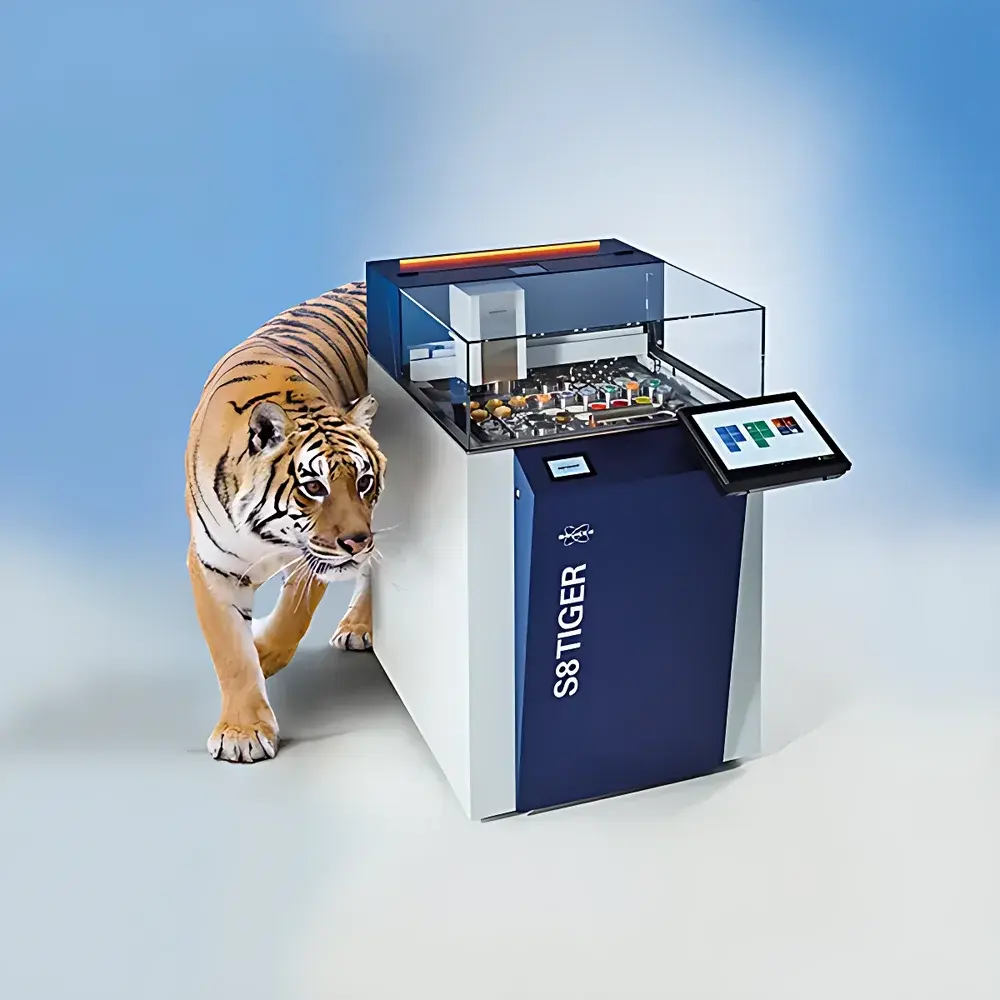
Bruker S8 TIGER第三代波长色散X射线荧光光谱仪
| Brand | Bruker |
|---|---|
| Origin | Germany |
| Model | S8 TIGER (3rd Generation) |
| Instrument Type | Floor-standing WDXRF Spectrometer |
| X-ray Tube Power | 3 kW / 4 kW |
| Analyzable Elements | Be to Am |
| Configuration | Simultaneous/Sequential Multi-channel |
| Detector System | HighSense™ XE + SensorBoost™ Signal Processing |
| Operating Voltage Range | 20–60 kV |
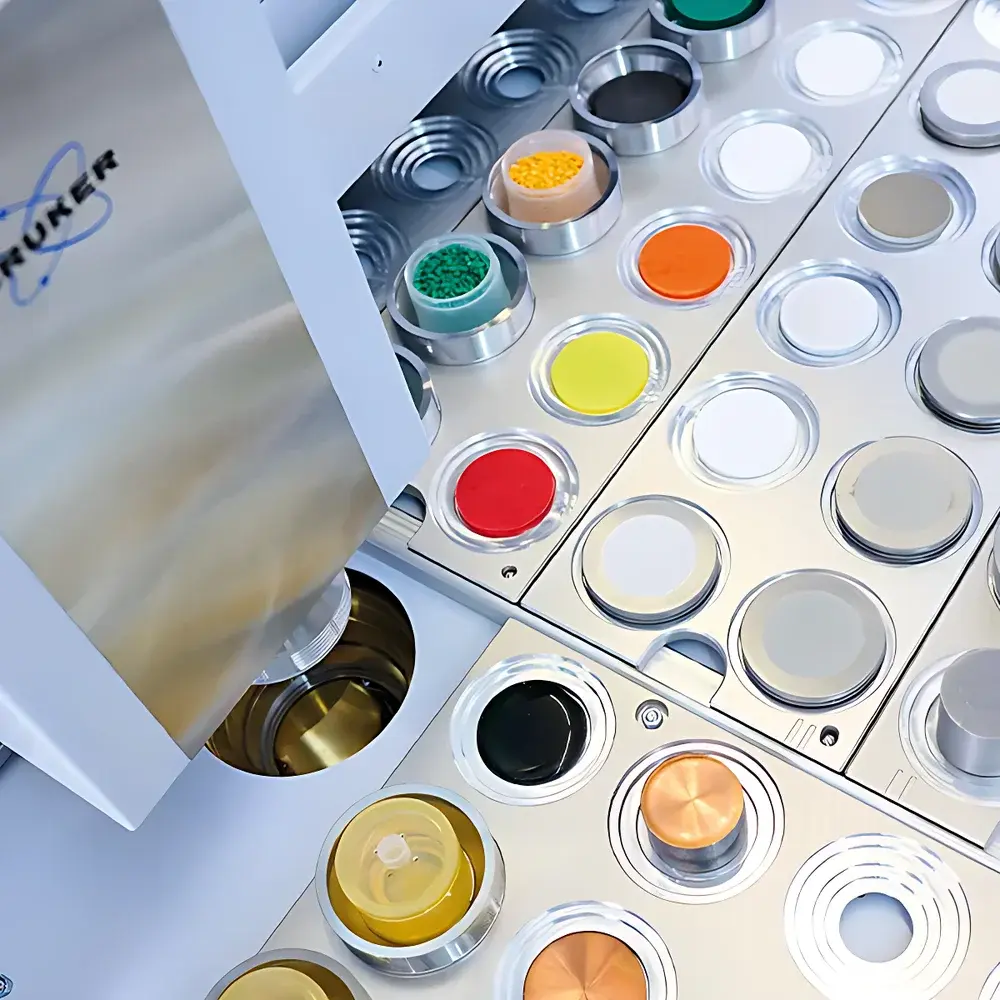
| Sample Capacity | 84-position EasyLoad™ Autoloader with AI Vision |
| Vacuum System | Dual-chamber sealed vacuum with high-transmission beryllium window |
| Crystal Options | 8-position analyzing crystal changer |
| Collimator Options | 4-position collimator changer |
| Filter Options | 10-position filter changer |
| Aperture Mask Options | 5-position mask changer |
| Detectors | Flow-proportional counter & scintillation counter |
Overview
The Bruker S8 TIGER (3rd Generation) is a floor-standing, high-performance wavelength dispersive X-ray fluorescence (WDXRF) spectrometer engineered for precision elemental analysis across industrial, research, and regulatory environments. Leveraging Bragg diffraction principles, the instrument separates characteristic X-ray emissions by wavelength using precisely aligned analyzing crystals—enabling quantitative and qualitative determination of elements from beryllium (Be, Z=4) to americium (Am, Z=95) with exceptional spectral resolution and minimal peak overlap. Designed for mission-critical applications in metallurgy, cement, geochemistry, polymers, and advanced materials R&D, the S8 TIGER integrates decades of WDXRF expertise with modern engineering rigor—including stable high-power X-ray excitation (up to 4 kW), ultra-low-drift tube architecture, and dual-detector capability (flow-proportional and scintillation) optimized for both light-element sensitivity and heavy-element throughput.
Key Features
- High-Power Excitation Platform: Dual-mode X-ray generator delivering 3 kW or 4 kW output at currents up to 170 mA and voltages from 20–60 kV—ensuring optimal excitation efficiency across the full elemental range, especially for low-Z elements (e.g., Na, Mg, Al, Si).
- HighSense™ XE Detector & SensorBoost™ Technology: Patented real-time signal processing eliminates dead-time limitations, achieving >12 million counts per second (cps) maximum counting rate—critical for high-precision process control in metal production and rapid multi-element screening.
- AI-Enabled Sample Handling: EasyLoad™ autoloader features an integrated AI vision system that identifies sample geometry, detects barcode/QR code metadata, and auto-selects measurement parameters—including mask size (5–34 mm), collimator (four options), filter (ten positions), and crystal (eight positions)—reducing operator dependency and method setup time.
- Dual-Chamber Vacuum Architecture: Hermetically sealed spectrometer chamber maintains long-term optical alignment and detector stability, while independent sample chamber vacuuming minimizes downtime during sample exchange—supporting uninterrupted 24/7 operation.
- Predictive System Health Monitoring: SafeGuard™ continuously logs operational parameters (tube current/voltage drift, detector gain, vacuum integrity, cooling performance) and applies statistical models to forecast maintenance intervals—enhancing uptime compliance for GLP/GMP-regulated labs.
Sample Compatibility & Compliance
The S8 TIGER accommodates solid discs, fused beads, powders, thin films, and irregular solids via its modular sample stage and five-aperture mask changer. Its 84-position autoloader supports unattended batch analysis under ISO/IEC 17025-compliant workflows. The system meets mechanical and electromagnetic safety requirements per IEC 61000-6-2/-4 and radiation safety standards EN 61000-3-2/-3. Software operation complies with FDA 21 CFR Part 11 requirements through audit-trail-enabled LabScape Cloud integration, including electronic signatures, user role management, and secure data archiving. Method validation protocols align with ASTM E1621 (standard guide for WDXRF elemental analysis), ISO 21043 (XRF for cement and clinker), and USP (elemental impurities in pharmaceuticals).
Software & Data Management
Control and data evaluation are executed via Bruker’s proprietary QUANTAX software suite, featuring intuitive TouchControl™ GUI, automated calibration curve generation, matrix correction algorithms (e.g., fundamental parameters, empirical alpha coefficients), and uncertainty propagation reporting. All raw spectra, processed results, and instrument logs synchronize securely to Bruker LabScape Cloud—enabling centralized fleet monitoring, remote diagnostics, and version-controlled method deployment across global sites. Audit trails record every parameter change, measurement start/stop, user login, and report export—fully traceable for regulatory inspections. Data exports support ASTM E1346-compliant ASCII formats and direct integration into LIMS via ODBC or REST API.
Applications
- Metallurgical Process Control: Real-time quantification of alloying elements (Cr, Ni, Mo, Co) and tramp elements (Pb, As, Sn) in stainless steels and superalloys—meeting ASTM E1086 and ISO 11573 specifications.
- Cement & Building Materials: Major oxide analysis (CaO, SiO₂, Al₂O₃, Fe₂O₃) and trace alkalis (Na₂O, K₂O) with sub-0.02 wt% precision, supporting ISO 29581-2 and EN 196-2 compliance.
- Geochemical Exploration: Detection of trace rare earth elements (REEs) and pathfinder metals (Au, Pt, Pd) in soils and drill cores using Theoretical Background™ software enhancements—improving detection limits by up to 40% in complex matrices.
- Polymers & Electronics: Halogen screening (Cl, Br) and heavy metal verification (Cd, Pb, Hg) per IEC 62321-5 and RoHS Directive Annex II requirements.
- Pharmaceutical Excipients: Quantitative assay of catalyst residues (Pd, Pt, Rh) and elemental impurities (As, Cd, Hg, Pb) down to µg/g levels—validated per ICH Q3D and USP /.
FAQ
What is the minimum detectable limit (MDL) for light elements such as sodium or magnesium?
MDLs are matrix- and configuration-dependent; typical values range from 10–50 µg/g for Na and Mg in fused glass beads using optimized vacuum conditions and LiF(200) crystals.
Can the S8 TIGER be upgraded from sequential to simultaneous channel configuration post-purchase?
Yes—hardware modules (additional detectors, fixed-channel optics) and software licenses can be added field-upgradable without system requalification.
Does the system support automated calibration verification using certified reference materials (CRMs)?
Yes—QUANTAX includes CRM-based drift correction routines compliant with ISO/IEC 17025 clause 7.7, with automatic alerting on deviation thresholds.
Is remote service access available without compromising data security?
LabScape Cloud employs TLS 1.3 encryption, zero-trust authentication, and configurable firewall rules—certified per ISO/IEC 27001 for secure remote diagnostics.
How does SensorBoost™ improve accuracy for major element analysis in cement?
By dynamically correcting for pulse pile-up and baseline shift in real time, SensorBoost™ reduces relative standard deviation (RSD) for CaO and SiO₂ measurements to ≤0.15% (n=10), exceeding ASTM C114 repeatability criteria.






