
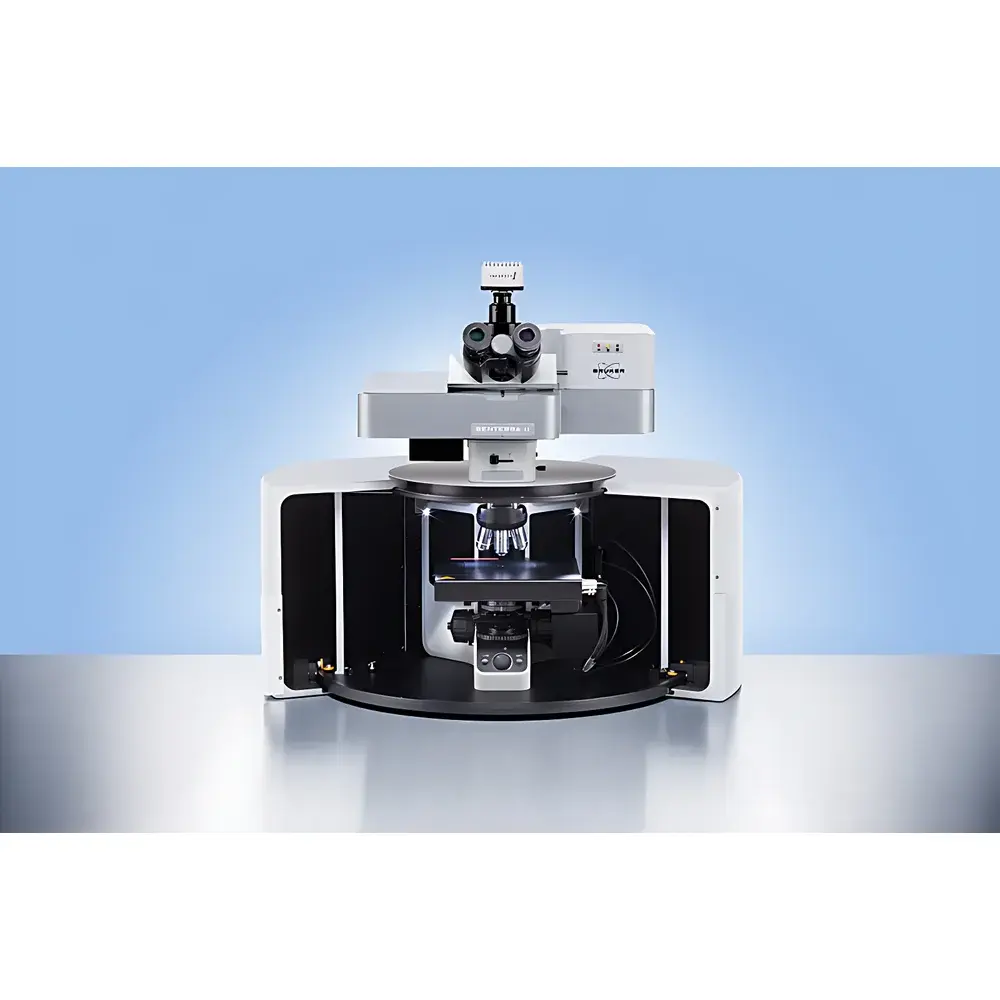
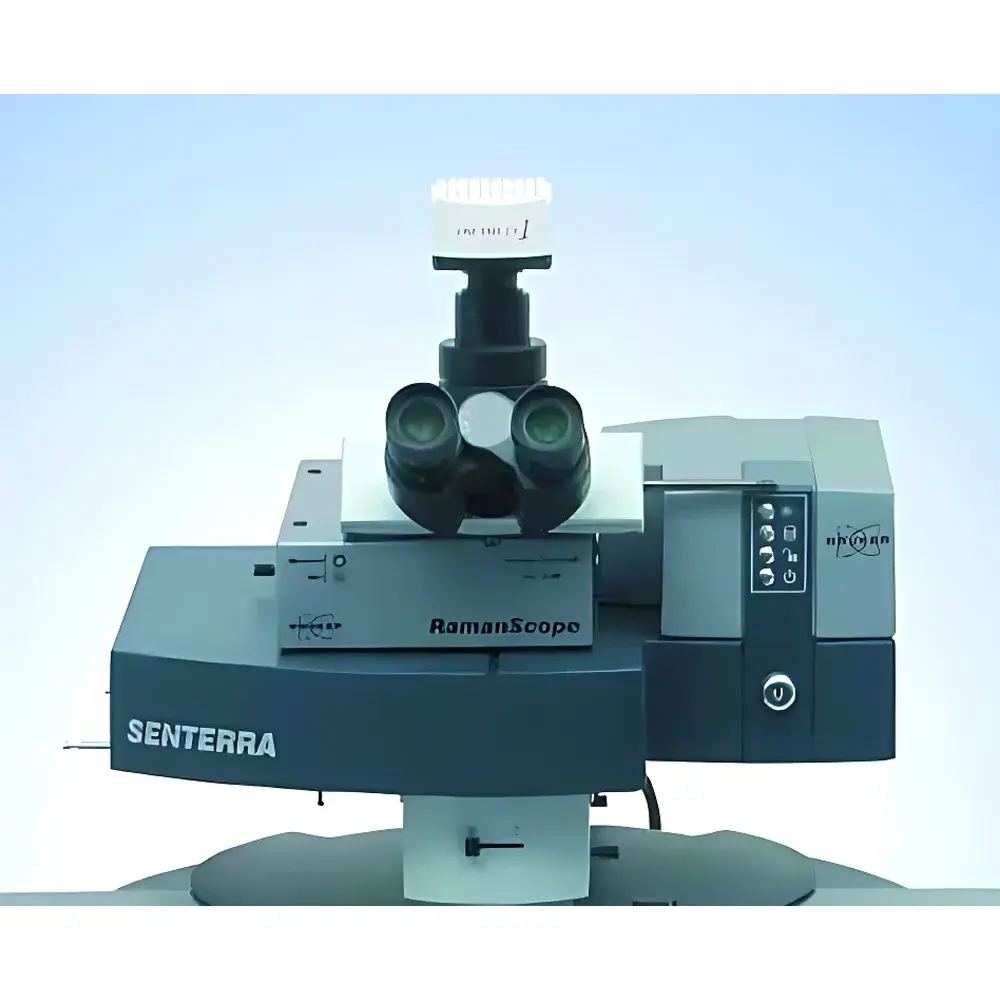
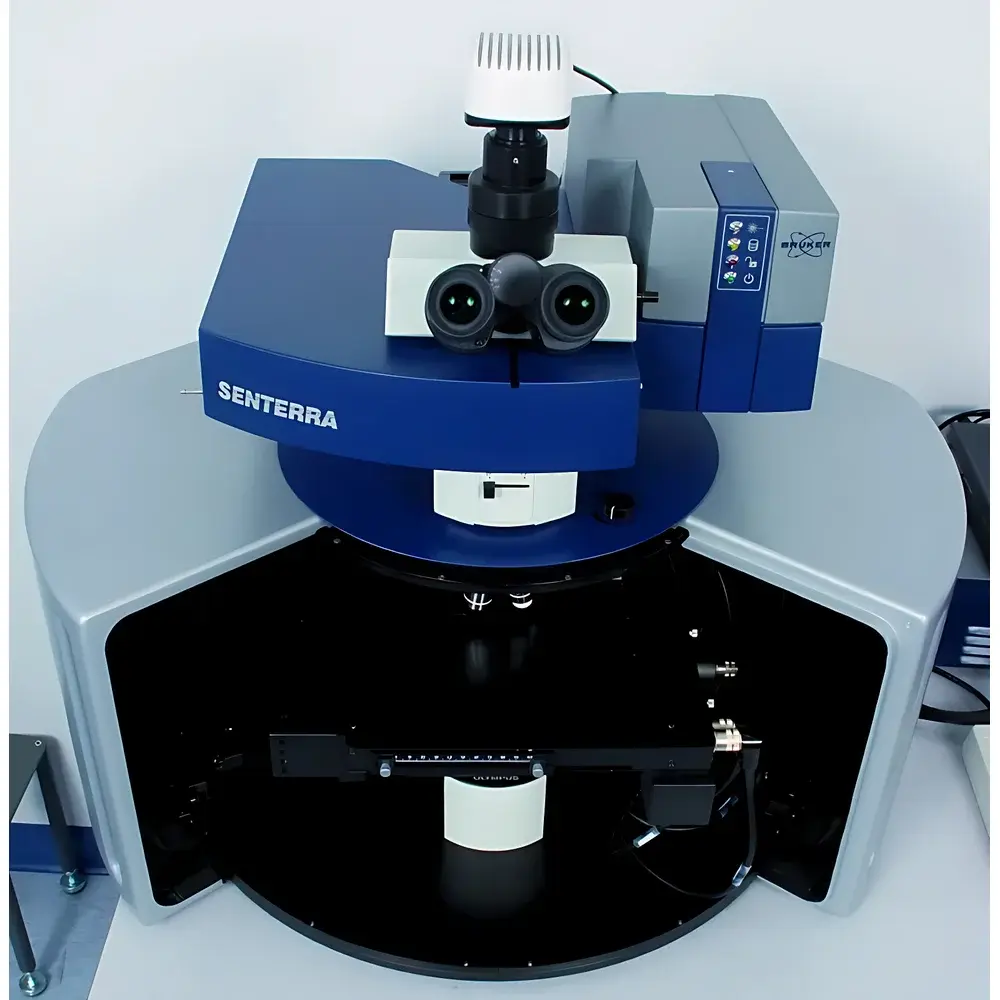
Bruker SENTERRA II Confocal Raman Microscope
| Brand | Bruker |
|---|---|
| Origin | Germany |
| Model | SENTERRA II |
| Instrument Type | Confocal Raman Microspectrometer |
| Spectral Range | 50–4400 cm⁻¹ |
| Spectral Resolution | 1.5 cm⁻¹/pixel |
| Spatial Resolution | Lateral 1 µm, Axial 2 µm |
| Minimum Wavenumber | 50 cm⁻¹ |
| Spectral Reproducibility | 0.06 cm⁻¹ |
Overview
The Bruker SENTERRA II Confocal Raman Microscope is a research-grade, fully automated confocal Raman microspectrometer engineered for high-fidelity molecular characterization at submicron spatial scales. It operates on the principle of inelastic light scattering (Raman effect), where monochromatic laser excitation induces vibrational transitions in chemical bonds, generating spectrally resolved fingerprint signatures. Its optical architecture integrates a compact, short-path design with high-throughput transmission optics, thermally stabilized spectrograph, and precision motorized XYZ stage—enabling simultaneous optimization of spectral fidelity, detection sensitivity, and confocal spatial resolution. Designed for both routine QC/QA environments and frontier academic or industrial research, the SENTERRA II delivers reproducible, traceable, and metrologically robust Raman data without compromising analytical flexibility.
Key Features
- Automated wavelength calibration via Bruker’s proprietary SureCAL™ technology—ensuring continuous, hands-free wavenumber axis correction with long-term stability better than ±0.1 cm⁻¹.
- Full-spectrum coverage (50–4400 cm⁻¹) with selectable spectral resolution down to 1.5 cm⁻¹/pixel, supporting isotopic shift analysis, polymorph discrimination, and stress/strain mapping.
- Confocal spatial resolution of ≤1 µm lateral and ≤2 µm axial—achieved through adjustable pinhole aperture, high-NA objectives, and precise optical alignment.
- Multi-laser platform with rapid, software-controlled switching between UV, visible, and NIR excitation sources (e.g., 325 nm, 532 nm, 633 nm, 785 nm), minimizing sample photodegradation while maximizing signal-to-noise ratio.
- Integrated hardware-software synchronization: all optical components—including gratings, filters, apertures, and laser lines—are automatically configured based on user-defined measurement protocols.
- Real-time spectral evaluation during acquisition using OPUS software, incorporating univariate peak fitting, multivariate chemometrics (PCA, MCR, PLS), and library search against >10,000 reference Raman spectra.
Sample Compatibility & Compliance
The SENTERRA II accommodates diverse sample formats—including bulk solids, thin films, powders, biological tissues, battery electrodes, 2D materials (e.g., graphene, MoS₂), and photovoltaic layers—without requiring conductive coating or vacuum. Its low-fluence excitation capability enables non-destructive analysis of light-sensitive specimens such as organic semiconductors, pharmaceutical cocrystals, and carbon nanotubes. The system complies with international regulatory frameworks for analytical instrumentation: it supports full audit trails, electronic signatures, and secure user access control per FDA 21 CFR Part 11; meets validation requirements under USP , Ph. Eur. 2.2.48, ASTM E1840 and E2529-06; and is deployable in GLP and GMP-compliant laboratories with documented IQ/OQ/PQ protocols.
Software & Data Management
OPUS software serves as the unified interface for instrument control, experiment design, real-time visualization, and advanced data processing. Its workflow-driven interface presents only context-relevant functions at each step—reducing operator error and accelerating method deployment. All raw hyperspectral datasets (Raman maps) are stored in vendor-neutral HDF5 format with embedded metadata (laser power, integration time, objective magnification, calibration history). Built-in tools support spectral preprocessing (cosmic ray removal, baseline correction, normalization), multivariate image segmentation, false-color mapping, and statistical outlier detection. Data export options include CSV, ASCII, and industry-standard JCAMP-DX, facilitating integration into LIMS and ELN platforms.
Applications
- Pharmaceutical solid-state analysis: polymorph identification, API-excipient interaction mapping, counterfeit drug screening.
- Materials science: strain distribution in semiconductor heterostructures, defect density quantification in CVD-grown graphene, phase segregation in perovskite solar cells.
- Geosciences: mineral identification in thin sections, fluid inclusion characterization, metamorphic reaction zoning.
- Life sciences: label-free cellular imaging, lipid droplet distribution in adipocytes, amyloid fibril conformational analysis.
- Forensics: pigment identification in artworks, fiber analysis, explosive residue detection.
- Quality control: coating thickness verification, contaminant localization in microelectronics, batch homogeneity assessment.
FAQ
Does the SENTERRA II support automated performance qualification (PQ) testing?
Yes—fully automated IQ/OQ/PQ routines are embedded in OPUS, executing standardized tests per USP , Ph. Eur. 2.2.48, and ASTM E1840 without interrupting routine analysis.
Can spectral resolution be adjusted during mapping acquisition?
Yes—users may select resolution modes (e.g., 4 cm⁻¹ for rapid survey mapping or 1.5 cm⁻¹ for high-fidelity band deconvolution) on a per-point or per-region basis.
Is remote operation supported?
Yes—OPUS supports secure remote desktop access and scheduled unattended acquisitions via networked Windows environments.
What level of training is required to operate the SENTERRA II?
Minimal training is required for routine measurements due to its guided workflow architecture; however, advanced applications (e.g., stress tensor modeling, resonance Raman optimization) benefit from Bruker-certified application specialist support.
How is wavenumber accuracy maintained over extended operational periods?
SureCAL™ performs continuous, real-time calibration using an internal neon emission line reference—eliminating drift-related uncertainty and ensuring compliance with ISO/IEC 17025 metrological requirements.






