
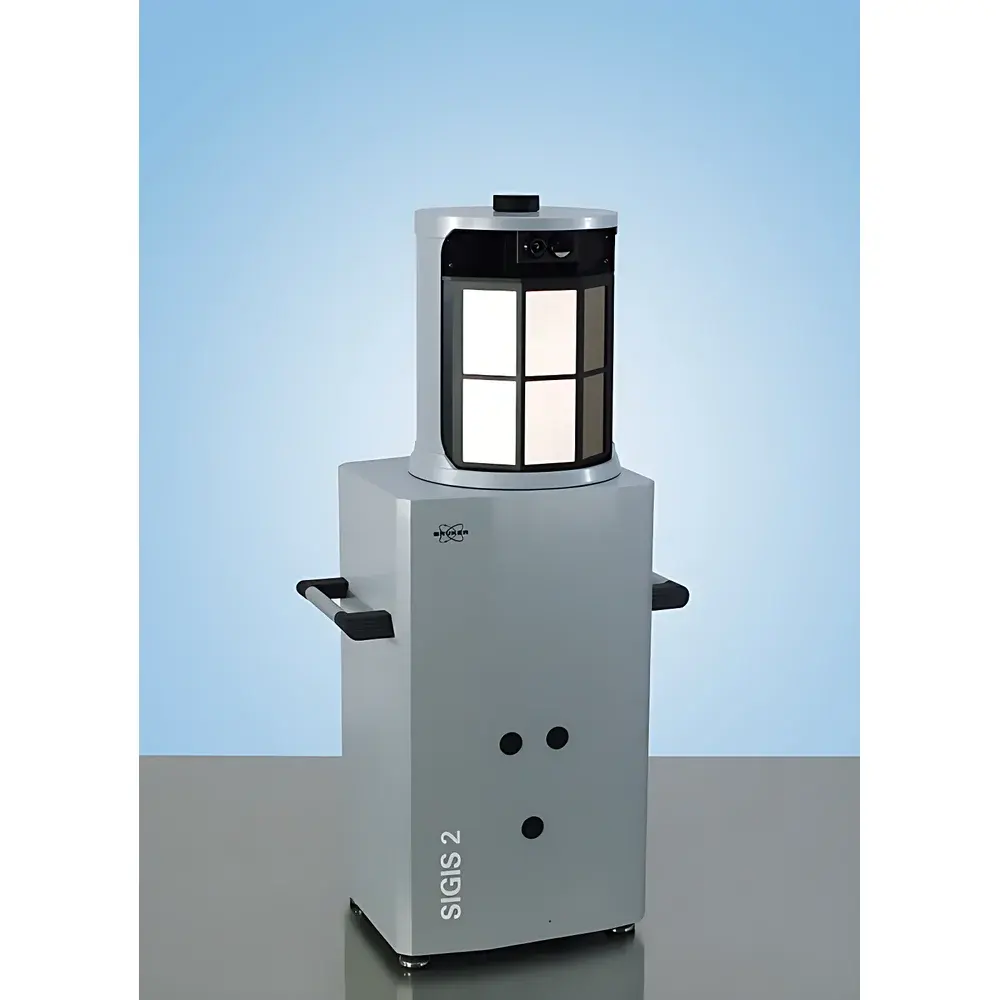
Bruker SIGIS II Remote Sensing Imaging Infrared Spectrometer
| Brand | Bruker |
|---|---|
| Origin | Germany |
| Manufacturer Type | Authorized Distributor |
| Origin Category | Imported |
| Model | SIGIS II |
| Pricing | Upon Request |
Overview
The Bruker SIGIS II is a field-deployable, passive remote sensing imaging infrared spectrometer engineered for standoff detection, identification, and quantitative mapping of gaseous plumes in open-air environments. Operating on the principle of Fourier-transform infrared (FTIR) spectroscopy coupled with high-resolution scanning optics, the SIGIS II captures spectral radiance emitted naturally by gases in the mid-infrared atmospheric window (typically 600–5000 cm⁻¹). As a fully passive system, it requires no external illumination source or retroreflective targets—relying instead on inherent thermal emission from gas molecules under ambient temperature gradients. This enables reliable, non-intrusive monitoring at distances up to several kilometers, depending on atmospheric conditions and target concentration. Designed for continuous operational readiness, the SIGIS II integrates seamlessly into environmental surveillance networks, industrial fence-line monitoring programs, and emergency response command infrastructures.
Key Features
- Passive FTIR-based remote sensing architecture with no requirement for active illumination or reflective surfaces
- Motorized, precision scanning mirror system enabling programmable spatial coverage—including full 360° azimuthal monitoring
- Integrated visible-light and uncooled microbolometer IR camera for co-registered video-spectral fusion and day/night operation
- Real-time spectral acquisition and on-board chemometric analysis using Bruker’s proprietary algorithms and embedded spectral libraries (including TIC—Toxic Industrial Chemicals—and CWA—Chemical Warfare Agents)
- Automatic atmospheric compensation using real-time background subtraction and multi-gas interference modeling (e.g., H₂O, CO₂, CH₄)
- Self-calibrating optical path with internal reference blackbody and alignment verification routines—eliminating need for routine field calibration with target gases
- High optical throughput and low-noise detector configuration optimized for weak-emission plume detection under variable meteorological conditions
- 24/7 autonomous operation with configurable alarm thresholds, automated report generation, and secure data upload via TLS-encrypted protocols to central servers
Sample Compatibility & Compliance
The SIGIS II is validated for detection and quantification of over 150 volatile compounds—including hydrocarbons (e.g., ethylene, benzene), acid gases (e.g., HCl, SO₂), ammonia, nitrogen oxides, hydrogen sulfide, and regulated chemical warfare agent simulants. It complies with international standards for environmental monitoring instrumentation, including ISO 14001-aligned operational protocols and ASTM D6348-18 guidelines for gaseous emission measurement via optical remote sensing. Its software architecture supports audit-trail logging and user-access controls consistent with GLP and EPA Method 320 requirements. While not a medical device, its data output meets traceability and metadata documentation criteria required for regulatory reporting under EU Directive 2010/75/EU (IED) and U.S. EPA 40 CFR Part 60 Subpart A.
Software & Data Management
The SIGIS II operates with Bruker’s SIGIS Control Suite—a modular software platform supporting both operator-level and expert-mode interfaces. The standard package includes automated plume tracking, dynamic region-of-interest (ROI) definition on live video feeds, and overlay of concentration maps onto georeferenced imagery. Advanced modules enable spectral deconvolution of overlapping gas signatures, time-series trend analysis, and integration with GIS platforms via standardized OGC WMS/WFS protocols. All spectral acquisitions are stored in Bruker OPUS format (.0), ensuring compatibility with third-party chemometric tools (e.g., MATLAB, Python scikit-learn). Data integrity is preserved through SHA-256 hashing, timestamped metadata embedding, and optional 21 CFR Part 11-compliant electronic signature workflows for regulated environments.
Applications
- Continuous perimeter monitoring of petrochemical plants, refineries, and LNG terminals for fugitive emissions and leak detection
- Volcanic gas flux studies and atmospheric chemistry research in collaboration with national observatories and academic institutions
- Rapid hazard assessment during industrial accidents, transportation incidents, or natural disasters involving hazardous material release
- Security screening at high-profile events—including G20 summits, Olympic Games, and diplomatic conferences—to detect unauthorized chemical threats
- Long-term urban air quality surveillance networks integrating with municipal environmental data hubs
- Verification of compliance with emission limits under national permitting frameworks and transboundary pollution agreements
FAQ
What types of gases can the SIGIS II detect?
It detects and quantifies a broad spectrum of volatile organic and inorganic compounds—including but not limited to methane, ammonia, sulfur dioxide, hydrogen sulfide, chlorine, phosgene, and chemical warfare agent simulants—based on their unique mid-IR absorption fingerprints.
Does the system require calibration with known gas standards in the field?
No. The SIGIS II performs automatic internal calibration using an integrated blackbody reference and optical alignment verification; no external gas cylinders or field calibration procedures are needed for routine operation.
Can the SIGIS II operate autonomously for extended periods?
Yes. It supports unattended 24/7 monitoring with scheduled scans, event-triggered acquisition, remote firmware updates, and fault-tolerant data transmission to centralized servers.
Is the system suitable for mobile deployment?
Yes. The SIGIS II is available in fixed-site, trailer-mounted, and vehicle-integrated configurations, with environmental enclosures rated IP54 and operating temperature range of −20 °C to +50 °C.
How is data security ensured during remote transmission?
All network communications use TLS 1.2+ encryption; authentication is enforced via X.509 certificates or OAuth 2.0 tokens, and local storage employs AES-256 encryption where applicable.







