
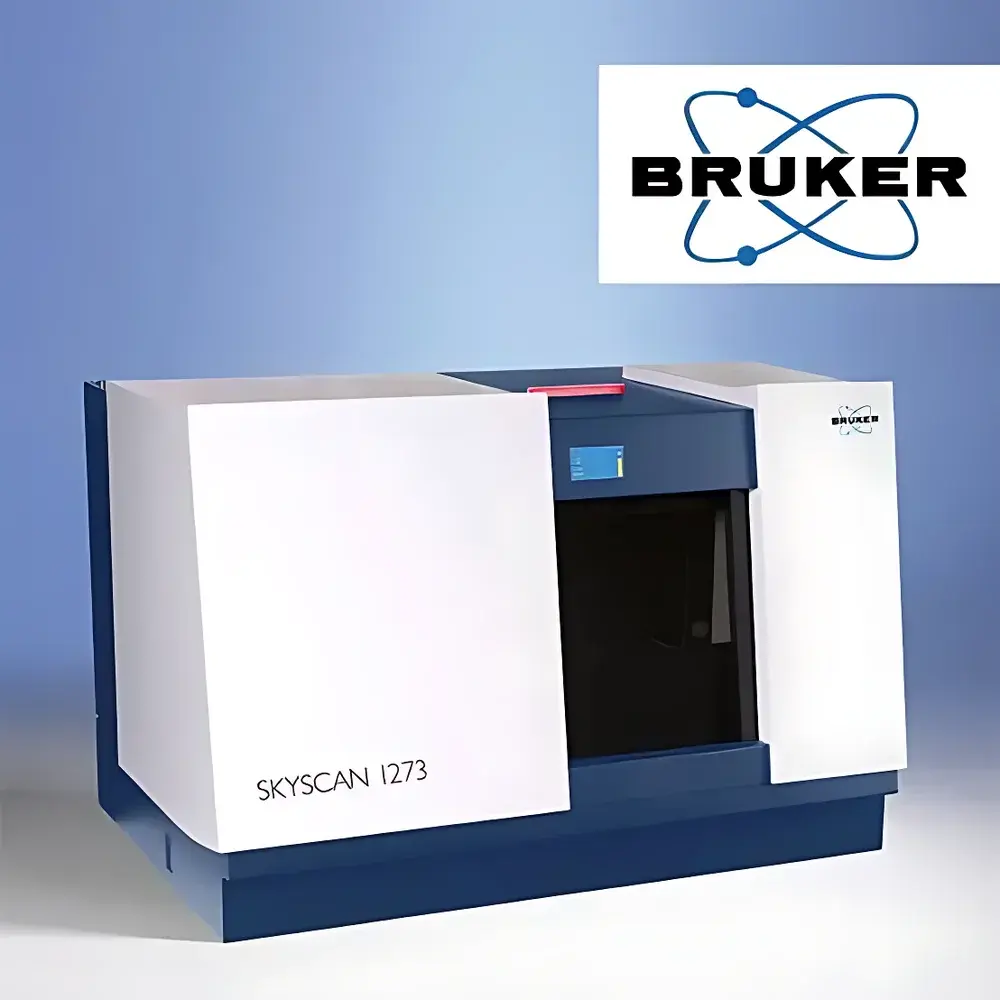
Bruker SkyScan 1273 High-Energy Desktop 3D X-ray Microtomography System
| Brand | Bruker |
|---|---|
| Origin | Belgium |
| Model | SkyScan 1273 |
| X-ray Source | 40–130 kV, up to 39 W |
| Detector | 6 MP CMOS flat-panel (3072 × 1944 pixels) |
| Spatial Resolution | < 5 µm |
| Voxel Size | < 3 µm |
| Max Sample Dimensions | Ø250 mm × H250 mm |
| Max Sample Weight | 20 kg |
| Reconstructed Volume | up to 4800 × 4800 pixels |
| External Dimensions | 1250 × 815 × 820 mm (W × D × H) |
| Radiation Leakage | < 1 µSv/h at any point on external surface |
| Power Supply | 100–240 V, 50–60 Hz, 3 A |
| Weight | 400 kg (net) |
Overview
The Bruker SkyScan 1273 is a high-energy, benchtop 3D X-ray microtomography (micro-CT) system engineered for non-destructive internal structure characterization across materials science, additive manufacturing, geoscience, electronics, and life sciences. Operating on the principle of cone-beam computed tomography, it acquires hundreds of 2D projection images as the sample rotates through 360°, followed by iterative or filtered back-projection reconstruction to generate isotropic 3D volumetric datasets (voxel-based). Unlike conventional industrial CT systems requiring shielded rooms, the SkyScan 1273 integrates full radiation containment within its self-shielded cabinet—complying with IEC 61000-6-3 and EN 62471—and delivers sub-5 µm spatial resolution without synchrotron infrastructure. Its 40–130 kV microfocus X-ray source enables robust penetration of dense metals (e.g., aluminum alloys, titanium), ceramics, and composite laminates, while maintaining sufficient contrast for low-Z materials such as polymers and biological tissues.
Key Features
- High-energy microfocus X-ray source (40–130 kV, up to 39 W) with integrated 8-position automatic filter changer for optimal beam hardening correction and contrast tuning per material class
- Large-area, high-dynamic-range CMOS flat-panel detector (3072 × 1944 pixels, 6 MP) enabling single-scan field-of-view up to Ø250 mm × H250 mm with minimal geometric magnification loss
- HART Plus (Hierarchical Accelerated Reconstruction Technology) algorithm suite—GPU-accelerated—to reduce reconstruction time by up to 4× for high-aspect-ratio samples without compromising fidelity
- Spiral scanning mode with precise helical trajectory control, delivering enhanced axial resolution and reduced ring artifacts in cylindrical or elongated specimens
- Automated offset scanning and large-volume stitching for seamless reconstruction of samples exceeding detector FOV (e.g., PCBs, turbine blades, bone cores)
- Self-contained radiation shielding meeting international safety standards (IEC 61000-6-3, EN 62471); measured dose rate < 1 µSv/h at all external surfaces during operation
Sample Compatibility & Compliance
The SkyScan 1273 accommodates diverse sample geometries within a maximum envelope of Ø250 mm × H250 mm and 20 kg mass. Its open-stage design supports custom fixtures—including heated/cooled stages, tensile rigs, and in situ deformation cells—for dynamic 4D (3D + time) experiments. The system complies with ISO/IEC 17025 requirements for measurement traceability when operated under documented SOPs. Data acquisition workflows align with GLP and GMP principles, supporting audit-ready metadata logging (including voltage, current, exposure time, filter selection, rotation step, and temperature). While not FDA 21 CFR Part 11–certified out-of-the-box, the NRecon and CTAn software modules support configurable user access controls, electronic signatures, and immutable audit trails—enabling validation in regulated environments upon site-specific qualification.
Software & Data Management
Bruker’s proprietary software suite—NRecon (reconstruction), DataViewer (slice navigation), CTAn (quantitative analysis), and CTVox (volume rendering)—is delivered as a unified, license-managed platform. All modules operate natively on Windows 10/11 (64-bit) and support GPU-accelerated processing via CUDA-compatible NVIDIA GPUs. Raw projections are stored in lossless TIFF or HDF5 format; reconstructed volumes are saved in native .ctimg or standardized .tiff/.nii formats for third-party integration (e.g., Avizo, Dragonfly, MATLAB). Batch processing pipelines allow unattended multi-sample runs with auto-calibration and QC flagging. Metadata—including instrument parameters, calibration certificates, and user annotations—is embedded directly into image headers per DICOM Supplement 122 conventions, facilitating PACS interoperability in preclinical research settings.
Applications
- Materials Science: Pore network quantification in metal foams, crack propagation mapping in thermal barrier coatings, fiber orientation analysis in carbon-fiber-reinforced polymers (CFRPs)
- Additive Manufacturing: Defect detection (porosity, lack-of-fusion, spatter), dimensional accuracy verification against CAD models (GD&T-compliant deviation mapping), powder bed density profiling
- Geosciences: Digital rock physics modeling (permeability, capillary pressure prediction), fossil morphology reconstruction, shale matrix–kerogen phase segmentation
- Electronics: Solder joint void fraction measurement, wire bond integrity assessment, conformal coating thickness uniformity, BGA interconnect inspection
- Life Sciences: Ex vivo murine organ phenotyping, dental enamel microstructure, trabecular bone morphometry (BV/TV, Tb.Th, Tb.Sp per ASBMR guidelines), biomaterial scaffold degradation kinetics
FAQ
What is the minimum achievable voxel size on the SkyScan 1273?
The system achieves voxel sizes down to < 3 µm under optimal magnification conditions—dependent on source-to-object distance, detector binning, and sample geometry—not a fixed specification across all configurations.
Does the SkyScan 1273 require external radiation shielding or a dedicated vault?
No. It is a fully self-shielded Class I cabinet system compliant with EU and North American radiation safety regulations; no additional room shielding is required for standard operation.
Can the system perform in situ mechanical testing?
Yes—via optional motorized stages and third-party load frames compatible with Bruker’s real-time acquisition trigger interface (TTL/RS-232), enabling synchronized 4D tomographic monitoring of deformation, fatigue, or thermal cycling.
Is CTAn software validated for ISO 13585 or ASTM E1441 compliance?
CTAn implements algorithms traceable to ISO 13585 Annex A (X-ray computed tomography—terminology and metrological requirements) and supports measurement uncertainty estimation per GUM (JCGM 100:2008); formal validation documentation is available upon request for qualified users.
What file formats are supported for export to finite element analysis (FEA) tools?
Segmented binary masks can be exported as STL (surface mesh) or raw voxel arrays in ASCII/RAW/NumPy formats; direct ANSYS APDL and Abaqus INP script generation is supported via CTAn’s FEA module.



