
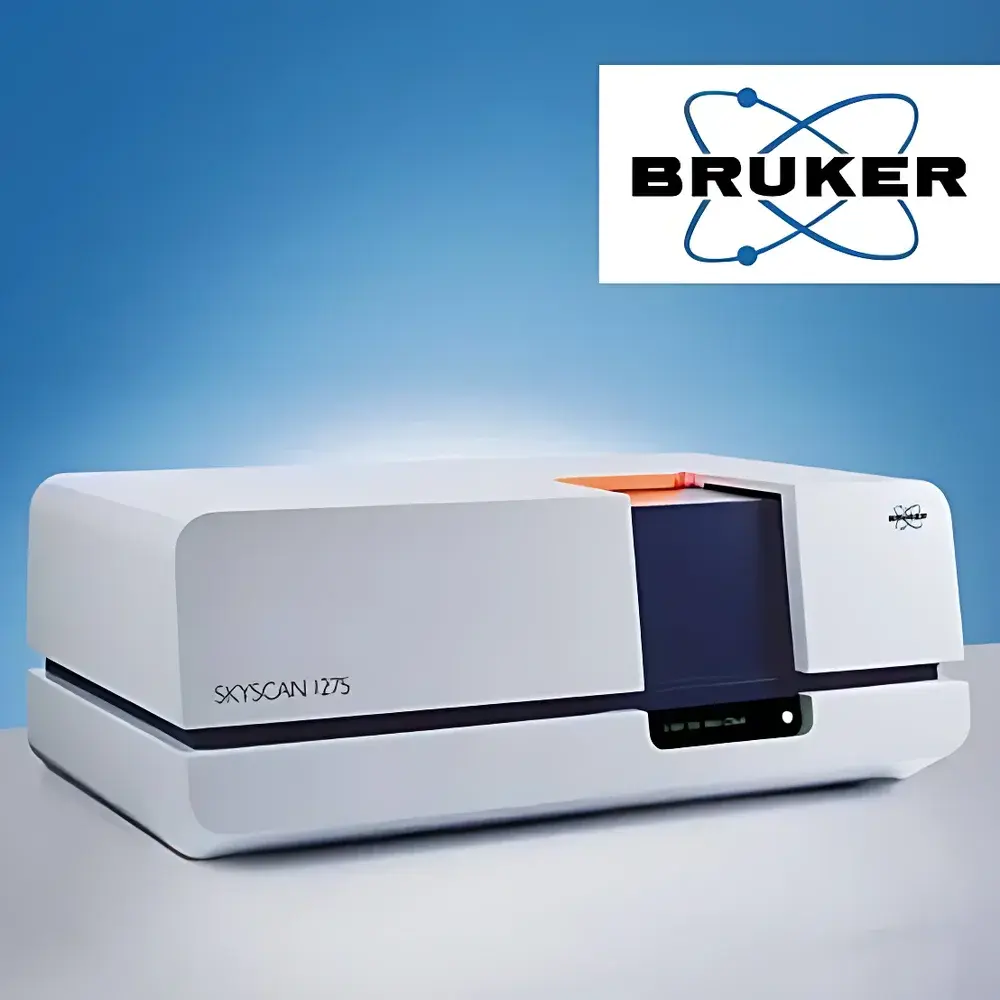
Bruker SkyScan 1275 Desktop High-Speed Micro-CT System
| Brand | Bruker |
|---|---|
| Origin | Belgium |
| Manufacturer Type | Authorized Distributor |
| Origin Category | Imported |
| Model | SkyScan 1275 |
| X-ray Source | 20–100 kV, 10 W, < 5 µm focal spot size at 4 W |
| Detector | 3 MP CMOS flat-panel detector (1944 × 1536 effective pixels) |
| Spatial Resolution | < 4 µm (nominal, at maximum magnification) |
| Density Resolution | < 4 µm (nominal, inferred from spatial resolution and contrast transfer performance) |
| Sample Capacity | Max height 120 mm, max diameter 96 mm |
| Dimensional Measurement Accuracy | Consistent with < 4 µm spatial resolution under calibrated conditions |
| Density Measurement Accuracy | Supported by high dynamic range (16-bit) detector and beam-hardening correction algorithms |
| Power Requirement | Standard 230 V AC, 50/60 Hz, single-phase outlet |
| Radiation Safety | Compliant with IEC 61000-6-3, IEC 61000-6-4, and national regulatory requirements for Class II B radiation devices |
Overview
The Bruker SkyScan 1275 is a fully automated, high-speed desktop micro-computed tomography (µCT) system engineered for non-destructive 3D internal structure characterization across materials science, life sciences, geosciences, electronics, and industrial quality assurance. Operating on the principle of cone-beam X-ray computed tomography, the system acquires hundreds of 2D projection images as the sample rotates through 360°, followed by iterative or filtered back-projection reconstruction to generate isotropic volumetric datasets (voxel sizes down to < 4 µm). Its integrated Push-Button-CT™ workflow eliminates manual parameter tuning—automating sample detection, trajectory optimization, exposure time selection, acquisition, reconstruction, and volume rendering in a single unattended sequence. This architecture enables true 4D (3D + time) dynamic imaging, supporting in situ and operando studies such as thermal expansion, fluid infiltration, or mechanical deformation under load.
Key Features
- High-throughput acquisition: Optimized geometry (short source-to-detector distance) combined with fast-readout CMOS detector enables full-volume scans in under 15 minutes—even at sub-5 µm resolution—reducing typical µCT cycle times from hours to minutes.
- Robust sealed-tube X-ray source: Air-cooled, maintenance-free 20–100 kV microfocus tube with 20,000 hours of stable operation and eliminating downtime associated with open-tube systems.
- High-fidelity detector system: 3 MP (1944 × 1536) CMOS flat-panel detector with 16-bit dynamic range, high quantum efficiency, and low electronic noise—enabling superior contrast-to-noise ratio (CNR) for distinguishing low-Z organic phases (e.g., polymers, biological tissue) from higher-Z matrices (e.g., metals, ceramics).
- Push-Button-CT™ automation: Fully autonomous workflow including automatic sample dimension detection, optimal trajectory calculation, exposure time adaptation, ring artifact suppression, and GPU-accelerated reconstruction—requiring no prior µCT expertise.
- Expandable platform: Optional motorized sample changer supports up to 12 samples for unattended overnight scanning; compatible with environmental stages (heating/cooling, compression, fluid cells) for time-resolved experiments.
- Regulatory-ready design: Certified for Class II B radiation device compliance per IEC 61000-6-3 (EMC emission), IEC 61000-6-4 (EMC immunity), and regional directives (e.g., EU Directive 2013/59/Euratom); includes interlocked shielding and real-time dose monitoring.
Sample Compatibility & Compliance
The SkyScan 1275 accommodates specimens up to 120 mm in height and 96 mm in diameter, covering a broad spectrum of industrial and research samples—including battery electrodes, additively manufactured metal parts, composite laminates, rock cores, pharmaceutical tablets, plant roots, and small-animal skeletal segments. Its variable kV range (20–100 kV) allows optimization for both low-density organic materials (e.g., 30–45 kV for soft tissue or polymer foams) and dense metallic components (e.g., 80–100 kV for aluminum or titanium alloys). All acquisitions support traceable calibration using NIST-traceable phantoms (e.g., Bruker CT Phantom Set), enabling quantitative dimensional metrology compliant with ISO 12716:2021 (Non-destructive testing — Computed tomography — Qualification of CT systems) and ASTM E1441-22 (Standard Guide for Computed Tomography (CT) Imaging). Data provenance and audit trails meet GLP/GMP documentation requirements when used with optional Bruker CT Studio software modules configured for 21 CFR Part 11 compliance.
Software & Data Management
Controlled via Bruker’s CT Studio v6.x platform, the system delivers end-to-end data handling—from acquisition scheduling and real-time preview to multi-threaded reconstruction (CPU/GPU hybrid), advanced segmentation (machine learning-assisted thresholding, region-growing, watershed), and quantitative morphometry (porosity, tortuosity, particle size distribution, phase connectivity). Reconstruction outputs are stored in standard DICOM and TIFF stacks, ensuring interoperability with third-party analysis tools (e.g., Avizo, Dragonfly, MATLAB, ImageJ/Fiji). Raw projections and metadata (including exposure parameters, geometric calibration coefficients, and dose logs) are archived in vendor-neutral HDF5 format, supporting FAIR (Findable, Accessible, Interoperable, Reusable) data principles. Optional CT Studio Enterprise Edition provides centralized license management, remote monitoring, role-based access control, and automated report generation aligned with ISO/IEC 17025 quality management frameworks.
Applications
- Quality control of additive manufacturing parts: pore network analysis, lack-of-fusion defect detection, wall thickness mapping.
- Battery R&D: electrode porosity evolution during cycling, separator integrity assessment, lithium dendrite tracking.
- Geoscience: pore-throat geometry quantification in reservoir rocks, fluid saturation dynamics, digital rock physics modeling.
- Electronics: solder joint voiding analysis, wire bond integrity, encapsulant delamination detection.
- Pharmaceuticals: tablet coating uniformity, granule distribution, dissolution pathway visualization.
- Life sciences: bone microarchitecture (BV/TV, Tb.Th, Tb.Sp), vascular network reconstruction, developmental morphology.
FAQ
What is the minimum detectable feature size under standard operating conditions?
The nominal spatial resolution is < 4 µm, achieved at maximum geometric magnification with optimized exposure and reconstruction settings. Actual resolvable detail depends on sample composition, contrast, and signal-to-noise ratio.
Does the system require external cooling or specialized power infrastructure?
No. The SkyScan 1275 operates from a standard 230 V AC, 50/60 Hz single-phase outlet and uses passive/air-cooled thermal management—no chilled water or three-phase supply is needed.
Can reconstructed volumes be exported for finite element analysis (FEA)?
Yes. Binary STL, PLY, and voxel-based NRRD formats are supported for direct import into ANSYS, COMSOL, and other simulation platforms. Mesh generation preserves topological fidelity and includes surface smoothing and watertight closure options.
Is remote operation supported?
Yes. CT Studio includes secure remote desktop access, live acquisition monitoring, and queue-based job submission—enabling off-site instrument utilization without compromising data security or audit integrity.
How is radiation safety ensured during routine operation?
The system integrates lead-shielded enclosure with dual-interlock door sensors, real-time X-ray emission monitoring, and automatic beam cutoff upon door opening—fully compliant with international radiation protection standards for laboratory-class µCT systems.



