
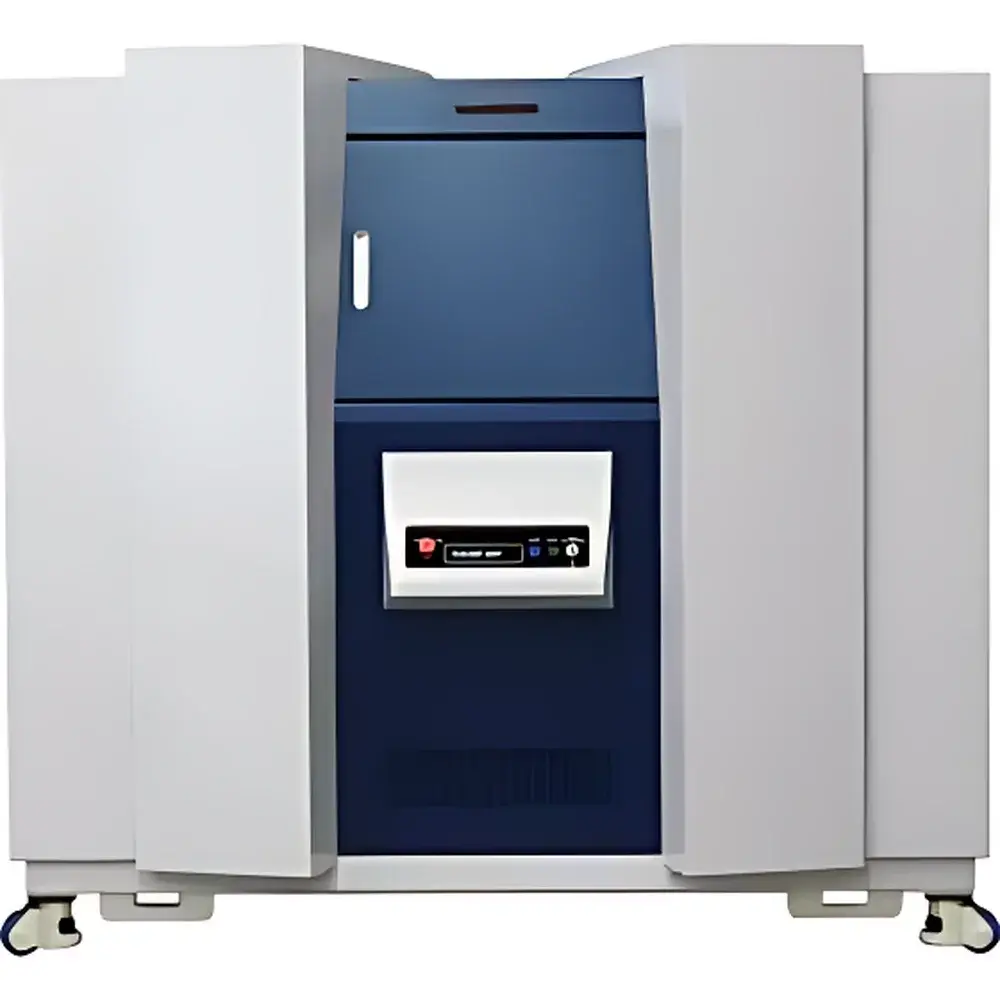
Bruker SkyScan 2211 High-Resolution X-ray Micro-CT System
| Brand | Bruker |
|---|---|
| Origin | Germany |
| Model | SkyScan 2211 |
| X-ray Source | 20–190 kV, 4/10/25 W, sub-micron focal spot size, 5-position filter wheel |
| X-ray Target | Tungsten (standard) |
| Detector | 3 MP CMOS flat panel (1920 × 1536 px) or 11 MP cooled CCD (4032 × 2670 px) |
| Reconstruction Volume (CMOS) | up to 3776 × 3776 × 1160 px (dual offset mode) |
| Reconstruction Volume (CCD) | up to 8000 × 8000 × 2272 px (dual offset mode) |
| Spatial Resolution | down to 100 nm (detector-limited, geometry-dependent) |
| Sample Capacity | Ø204 mm × L200 mm, max. 25 kg |
| Sample Positioning | direct-drive air-bearing rotation stage with integrated piezo-driven micro-positioning (5.5 mm travel) |
| Reconstruct Time | 1 min 12 sec (600 projections, 2K × 2K × 1K) |
| Radiation Safety | <0.5 µSv/h at 10 cm from surface (measured at 190 keV, 4 W on target) |
| Power Supply | 100–130 V or 200–240 V AC, 50–60 Hz |
| Cooling & Air Supply | integrated closed-loop water chiller and oil-free air compressor with particle filters and desiccant dryer |
Overview
The Bruker SkyScan 2211 High-Resolution X-ray Micro-CT System is a laboratory-scale industrial micro-computed tomography platform engineered for non-destructive, quantitative 3D internal structure analysis across a broad range of sample sizes and material densities. Based on cone-beam X-ray computed tomography (CBCT), the system employs high-brightness, open-type microfocus X-ray source technology with dual-stage electron optics and selectable anode targets—enabling optimal contrast tuning for diverse material systems including low-Z polymers, ceramics, metal alloys, porous media, and heterogeneous composites. Its modular detector architecture supports both high-speed CMOS flat-panel imaging and ultra-high-resolution cooled CCD acquisition, allowing users to balance throughput and resolution requirements within a single platform. The SkyScan 2211 delivers true isotropic voxel resolutions down to 100 nm under optimized geometric magnification conditions, making it suitable for nanoscale morphological characterization in research and industrial QA/QC environments where dimensional fidelity, phase segmentation accuracy, and repeatability are critical.
Key Features
- Multi-range X-ray source (20–190 kV, 4/10/25 W) with sub-micron focal spot and five-position automatic filter wheel for spectral optimization
- Dual-detector capability: 3 MP CMOS flat panel (1920 × 1536 px) for rapid scanning and dynamic studies; 11 MP cooled CCD (4032 × 2670 px) for high-fidelity static reconstructions
- True isotropic reconstruction volumes up to 8000 × 8000 × 2272 voxels (CCD, dual-offset mode), enabling sub-voxel feature localization and accurate volumetric quantification
- Precision sample handling: direct-drive air-bearing rotation stage with integrated piezo-driven micro-positioning (5.5 mm travel), ensuring mechanical stability and sub-pixel registration repeatability
- Integrated thermal and pneumatic infrastructure: closed-loop water chiller, oil-free air compressor, particulate filtration, and desiccant drying—all housed within the system footprint
- Compliance-ready radiation shielding: measured dose rate <0.5 µSv/h at 10 cm from enclosure surface during operation at maximum beam energy and power
Sample Compatibility & Compliance
The SkyScan 2211 accommodates samples up to Ø204 mm × 200 mm length and 25 kg mass, supporting both small-volume high-resolution scans (e.g., battery electrode cross-sections, MEMS devices) and large-part porosity mapping (e.g., turbine blades, composite laminates). Its flexible source-detector geometry permits variable magnification without hardware reconfiguration. The system meets international safety standards for Class I X-ray equipment per IEC 61010-1 and EN 62471. Shielding design complies with national radiation protection guidelines (e.g., German RöV, US NRC 10 CFR Part 20), and operational protocols support GLP/GMP-aligned workflows through audit-trail-enabled software logging. Optional integration with ISO/IEC 17025-compliant calibration services is available for metrology-grade applications.
Software & Data Management
Acquisition, reconstruction, and analysis are managed via Bruker’s proprietary NRecon, CTAn, and CTVox software suite—designed for scientific rigor and regulatory traceability. NRecon implements iterative and filtered back-projection algorithms with ring artifact correction, beam hardening compensation, and GPU-accelerated processing. CTAn provides ISO 16232- and ASTM E1245-compliant particle analysis, pore network modeling, wall thickness mapping, and fiber orientation tensor calculation. All processing steps—including ROI selection, thresholding, and morphometric parameter extraction—are fully scriptable and logged with user ID, timestamp, and parameter history. Data export supports DICOM, TIFF stack, HDF5, and STL formats; metadata embedding follows MIAME/MINIMUM standards. Software architecture conforms to FDA 21 CFR Part 11 requirements when deployed with electronic signature and role-based access control modules.
Applications
- Oil & gas: pore-throat network quantification in shale cores, digital rock physics simulations, fluid displacement modeling
- Advanced materials: void fraction and interfacial adhesion analysis in carbon-fiber reinforced polymers, thermal barrier coating integrity assessment
- Energy: 3D reconstruction of catalyst layer microstructure in PEM fuel cells, lithium dendrite growth tracking in solid-state batteries
- Electronics: solder joint void detection, wire bond integrity verification, conformal coating uniformity evaluation
- Additive manufacturing: as-built defect classification (lack-of-fusion, keyholing), grain boundary mapping, residual stress proxy analysis via distortion field modeling
- Geosciences: fossil digitization, mineral phase segmentation, fracture network topology extraction
FAQ
What is the minimum achievable voxel size?
The effective isotropic voxel size is geometry-dependent and determined by source focal spot size, source-to-object distance, and detector pixel pitch. Under optimal magnification conditions with the cooled CCD detector, the system achieves nominal voxel sizes down to 100 nm.
Can the SkyScan 2211 perform in situ or time-resolved CT?
Yes—the system supports programmable scan sequencing and external trigger synchronization (TTL input/output), enabling controlled mechanical loading, thermal cycling, or fluid injection experiments with temporal resolution limited only by detector frame rate and reconstruction latency.
Is the software validated for regulated environments?
Bruker offers IQ/OQ documentation packages and 21 CFR Part 11 compliance add-ons, including electronic signatures, audit trails, and secure user authentication—validated for use in pharmaceutical, aerospace, and medical device quality systems.
What maintenance is required for the X-ray source?
The open-type microfocus tube is rated for >10,000 hours of operation. Scheduled maintenance includes annual vacuum system inspection, filament performance verification, and cooling loop fluid replacement every 24 months.
Does the system support automated batch processing?
Yes—CTAn and custom Python scripts via Bruker’s SDK enable unattended processing of multi-sample datasets, including standardized reporting, pass/fail criteria application, and database archiving.



