
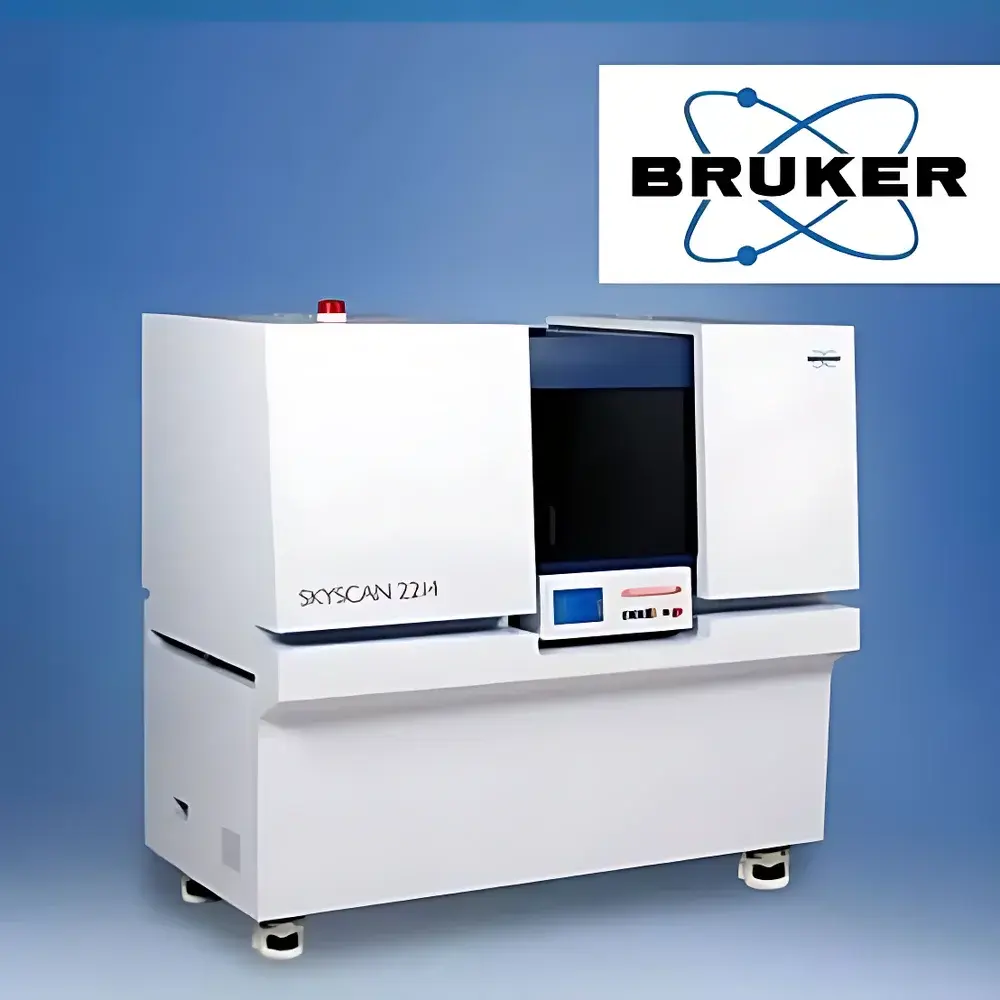
Bruker SKYSCAN 2214 Multi-Range 3D X-ray Nanotomography System
| Brand | Bruker |
|---|---|
| Origin | Belgium |
| Manufacturer Type | Authorized Distributor |
| Origin Category | Imported |
| Model | SKYSCAN 2214 |
| X-ray Source | 20–100 kV, 10 W, <5 µm focal spot size at 4 W |
| Maximum Voxel Resolution | <0.35 µm (16 MP detector) / <0.45 µm (11 MP detector) |
| Max Reconstructed Volume | 14456 × 14456 × 2630 px (16 MP) or 11840 × 11840 × 2150 px (11 MP) |
| Sample Capacity | Ø ≤ 75 mm, H ≤ 70 mm (standard) |
| Detector | 16 MP (4904 × 3280 px) or 11 MP (4032 × 2688 px), 14-bit cooled CCD coupled 1:1 to scintillator via fiber optic taper |
| Spatial & Density Resolution | <0.35 µm (16 MP) / <0.45 µm (11 MP), isotropic voxel capability |
| Reconstruction Engine | InstaRecon® real-time GPU-accelerated 3D reconstruction |
| Scan Modes | Cone-beam, helical, phase-contrast enabled, dynamic time-lapse |
| Compliance | Fully compatible with ASTM E1441, ISO 15732, and USP <1059> for non-destructive volumetric analysis |
Overview
The Bruker SKYSCAN 2214 Multi-Range 3D X-ray Nanotomography System is a high-performance industrial micro-CT platform engineered for quantitative, non-destructive 3D characterization at true sub-micron spatial resolution. Leveraging cone-beam X-ray computed tomography (CBCT) physics, the system reconstructs volumetric density distributions from hundreds of projection images acquired over 360° rotation. Its core architecture integrates a high-brightness microfocus X-ray source with a diamond transmission window (<500 nm effective focal spot), enabling stable, low-drift operation across kV and power settings (20–100 kV, up to 10 W). Paired with modular, field-upgradeable detector configurations—including dual high-sensitivity 16 MP and 11 MP cooled CCD detectors—the SKYSCAN 2214 delivers isotropic voxel sizes down to <0.35 µm under optimized acquisition conditions. Unlike conventional CT systems constrained by fixed geometry, this platform supports multi-scale scanning: from full-core geological samples (Ø ≤ 300 mm) to nanoscale polymer domains or battery electrode lamellae, all within a single instrument footprint and software environment.
Key Features
- Multi-range imaging capability: Seamless transition between macro-scale (mm–cm) and nano-scale (sub-µm) resolution via automated geometric magnification and detector selection.
- Diamond-window microfocus X-ray source: Ensures long-term stability, minimal thermal drift, and consistent beam quality—critical for quantitative density calibration and longitudinal time-series studies.
- Modular detector architecture: Supports up to four interchangeable detector modules (11 MP and 16 MP options), enabling on-site upgrades without system requalification or downtime.
- InstaRecon® GPU-accelerated reconstruction engine: Delivers full-volume 3D reconstructions in minutes—not hours—with support for iterative reconstruction, ring artifact suppression, and helical scan algorithms compliant with ASTM E2737.
- Dynamic 4D imaging suite: Integrated motion control and synchronized acquisition enable time-resolved in situ experiments (e.g., compression, heating, fluid injection) with temporal resolution down to seconds per volume.
- Low-maintenance mechanical design: Precision air-bearing rotation stage, vibration-damped optical enclosure, and sealed vacuum path minimize service intervals and ensure GLP-compliant operational continuity.
Sample Compatibility & Compliance
The SKYSCAN 2214 accommodates diverse sample geometries and material densities—from low-Z polymers and biological tissues to high-Z metal alloys and mineral composites—without requiring destructive sectioning or conductive coating. Standard sample holders support specimens up to Ø 75 mm × H 70 mm; optional large-bore stages extend capacity to Ø 300 mm for intact rock cores or composite panels. All acquisition and reconstruction workflows adhere to internationally recognized standards for non-destructive testing and quantitative imaging, including ASTM E1441 (Standard Guide for Computed Tomography), ISO 15732 (Non-destructive testing — Industrial computed tomography — Qualification of CT systems), and USP (Radiographic Imaging for Pharmaceutical Dosage Forms). Data provenance and audit trails comply with FDA 21 CFR Part 11 requirements when deployed with NIST-traceable calibration phantoms and Bruker’s validated CTControl™ software suite.
Software & Data Management
CTControl™ v6.x provides a unified interface for acquisition planning, real-time projection monitoring, reconstruction, segmentation, and quantitative morphometry. The software includes embedded calibration tools for beam hardening correction, flat-field normalization, and geometric distortion mapping—essential for metrological-grade dimensional and density measurements. Segmentation is performed using both threshold-based and machine learning–assisted algorithms (CTAn AI module), supporting batch processing of hundreds of volumes with reproducible ROI definition. Export formats include DICOM, TIFF stack, STL, and HDF5, ensuring interoperability with third-party platforms such as Avizo, Dragonfly, and MATLAB. All user actions, parameter changes, and reconstruction logs are timestamped and stored in an encrypted SQLite database, satisfying GLP/GMP documentation requirements for regulated laboratories.
Applications
- Geosciences & Energy: Quantitative pore-network modeling of reservoir rocks; 3D grain-size distribution and mineral phase mapping; in situ fluid flow visualization under confining pressure.
- Advanced Materials: Fiber orientation tensor analysis in carbon-fiber composites; void content and interfacial debonding quantification in thermosets; crack propagation tracking during cyclic loading.
- Battery R&D: Electrode porosity heterogeneity mapping; SEI layer thickness measurement; dendrite growth monitoring across charge/discharge cycles.
- Life Sciences: Osteocyte lacunocanalicular network morphology in bone biopsies; dental enamel microstructure and caries progression; plant vasculature and insect tracheal system architecture—without staining or embedding.
- Electronics & Additive Manufacturing: Solder joint void analysis; powder bed density uniformity assessment; lattice structure integrity verification in Ti-6Al-4V implants.
FAQ
What is the smallest resolvable feature size under optimal conditions?
The system achieves a nominal isotropic voxel size of <0.35 µm using the 16 MP detector and high-magnification geometry—enabling reliable detection of features ≥1.05 µm (3× voxel size) in homogeneous materials.
Can the SKYSCAN 2214 perform in situ mechanical testing?
Yes. Integrated load-stage synchronization allows real-time volumetric acquisition during uniaxial compression, tensile, or bending tests—provided external actuators meet positional repeatability and vibration isolation specifications.
Is phase-contrast imaging supported?
Phase retrieval is enabled via propagation-based phase contrast (PBI) using the system’s high-coherence microfocus source and precise detector positioning—particularly beneficial for low-absorption soft tissues and polymers.
How is calibration traceability maintained for metrology applications?
Bruker supplies NIST-traceable step-height and sphere-diameter phantoms; CTControl™ embeds automated calibration routines aligned with VDI/VDE 2630-1.1 and ISO 15530-3 protocols.
Does the system support automated batch scanning for QA/QC environments?
Yes. CTControl™ includes scriptable acquisition templates, barcode-triggered sample identification, and pass/fail tolerance thresholds linked to CTAn’s morphometric output—fully deployable in ISO 17025-certified labs.



