
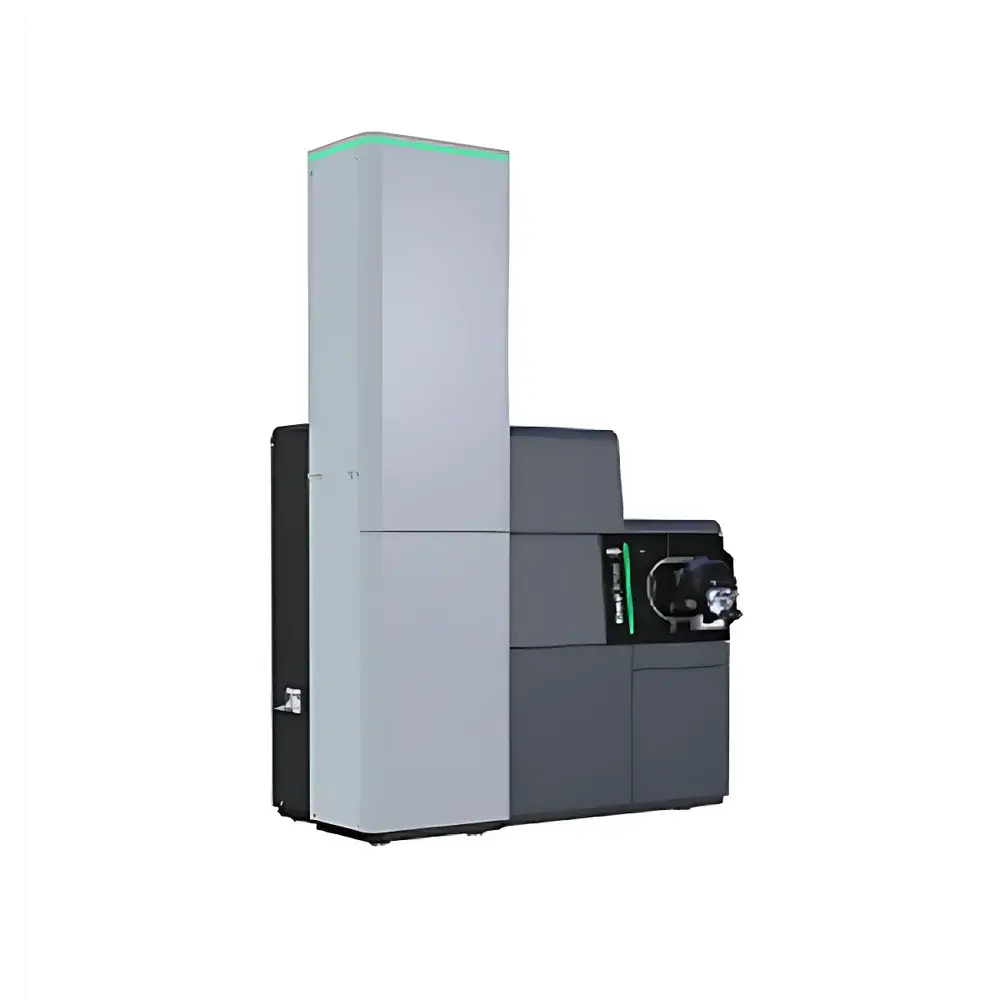
Bruker timsOmni Trapped Ion Mobility Spectrometry Mass Spectrometry System
| Brand | Bruker |
|---|---|
| Origin | Germany |
| Instrument Type | Trapped Ion Mobility Spectrometry (TIMS)–based Mass Spectrometer |
| Model | timsOmni |
| Application Scope | Universal for native and denatured proteoforms, intact proteins, oligonucleotides, PTMs, small molecules, and multi-specific biologics |
| Regulatory Compliance | Designed for GLP/GMP-aligned workflows |
Overview
The Bruker timsOmni is a next-generation trapped ion mobility spectrometry (TIMS)–coupled high-resolution mass spectrometry platform engineered for deep structural characterization of biomolecules across multiple analytical dimensions. At its core, the system integrates TIMS separation—based on differential mobility under electric field gradients—with advanced electron-induced dissociation (eXd) in a dynamically controlled, multi-stage MSn architecture. Unlike conventional CID or HCD fragmentation, eXd enables selective cleavage of labile bonds (e.g., C–Cl, N–Cα, phosphodiester linkages) while preserving post-translational modifications (PTMs), disulfide connectivity, and higher-order structure signatures. The timsOmni builds upon the proven timsTOF Ultra 2 hardware foundation but introduces the Omnitrap® multi-modal ion trapping module, enabling simultaneous accumulation, mobility-resolved isolation, and energy-tunable eXd within a single duty cycle. This architecture delivers reproducible collision cross-section (CCS) measurements with sub-1% relative standard deviation, supports collision-induced unfolding (CIU) for conformational landscape mapping, and provides full-scan sensitivity enhancements exceeding 10× compared to prior-generation TIMS-MS systems.
Key Features
- Omnitrap® multi-stage ion trapping: Enables sequential accumulation, mobility filtering, and eXd activation in a single acquisition cycle—maximizing precursor utilization (>90%) and fragment ion yield.
- Electron energy tunability: Precise control over electron kinetic energy (0.5–30 eV) and reaction time (ms–s range) allows optimization of fragmentation pathways for diverse analytes—from intact mAbs to oligonucleotides and small-molecule metabolites.
- Multi-dimensional MSn capability: Combines TIMS mobility separation, quadrupole isolation, and eXd fragmentation across up to five sequential stages (MS5) without signal loss from ion transmission inefficiencies.
- cDDA (charge-state-dependent data-dependent acquisition): Real-time deconvolution of charge envelopes during LC-MS runs enables intelligent, non-redundant targeting of co-eluting proteoforms—even at sub-femtomole abundance levels.
- NEOS-Source™ electrospray ionization: Optimized for native and semi-native conditions, delivering enhanced spray stability, reduced adduct formation, and improved reproducibility for intact protein and complex analysis.
- Full PASEF® compatibility: Maintains backward support for bottom-up proteomics workflows while extending functionality to middle-down and top-down applications via integrated eXd and TIMS mobility resolution.
Sample Compatibility & Compliance
The timsOmni accommodates a broad spectrum of sample types—including intact monoclonal antibodies (mAbs), multi-specific antibodies, antibody–drug conjugates (ADCs), histone complexes, membrane protein assemblies, synthetic oligonucleotides (DNA/RNA), and small-molecule pharmaceuticals. Its TIMS-based CCS measurement capability aligns with ISO/IEC 17025 requirements for orthogonal physicochemical characterization, and CIU-derived unfolding profiles are increasingly referenced in regulatory submissions for biosimilar comparability studies (FDA Guidance for Industry, 2022). All data acquisition, processing, and reporting workflows are fully compatible with 21 CFR Part 11 compliance when deployed with Bruker’s OmniScape™ software suite, which includes electronic signatures, role-based access control, and immutable audit trails for GLP and GMP environments.
Software & Data Management
Data acquisition and interpretation are unified under OmniScape™—a purpose-built software platform supporting real-time visualization of TIMS mobility drift times, CCS-calibrated spectra, CIU heatmaps, and eXd fragment annotation. The software implements intelligent algorithms for PTM localization (e.g., acetylation site assignment on histone H3), CDR sequencing of therapeutic antibodies, and modification mapping in RNA oligos. Raw data files adhere to open mzML 1.2 format, ensuring interoperability with third-party tools such as Skyline, MaxQuant, and BioPharma Finder. For regulated environments, OmniScape™ provides complete traceability: every parameter change, calibration event, and spectral annotation is timestamped, user-attributed, and archived in a tamper-evident database compliant with ALCOA+ principles.
Applications
- Intact Protein & Proteoform Analysis: High-confidence identification and quantification of glycoforms, oxidation variants, and sequence mutations in therapeutic proteins using CCS + eXd + MSn.
- Antibody CDR Sequencing: Deep coverage of complementarity-determining regions through high-efficiency eXd fragmentation and charge-state-resolved cDDA targeting.
- Oligonucleotide Characterization: EDD-enabled backbone cleavage for precise localization of methylation, phosphorylation, and base modifications in antisense oligos and siRNA therapeutics.
- Native MS of Protein Complexes: Preservation of non-covalent interactions during ionization and mobility separation, followed by gentle eXd to probe subunit stoichiometry and interface residues.
- Small-Molecule Structural Elucidation: Differentiation of positional isomers (e.g., benzyl vs. aryl chloride) via diagnostic fragment ions inaccessible to CID/HCD.
- Metabolite Profiling of Biologics: Detection and structural assignment of low-abundance in vivo degradation products—including Fab-arm exchange fragments and deamidated variants—in plasma and tissue extracts.
FAQ
What distinguishes timsOmni from timsTOF Pro 2 or timsTOF Ultra 2?
The timsOmni introduces the Omnitrap® module and full eXd capability—not available on earlier platforms—enabling true multi-stage, mobility-resolved electron-induced dissociation with quantitative precursor consumption control.
Can timsOmni perform both bottom-up and top-down workflows in the same instrument session?
Yes. It retains full PASEF® support for tryptic peptide analysis while enabling seamless switching to intact protein mode via NEOS-Source™ and Omnitrap®-driven eXd workflows.
Is CCS calibration traceable to NIST standards?
Yes. The system uses internally calibrated polyalanine and tune mix standards, with optional external calibration against NIST-traceable mobility standards (e.g., Agilent ESI-L Low Concentration Tuning Mix) for inter-laboratory reproducibility.
Does timsOmni support automated method development for eXd parameters?
OmniScape™ includes an eXd optimization wizard that recommends optimal electron energy and reaction time based on precursor m/z, charge state, and molecular weight—reducing method development time by >70%.
How does cDDA improve detection of low-abundance proteoforms in complex mixtures?
By dynamically assigning isolation windows to non-overlapping m/z regions across charge states—and excluding already-fragmented precursors—it eliminates spectral redundancy and increases duty cycle efficiency for rare variants.





