
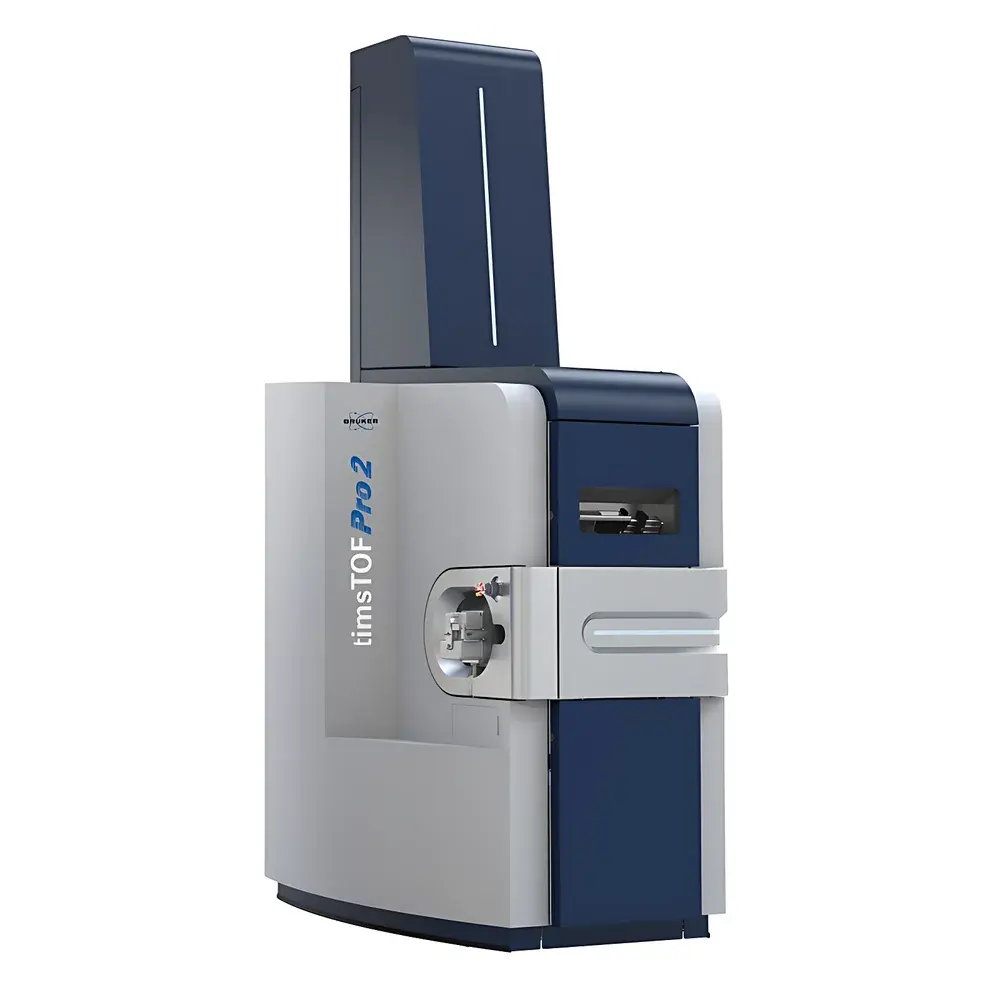
Bruker timsTOF Pro 2 Trapped Ion Mobility Time-of-Flight Mass Spectrometer
| Brand | Bruker |
|---|---|
| Origin | Germany |
| Model | timsTOF Pro 2 |
| Instrument Type | Trapped Ion Mobility Spectrometry (TIMS) Mass Spectrometer |
| Application Domain | Specialized Omics Research (Proteomics, Lipidomics, Phosphoproteomics, Clinical Biomarker Discovery) |
| Regulatory Context | Compliant with GLP/GMP data integrity requirements |
Overview
The Bruker timsTOF Pro 2 is a high-performance trapped ion mobility spectrometry (TIMS) coupled with orthogonal time-of-flight (TOF) mass spectrometry. It represents the current benchmark for 4D-omics — integrating retention time (LC), m/z (MS), intensity (quantitation), and collision cross-section (CCS) as the fourth orthogonal dimension. Unlike conventional drift-tube or traveling-wave IMS systems, TIMS employs dual parallel accumulation–serial fragmentation (PASEF®) to achieve near-100% ion utilization by temporally and spatially focusing ions within two stacked ring ion guides. This architecture enables simultaneous ion accumulation and mobility-based separation, delivering unprecedented sensitivity, duty cycle efficiency, and reproducible CCS measurement accuracy across large-scale sample cohorts.
Key Features
- Parallel Accumulation–Serial Fragmentation (PASEF®): Enables >120 Hz MS/MS scan speed without sacrificing resolution or sensitivity — critical for deep proteome coverage in short-gradient LC runs.
- Dual TIMS Architecture: First TIMS device with two independent ion mobility cells — one for accumulation, one for mobility-resolved elution — ensuring optimal ion transmission and CCS calibration stability.
- CCS-Enabled Identification & Validation: Provides experimentally derived collision cross-section values for every detected ion, enabling high-confidence library matching, reduced false discovery rates (FDR), and improved compound annotation in complex biological matrices.
- SRIG (Stainless Steel Stacked Ring Ion Guide): Engineered for robust ion transmission and minimal signal decay over extended acquisition periods — supporting continuous operation across thousands of samples without routine source cleaning.
- PaSER (Parallel Search Engine Real-time): GPU-accelerated, real-time database search engine integrated into Compass software; delivers peptide identifications and PTM localization within seconds post-acquisition — eliminating offline search bottlenecks.
- dia-PASEF & prm-PASEF Acquisition Modes: Extends DIA and PRM workflows with TIMS selectivity — enabling high-sensitivity, high-specificity quantification of co-eluting isobaric peptides and phosphoisoforms via mobility-resolved precursor isolation.
Sample Compatibility & Compliance
The timsTOF Pro 2 is optimized for low-input, high-complexity biological samples including single-cell lysates, fine-needle aspirates, plasma-derived exosomes, and microdissected tissue sections. Its sub-200 ng loading capability (e.g., 200 ng HeLa digest, 25 µg mouse brain lysate) meets stringent requirements for translational biomarker discovery and clinical proteomics. The system complies with international regulatory frameworks for analytical instrument qualification: it supports IQ/OQ/PQ documentation packages, full electronic audit trails per FDA 21 CFR Part 11, and traceable CCS calibration using polyalanine standards referenced to NIST-traceable mobility standards. All acquisition and processing workflows adhere to ISO/IEC 17025 and CLIA-aligned quality control practices.
Software & Data Management
Data acquisition and processing are fully integrated within Bruker’s Compass software suite (version 6.0+), which includes Biopharma Compass for intact protein analysis, SCiLS Lab for multivariate statistical modeling, and TIMS Viz for interactive visualization of mobility–mass alignment (MOMA). TIMS Viz enables direct interrogation of co-eluting isomeric peptides through dynamic CCS-mass overlays, facilitating confident site-localization of post-translational modifications. Raw data files (.d format) are natively compatible with open-source platforms including MaxQuant, FragPipe, and DIA-NN via vendor-neutral conversion tools. All processing steps — from peak picking to CCS extraction — are scriptable, version-controlled, and reproducible under GLP/GMP environments.
Applications
- Deep Proteome Profiling: Achieves >7,000 protein identifications and >60,000 peptides from 200 ng HEK digest in 60-min gradients — enabling comprehensive coverage without spectral libraries.
- Clinical Biomarker Discovery: Supports liquid biopsy applications via high-reproducibility dia-PASEF workflows — quantifying ~8,000 proteins and >70,000 peptides across replicate runs with CVs <15%.
- Phosphoproteomics & Isoform Resolution: Resolves positional isomers of phosphorylated peptides (e.g., pSer vs. pThr on adjacent residues) using MOMA-guided CCS filtering — demonstrated on 150 µg TiO₂-enriched samples yielding >27,000 phosphopeptides.
- Targeted Quantification: prm-PASEF increases multiplexing capacity by >5× versus conventional PRM — maintaining unit-resolution isolation and attomole-level LODs for validation cohorts.
- Integrated Multi-Omics: CCS values serve as stable, instrument-independent descriptors for cross-platform data integration with genomics and epigenomics datasets — supporting systems-level interpretation of cellular signaling networks.
FAQ
What distinguishes timsTOF Pro 2 from earlier TIMS platforms?
The timsTOF Pro 2 introduces enhanced dual-TIMS hardware, improved SRIG ion optics, and native PaSER integration — collectively increasing PASEF duty cycle, CCS precision (3× compared to timsTOF Pro.
Is CCS calibration required for each run?
No — the system uses internal polyalanine calibrants with pre-characterized CCS values; automated calibration is performed during method setup and validated daily via QC standards.
Can timsTOF Pro 2 support regulated bioanalysis workflows?
Yes — Compass software supports 21 CFR Part 11 compliance, including user authentication, electronic signatures, and immutable audit trails for all acquisition and processing events.
How does dia-PASEF improve quantitative reproducibility?
By coupling mobility-resolved precursor selection with optimized window scheduling, dia-PASEF reduces chimeric spectra and improves precursor purity — resulting in lower missing value rates and higher inter-run correlation (r > 0.98) in large cohort studies.
What sample preparation methods are recommended for maximal CCS utility?
Standard bottom-up workflows (e.g., FASP, SP3) are fully compatible; however, retention time alignment must be maintained across runs to preserve mobility–mass correlation integrity in MOMA-based analyses.





