
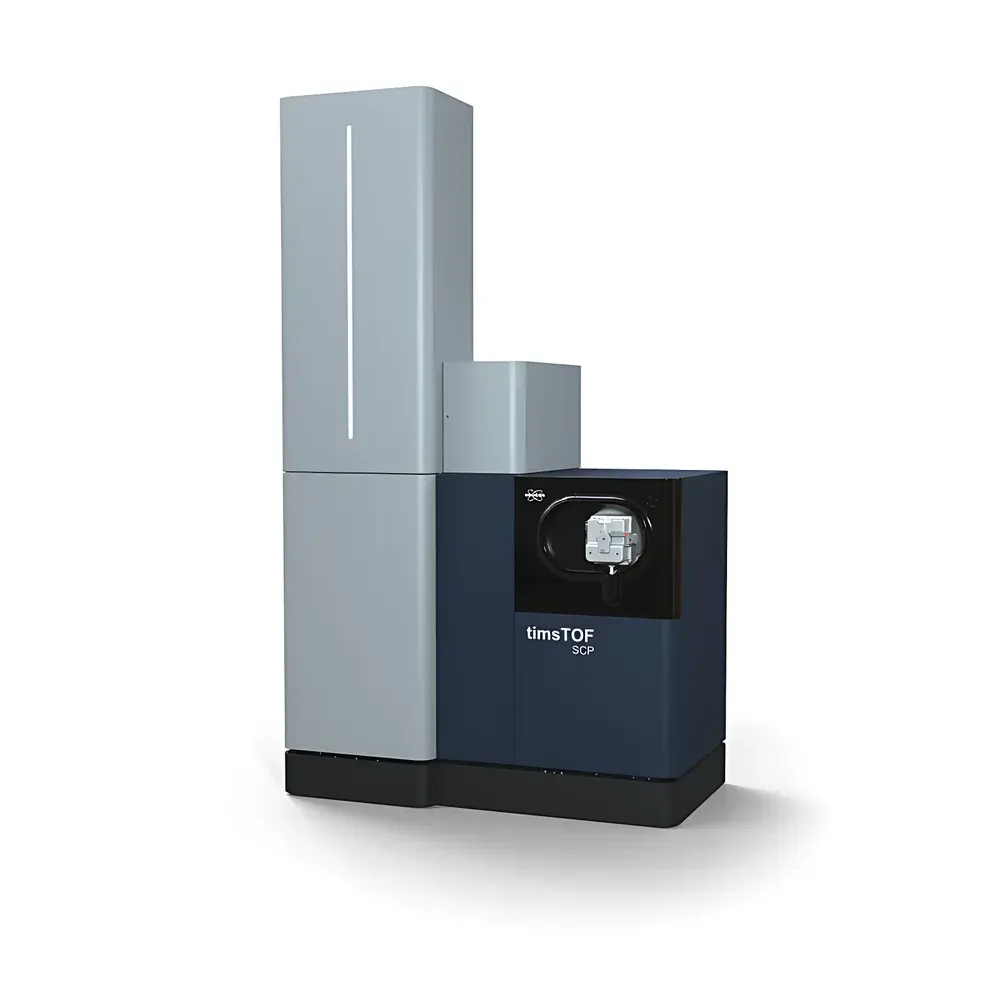
Bruker timsTOF SCP Single-Cell Mass Spectrometry System
| Brand | Bruker |
|---|---|
| Origin | Germany |
| Instrument Type | Trapped Ion Mobility Spectrometry–Time-of-Flight Mass Spectrometer (TIMS-TOF) |
| Model | timsTOF SCP |
| Application Domain | Specialized Single-Cell Proteomics, Immunopeptidomics, PTM Analysis, Epigenoproteomics |
| Ion Source | Optimized Dual-Orthogonal Reflectron Ion Source with 1-mm Transfer Capillary |
| Vacuum Architecture | 8-stage Differential Vacuum System |
| Acquisition Mode | dia-PASEF® (Data-Independent Acquisition Parallel Accumulation–Serial Fragmentation) |
| CCS Capability | Yes, Collision Cross Section–enabled Ion Mobility Separation |
| Scan Speed | >120 Hz MS/MS |
| Software Platform | timsControl, PaSER (Real-time Parallel Database Search Engine), Compatible with MaxQuant/Perseus, PEAKS Studio |
| Data Format | Open .d Format (Bruker) |
| Regulatory Compliance | Supports 21 CFR Part 11–compliant workflows (audit trail, electronic signatures, data integrity controls) |
Overview
The Bruker timsTOF SCP Single-Cell Mass Spectrometry System is a purpose-built high-sensitivity TIMS-TOF platform engineered for unbiased, depth-resolved 4D quantitative proteomics at the single-cell and sub-single-cell level. It integrates trapped ion mobility spectrometry (TIMS) as an orthogonal gas-phase separation dimension prior to quadrupole time-of-flight (QTOF) mass analysis—enabling four-dimensional data acquisition across retention time, m/z, intensity, and collision cross section (CCS). This architecture significantly increases peak capacity, reduces spectral complexity, and improves identification confidence in highly heterogeneous biological samples. Designed specifically for low-input workflows—including native single cells, laser-capture microdissected (LCM) tissue sections, and immunopeptide-enriched fractions—the timsTOF SCP delivers reproducible detection of ~1,500 proteins from ≤250 pg of digested material, and >2,000 proteins from 500 pg, establishing a new benchmark for sensitivity and quantitative fidelity in bottom-up proteomics.
Key Features
- Optimized dual-orthogonal reflectron ion source with 1-mm transfer capillary, delivering up to 5× higher ion transmission efficiency versus prior-generation TIMS platforms
- 8-stage differential vacuum architecture incorporating high-pressure ion funnels and staged pumping, ensuring long-term instrument stability across thousands of consecutive analyses without cleaning cycles
- dia-PASEF® acquisition mode enabling >120 Hz MS/MS scan speed while maintaining high sensitivity and resolution—critical for short-gradient LC separations and minimizing chromatographic dilution effects
- Dual-TIMS design: front TIMS accumulates ions; rear TIMS releases mobility-separated ion packets synchronously with quadrupole isolation and collision-induced dissociation, achieving near-100% ion utilization
- CCS-calibrated ion mobility measurements supporting enhanced compound identification, improved database matching specificity, and reduced false discovery rates (FDRs) in large-scale datasets
- Integrated real-time search engine (PaSER) enabling immediate peptide/protein identification upon LC-MS run completion—eliminating post-acquisition computational bottlenecks
Sample Compatibility & Compliance
The timsTOF SCP supports direct analysis of minute-volume samples including lysates from isolated single cells, LCM-derived FFPE tissue sections, immunopeptide-enriched fractions (e.g., HLA-bound peptides from tumor biopsies), and low-abundance PTM-modified peptides (e.g., phosphopeptides, acetylated histones). Its robust ion transmission and ultra-low detection limits enable reliable quantification across a dynamic range spanning four orders of magnitude. From a regulatory standpoint, the system operates within GLP/GMP-aligned environments when paired with validated methods and timsControl software configured for 21 CFR Part 11 compliance—including full audit trails, user access control, electronic signatures, and immutable raw data archiving. Method development aligns with ISO/IEC 17025 principles for analytical validation, and data output adheres to HUPO-PSI standards (mzML, mzTab) for interoperability with community repositories.
Software & Data Management
Data acquisition and method optimization are managed via timsControl, which allows full customization of dia-PASEF windowing strategies—including variable isolation width, TIMS ramp time, and cycle timing—to match diverse chromatographic conditions (e.g., Evosep One Whisper at 100 nL/min). Raw data are stored in Bruker’s open .d format, ensuring compatibility with third-party processing pipelines. MaxQuant leverages all four dimensions (retention time, m/z, intensity, CCS) for feature detection and quantification, improving peptide-level confidence and PTM localization accuracy. PEAKS Studio implements de novo sequencing optimized for TIMS-TOF fragmentation patterns and mobility-aligned spectra. PaSER provides real-time parallel database searching during acquisition—reducing turnaround time from days to minutes without compromising identification depth or FDR control.
Applications
The timsTOF SCP enables rigorous interrogation of cellular heterogeneity in contexts where bulk proteomics fails: tumor microenvironment (TME) profiling via LCM-isolated melanoma vs. stromal cells; discovery of neoantigens from limited clinical biopsies; temporal mapping of phosphorylation dynamics during immune cell activation; and deep characterization of epigenetic regulators in rare stem cell populations. Its ability to resolve co-eluting isobaric peptides via CCS separation makes it particularly valuable for immunopeptidomics and PTM analysis—where sequence homology and modification site ambiguity pose persistent challenges. The platform has been validated in peer-reviewed studies led by Matthias Mann’s group for single-cell proteome coverage exceeding 1,500 proteins per cell, supporting statistically powered population-level comparisons in disease stratification workflows.
FAQ
What distinguishes timsTOF SCP from conventional Q-TOF or Orbitrap-based single-cell proteomics platforms?
The timsTOF SCP uniquely combines TIMS-based gas-phase separation with dia-PASEF acquisition, delivering superior sensitivity, mobility-resolved CCS values, and >120 Hz MS/MS speed—enabling deeper proteome coverage from sub-nanogram inputs without chromatographic compromise.
Is CCS calibration supported out-of-the-box?
Yes—timsControl includes built-in CCS calibration routines using standard calibrants (e.g., tune mix ions), enabling retention of mobility-derived structural information across all acquired datasets.
Can timsTOF SCP data be reprocessed with updated databases or algorithms?
Absolutely—the open .d format preserves all raw mobility-resolved spectra, allowing retrospective reanalysis with newer search engines, spectral libraries, or machine learning–based annotation tools.
Does the system support targeted workflows such as PRM or SRM?
While optimized for discovery-mode dia-PASEF, the platform supports targeted acquisition modes via timsControl, including mobility-resolved parallel reaction monitoring (mPRM) for high-specificity quantification of low-abundance analytes.
How is instrument maintenance handled for high-throughput single-cell studies?
The dual-orthogonal reflectron design and eight-stage vacuum architecture minimize contamination buildup; routine maintenance intervals exceed 2,000 injections under standard operating conditions, with no requirement for source cleaning between runs.





