
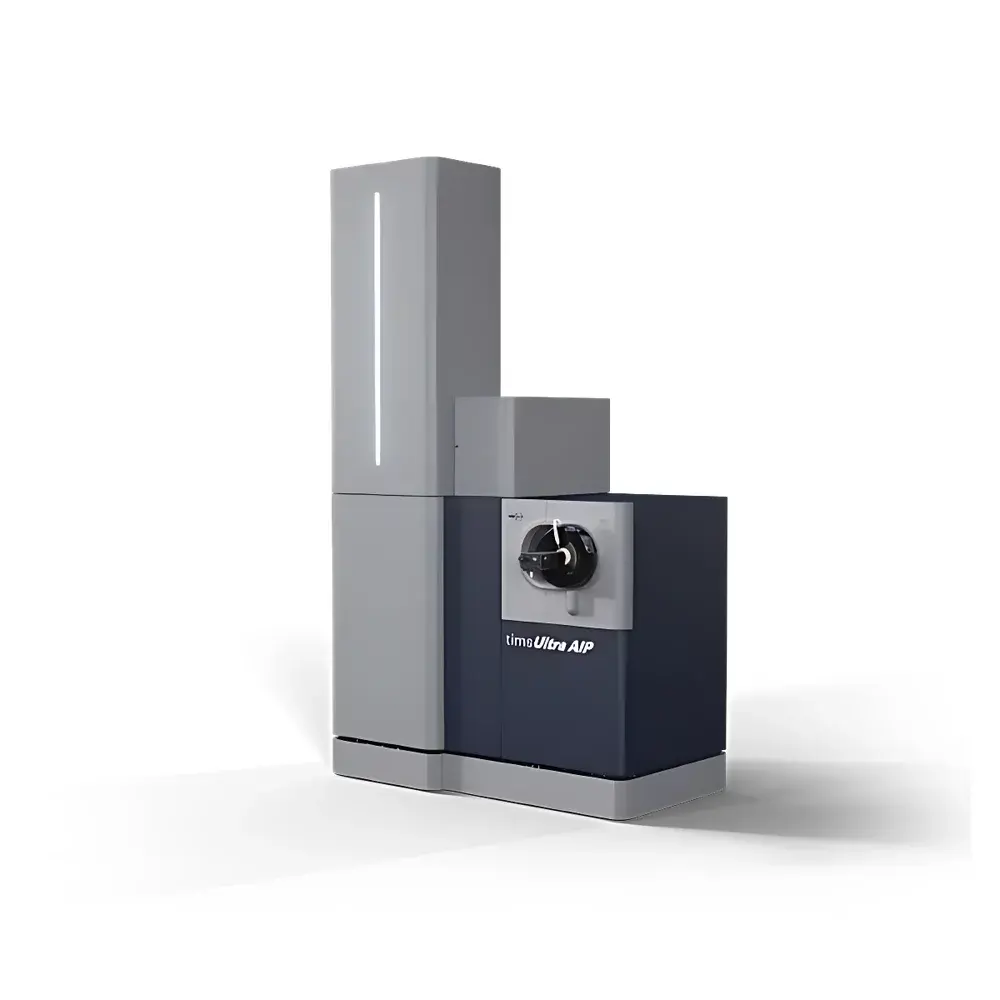
Bruker timsUltra AIP Trapped Ion Mobility Spectrometry Mass Spectrometer
| Brand | Bruker |
|---|---|
| Origin | Germany |
| Manufacturer Type | Authorized Distributor |
| Origin Category | Imported |
| Model | timsUltra AIP |
| Instrument Type | Trapped Ion Mobility Spectrometry (TIMS) Mass Spectrometer |
| Application Scope | Specialized Proteomics & Multi-Omics Platforms |
| Software Integration | TIMS PASEF®, TIMScore™, DIA-NN 4D-Proteomics™, Spectronaut® 20, ICC 2.0 |
Overview
The Bruker timsUltra AIP is a third-generation trapped ion mobility spectrometry (TIMS) mass spectrometer engineered for deep, quantitative proteomics across diverse biological contexts—from single cells to plasma and microbiomes. At its core, the system integrates orthogonal separation dimensions: liquid chromatography (LC), trapped ion mobility (TIMS), tandem MS/MS, and data-independent acquisition (DIA) via Parallel Accumulation–Serial Fragmentation (PASEF®). Unlike conventional drift-tube or traveling-wave IMS platforms, TIMS employs electric field gradients and radiofrequency confinement within a stacked-ring ion guide to accumulate, isolate, and elute ions based on their collision cross-section (CCS) values—enabling high-resolution mobility separation with sub-millisecond temporal control. This architecture delivers true 4D data acquisition (retention time, m/z, CCS, intensity), significantly enhancing peak capacity, specificity, and dynamic range in complex peptide mixtures. The timsUltra AIP represents a foundational upgrade to the timsTOF platform, built specifically for laboratories requiring reproducible, high-throughput, and ultra-sensitive analysis without compromising analytical robustness.
Key Features
- Athena Ion Processor (AIP): A programmable ion transmission module enabling mass-range tuning—focusing transmission on information-dense low-mass regions for bottom-up proteomics or extending coverage into intact proteins and glycopeptides.
- Enhanced Ion Transmission: Optimized CaptiveSpray Ultra 2 (CSI Ultra 2) ion source with aerodynamic gas flow control improves spray stability, ion yield, and long-term LC/MS run reproducibility—validated for >5,000 consecutive injections under routine operation.
- ICC 2.0 (Ion Charge Control 2.0): Dynamically regulates ion accumulation time and charge-state selection to maximize duty cycle efficiency across wide input concentration ranges—from femtomole to nanomole levels—without manual method re-optimization.
- MOMA (Mobility Offset, Mass Alignment): A computational framework that resolves co-eluting isobaric species by leveraging mobility-resolved precursor isolation, improving confidence in peptide identification and reducing false discovery rates in DIA workflows.
- diagonal-PASEF® Support: Unique to TIMS platforms, this acquisition mode enables simultaneous accumulation and mobility-resolved fragmentation of multiple precursors across diagonal regions of the mobility–m/z space—delivering up to 300 Hz sequencing speed with near-100% duty cycle utilization.
Sample Compatibility & Compliance
The timsUltra AIP supports broad sample types—including lysates from single cells, tissue homogenates, plasma, serum, microbial pellets, and environmental metaproteome extracts—with compatibility across standard nano-LC, micro-LC, and high-flow HPLC configurations. When coupled with the VIP-HESI source, it operates stably at flow rates up to 50 µL/min using 50-µm emitters—achieving 3× signal enhancement over conventional ESI sources. All instrument control, data acquisition, and processing comply with GLP/GMP-aligned environments: audit trails, electronic signatures, and secure user access are fully supported through Compass DataAnalysis and associated software suites. Data formats adhere to mzML 1.2 and PSI-MI standards; CCS calibration follows ISO/IEC 17025 traceable protocols using reference calibrants (e.g., Tuning Mix, Agilent ESI-L Low Concentration Standard). Regulatory readiness includes full 21 CFR Part 11 compliance for FDA-submitted studies.
Software & Data Management
Data acquisition is managed via Bruker’s Compass Control software, supporting real-time monitoring, method templating, and automated QC flagging. Raw data undergoes comprehensive processing using TIMScore™—a CCS-aware scoring algorithm that integrates mobility-derived features to boost low-S/N peptide identifications. For DIA quantification, integration with DIA-NN 4D-Proteomics™ and Spectronaut® 20 enables library-free or spectral-library-based workflows with retention time, m/z, and CCS alignment across batches. All software modules support FAIR data principles: metadata tagging, version-controlled processing pipelines, and export to standardized repositories (e.g., PRIDE, MassIVE). Cloud-enabled compute scaling allows distributed processing of large cohort datasets—critical for population-scale plasma proteomics or longitudinal microbiome studies.
Applications
- Single-Cell Proteomics: Achieves identification of >1,500 proteins per mammalian cell with median CVs <18%, enabling statistical inference of cellular heterogeneity in tumor microenvironments and developmental lineages.
- Plasma Proteomics: Delivers sub-10-minute 4D-DIA runs at 50 µL/min flow, quantifying >2,000 proteins across 100+ clinical samples per day—ideal for biomarker discovery in large epidemiological cohorts.
- Metaproteomics: Resolves host–microbiota peptide overlaps in gut luminal samples, identifying >8,000 microbial proteins with <20% technical variability—supporting functional annotation beyond taxonomic profiling.
- Immunopeptidomics: Leverages MOMA-enhanced specificity to distinguish post-translationally modified MHC-I ligands from background peptides, accelerating neoantigen discovery pipelines.
- Glycoproteomics & Intact Protein Analysis: AIP’s extended mass range and optimized collision cell dynamics enable confident CCS measurement of glycoforms and native-like protein complexes.
FAQ
What distinguishes TIMS from other ion mobility technologies?
TIMS provides higher resolving power (>150) and superior CCS reproducibility (<0.5% RSD) compared to drift-tube or TWIMS due to its trapping-and-elution mechanism and intrinsic calibration stability.
Is timsUltra AIP compatible with existing timsTOF methods and databases?
Yes—it maintains full backward compatibility with timsTOF SCP and fleX methods, spectral libraries, and CCS calibration files, enabling seamless transition and method portability.
Can the system be upgraded post-purchase?
All timsTOF platforms—including timsUltra AIP—are designed with modular hardware architecture; firmware, software, and select components (e.g., ion source, collision cell) can be upgraded in situ to incorporate future innovations without full-system replacement.
How does ICC 2.0 improve quantitative precision in label-free workflows?
ICC 2.0 dynamically adjusts accumulation times per charge state and retention window, minimizing ion suppression effects and ensuring consistent precursor sampling across gradient segments—reducing missing values and improving inter-run alignment.
Does the system support regulatory submissions for clinical assay development?
Yes—validated instrument qualification packages, IQ/OQ/PQ documentation templates, and 21 CFR Part 11-compliant software modules are available through Bruker’s GxP Services program.





