
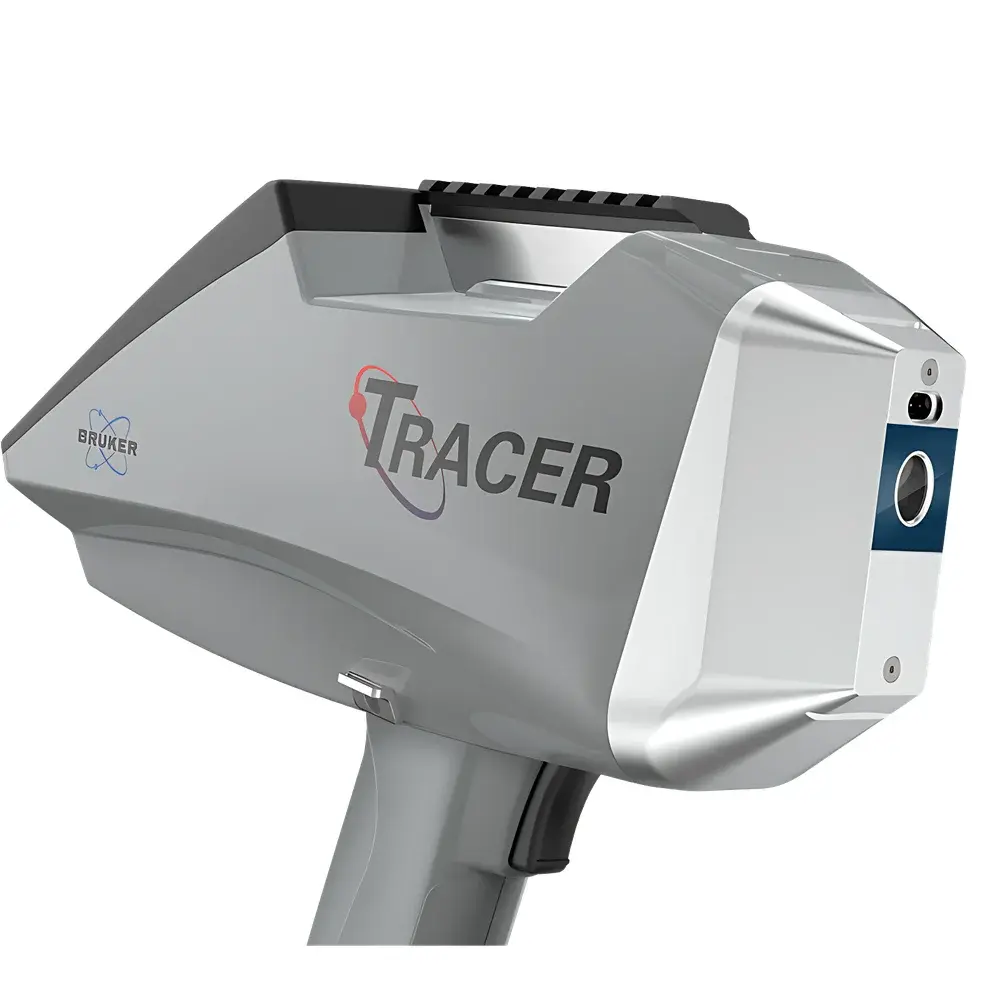
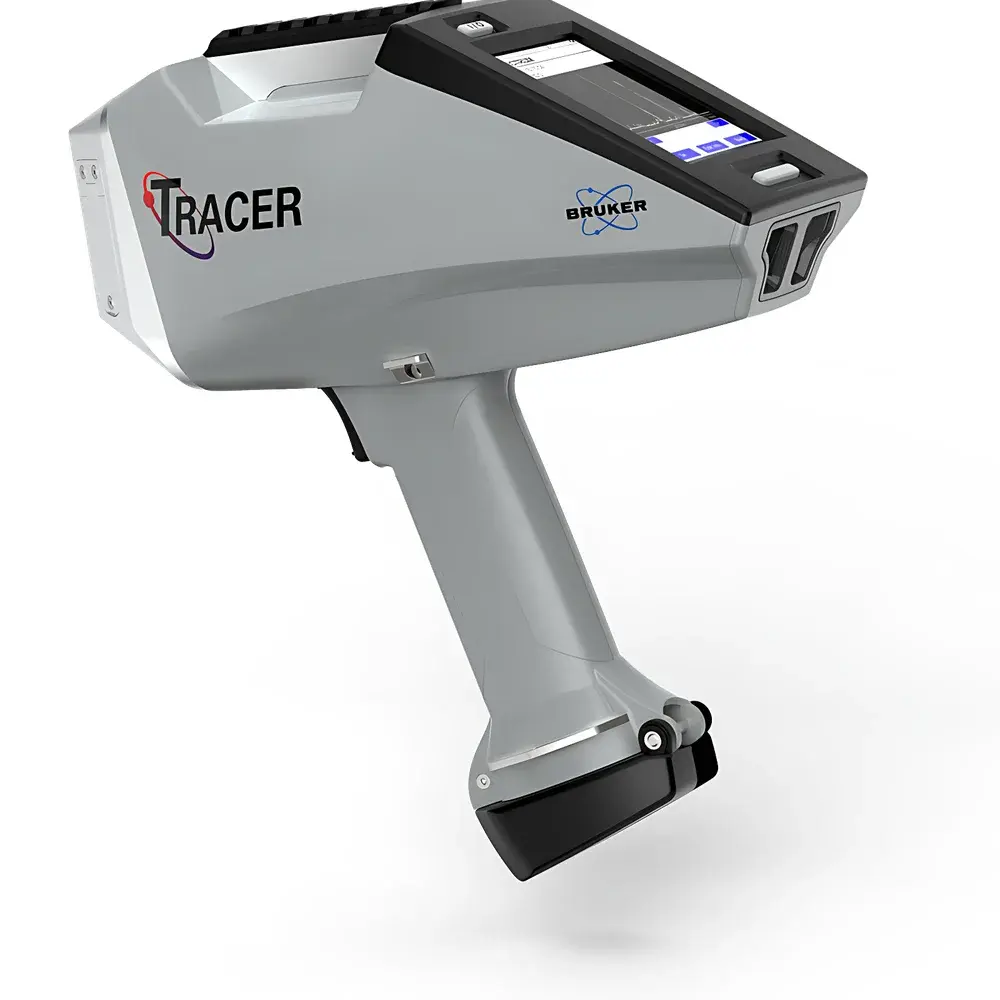
Bruker TRACER 5 Portable Energy Dispersive X-Ray Fluorescence Spectrometer
| Brand | Bruker |
|---|---|
| Origin | USA |
| Manufacturer Type | Authorized Distributor |
| Import Status | Imported |
| Model | TRACER 5 |
| Application | Handheld / Portable |
| Industry Use | General-Purpose |
| Elemental Range | F to U |
| Quantification Range | ppm to wt% |
| Energy Resolution | 145 eV |
Overview
The Bruker TRACER 5 is a high-performance, handheld energy dispersive X-ray fluorescence (EDXRF) spectrometer engineered for field-deployable elemental analysis with laboratory-grade accuracy. It operates on the fundamental principle of X-ray fluorescence: when a sample is irradiated with primary X-rays, atoms emit characteristic secondary (fluorescent) X-rays whose energies are unique to each element. The TRACER 5 detects and resolves these emitted photons using a silicon drift detector (SDD) coupled with an ultra-thin graphene window—replacing conventional 8 µm beryllium windows. This innovation enables enhanced transmission across the full soft X-ray spectrum (0.1–10 keV), significantly improving detection sensitivity for light elements without compromising structural integrity or vacuum compatibility.
Key Features
- Graphene-based detector window (1 µm thickness): Delivers >3× higher Na sensitivity and ~2× higher Mg sensitivity versus legacy Be-window instruments; enables reliable detection of fluorine (F) down to 300 ppm (with He purge) and magnesium down to 100 ppm.
- High-resolution SDD with 145 eV Mn Kα resolution at −20 °C: Ensures precise peak separation for overlapping transitions (e.g., S Kα/Pb Mα, Ca Kβ/Ti Kα), critical for complex matrix quantification.
- Optimized excitation geometry: Dual-mode X-ray tube (Ag anode, 4 W max power) with selectable voltage (up to 50 kV) and current (up to 200 µA), enabling tailored excitation for light- and heavy-element analysis in a single measurement.
- Ruggedized IP54-rated housing with integrated Li-ion battery (8 h typical operation): Certified for field use under ASTM E2927-22 and ISO 18115-2 compliance frameworks.
- Real-time spectral processing engine: On-device deconvolution, background subtraction, and fundamental parameters (FP)-based quantification eliminate dependency on PC-based software during acquisition.
Sample Compatibility & Compliance
The TRACER 5 supports direct analysis of solids (rocks, soils, alloys, ceramics), powders (pressed pellets), and thin films without destructive preparation. Its lightweight form factor (1.5 kg) and ergonomic grip facilitate extended operator use in geotechnical surveys, scrap sorting, environmental site assessments, and cultural heritage diagnostics. Regulatory alignment includes adherence to IEC 62471 (photobiological safety), FDA 21 CFR Part 11 (audit trail and electronic signature readiness when paired with Bruker’s S1 PXRF software), and GLP-compliant reporting templates aligned with ISO/IEC 17025 requirements. For soil science applications, it satisfies method equivalency to EPA Method 6200 and ASTM D7722 for total elemental screening.
Software & Data Management
Data acquisition and interpretation are managed via Bruker’s proprietary S1 PXRF software suite (v4.5+), which supports multi-layer calibration models—including empirical, fundamental parameters (FP), and Monte Carlo hybrid algorithms. All spectra include embedded metadata (GPS coordinates, operator ID, timestamp, instrument settings) compliant with FAIR data principles. Raw spectral files (.spx) are exportable in ASCII and .csv formats for third-party chemometric analysis (e.g., PCA, PLS regression). Audit trails record every parameter change, calibration update, and result modification—fully traceable for regulatory audits per ISO 17025 Clause 7.7 and USP .
Applications
- Geochemical mapping: Quantitative determination of F, Na, Mg, Al, Si, Ca, Fe, and trace metals in carbonate lithologies (e.g., distinguishing calcite, dolomite, and magnesian calcite based on Mg/Ca ratios).
- Environmental soil monitoring: Field screening of total fluorine in agricultural topsoil (0–20 cm depth), supporting spatial interpolation studies with GIS integration and geostatistical modeling (e.g., variogram analysis of F distribution patterns).
- Mineral exploration: Real-time grade control of Ni-Cu-PGE deposits via simultaneous quantification of S, Fe, Cu, Ni, and Pt-group elements in drill core and chip samples.
- Industrial QA/QC: Alloy verification (ASTM E2865), RoHS screening (Pb, Cd, Hg, Cr⁶⁺, Br), and catalyst composition checks in petrochemical refineries.
- Cultural heritage science: Non-invasive pigment identification (e.g., Pb-Sn yellow, As-containing emerald green) and provenance analysis of archaeological ceramics.
FAQ
Does the TRACER 5 require helium purging to detect fluorine?
Yes—optimal F detection (LOD ≈ 300 ppm) requires He gas flow (1–2 L/min) to displace atmospheric nitrogen and oxygen, which absorb low-energy F Kα X-rays (0.677 keV). Optional integrated He purge module available.
Can the TRACER 5 quantify light elements in air without vacuum?
It achieves robust Na and Mg quantification in ambient air using optimized beam filtration and FP modeling; however, F detection remains He-dependent due to its sub-1 keV emission energy.
Is spectral data compatible with third-party multivariate analysis tools?
Yes—exported .csv and ASCII spectra retain full channel-energy calibration and count statistics, enabling direct import into MATLAB, Python (scikit-learn, PyMca), or Unscrambler for advanced chemometrics.
How does the graphene window affect long-term detector stability?
Graphene exhibits superior mechanical resilience and thermal conductivity versus Be, reducing window degradation under repeated thermal cycling and minimizing risk of pinhole formation over >5-year operational life.
What calibration standards are recommended for soil analysis?
NIST SRM 2710a (Montana Soil), GBW07401 (Chinese Loess), and custom matrix-matched pressed pellets prepared from certified reference materials (CRMs) covering F–U concentration ranges relevant to target application matrices.
Related Products






