
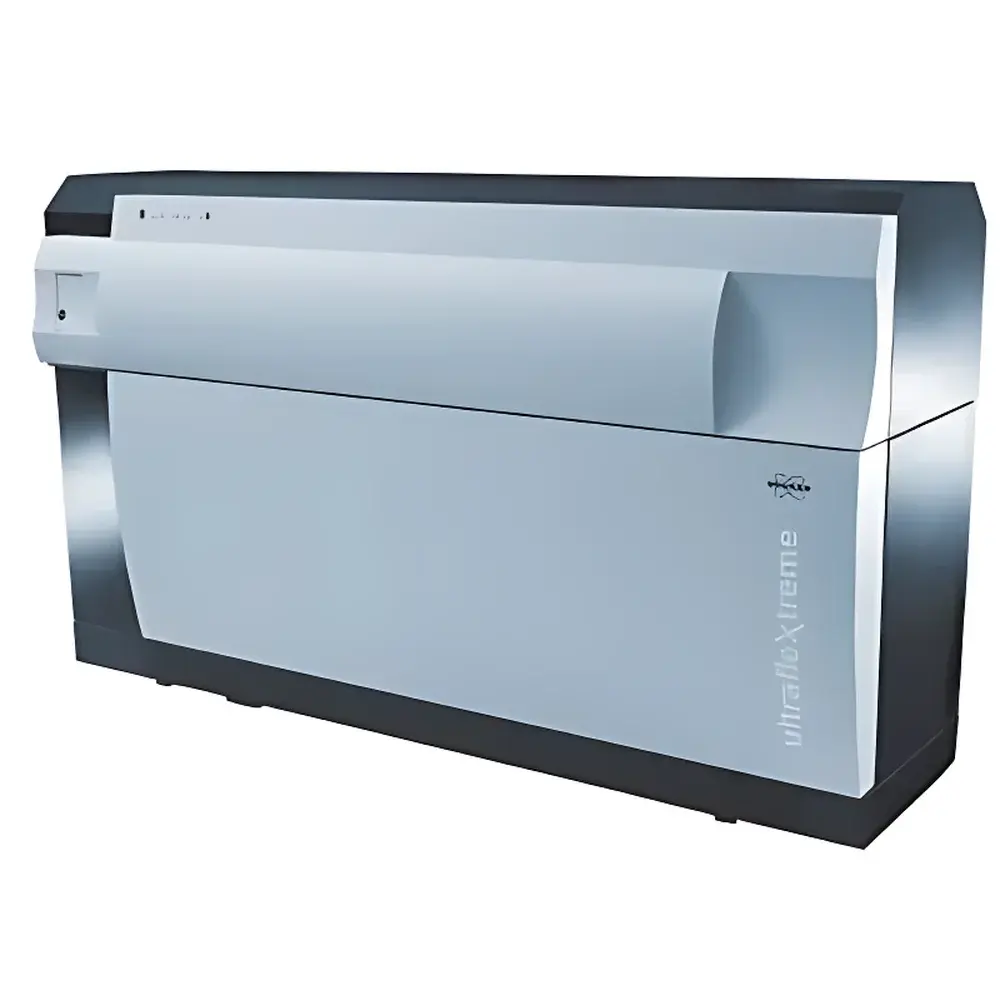
Bruker ultrafleXtreme MALDI-TOF/TOF Mass Spectrometer
| Brand | Bruker |
|---|---|
| Origin | Germany |
| Model | ultrafleXtreme |
| Instrument Type | TOF-TOF |
| Application Domain | Universal |
| Category | Biomass Spectrometer |
| Distribution Status | Authorized Distributor (Imported) |
Overview
The Bruker ultrafleXtreme MALDI-TOF/TOF Mass Spectrometer represents a mature evolution of matrix-assisted laser desorption/ionization time-of-flight tandem mass spectrometry. Engineered for high-performance biomolecular analysis, it employs orthogonal acceleration (oa) TOF geometry in both MS and MS/MS stages, enabling precise mass measurement of intact proteins, peptides, glycans, and post-translationally modified species. Its dual-stage reflectron design delivers enhanced mass resolution and mass accuracy—critical for confident identification and structural characterization in complex biological matrices. Unlike single-stage TOF platforms, the ultrafleXtreme integrates a nitrogen laser-driven MALDI source with a collision-induced dissociation (CID) cell and high-transmission ion optics, supporting robust top-down, bottom-up, and imaging workflows without hardware reconfiguration.
Key Features
- True TOF-TOF architecture with delayed extraction, reflectron mode, and pulsed ion extraction for improved mass resolution and sensitivity
- SmartBeam™ II laser system with automated beam homogenization and adjustable spot size (10–200 µm), optimized for heterogeneous tissue sections and discrete sample spots
- FlexAnalysis™ software suite with integrated peak detection, deisotoping, and calibration algorithms compliant with ISO/IEC 17025 data integrity requirements
- GlycoQuest™ module for automated N-/O-glycan assignment from MALDI-TOF/TOF MS/MS spectra using curated glycan fragmentation libraries and heuristic scoring
- ImageID™ workflow for spatially resolved protein identification directly from MALDI imaging datasets—enabling simultaneous localization and sequence confirmation in FFPE and frozen tissue sections
- Comprehensive top-down capability including intact mass profiling of mAbs, PEGylated proteins, and multi-domain glycoproteins up to 150 kDa
Sample Compatibility & Compliance
The ultrafleXtreme accepts standard MALDI target plates (e.g., AnchorChip™, polished steel, conductive glass) and supports direct analysis of peptides, intact proteins, oligosaccharides, synthetic polymers, and small-molecule pharmaceuticals. It is routinely deployed in GLP-compliant laboratories for biopharmaceutical characterization per ICH Q5E and USP . Data acquisition and processing comply with FDA 21 CFR Part 11 requirements when operated with Bruker’s Compass LIMS integration package, including full audit trail, electronic signatures, and role-based access control. Instrument qualification protocols align with ASTM E2968-14 (Standard Guide for MALDI-TOF Mass Spectrometer Performance Verification).
Software & Data Management
Data acquisition is governed by flexControl™, offering real-time spectral preview, automated internal/external calibration, and adaptive laser power optimization. All raw data are stored in Bruker’s proprietary .fid format, fully compatible with open standards (mzML 1.1.0). Quantitative workflows leverage Progenesis QI for proteomics or GlycoWorkbench for glycan annotation. Export modules support direct submission to UniProt, GlyConnect, and PRIDE repositories. Long-term archiving follows ISO 16363 (Trusted Digital Repository) guidelines via optional Compass ArchiveLink™ integration.
Applications
- High-throughput protein identification from 2D gels and LC-MALDI fractions
- Direct molecular histology via MALDI imaging of formalin-fixed paraffin-embedded (FFPE) tissue sections at 20–50 µm spatial resolution
- Structural characterization of monoclonal antibodies—including disulfide mapping, C-terminal lysine clipping, oxidation, and glycosylation microheterogeneity
- Rapid glycopeptide sequencing using diagnostic oxonium ion filtering and Y/B-ion ladder interpretation in MS/MS mode
- Quality-by-Design (QbD) monitoring of biosimilars through comparative intact mass fingerprinting and subunit analysis
- Discovery of spatially restricted biomarkers in tumor microenvironments using unsupervised clustering of imaging MS datasets
FAQ
What sample preparation methods are recommended for FFPE tissue imaging?
Standard on-tissue enzymatic digestion (e.g., trypsin) following antigen retrieval and delipidation is required; Bruker provides validated protocols for FFPE-compatible matrix application (e.g., CHCA + DHB co-crystallization).
Does the ultrafleXtreme support quantitative analysis of glycoforms?
Yes—via label-free relative quantification using extracted ion chromatograms (XICs) of diagnostic glycan oxonium ions (e.g., m/z 204.087, 366.139) combined with GlycoQuest’s semi-quantitative scoring algorithm.
Can the system be integrated into an automated laboratory workflow?
It supports robotic sample loading via third-party autosamplers (e.g., HTC Pal) and API-level integration with ELN/LIMS systems through Bruker’s OpenAccess SDK.
Is method transfer possible between ultrafleXtreme and other Bruker TOF platforms?
Calibration parameters, peak-picking settings, and GlycoQuest search configurations are fully portable across the ultrafleX series when using identical firmware versions and matrix chemistry.
What maintenance intervals are recommended for routine operation?
Laser optics inspection every 6 months; vacuum system service annually; detector gain recalibration quarterly—per Bruker’s Service Level Agreement (SLA) documentation.
Related Products




