
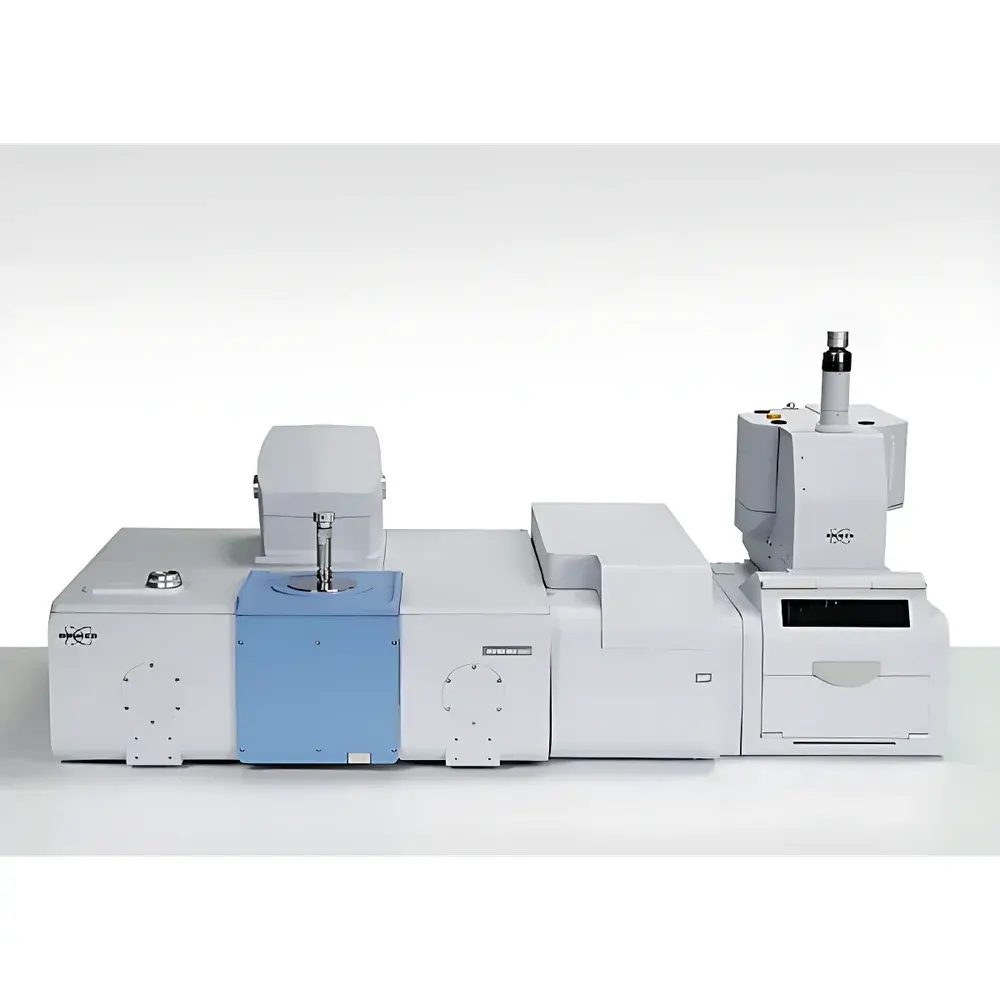
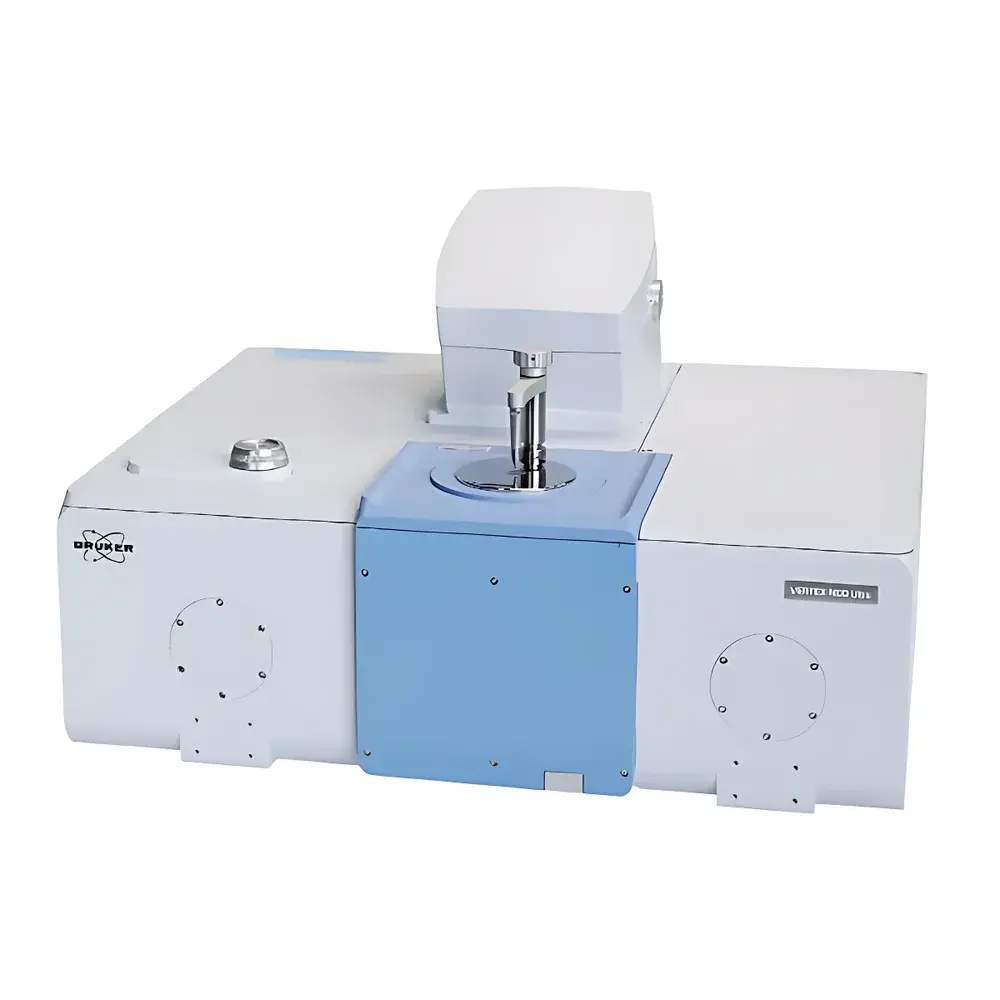
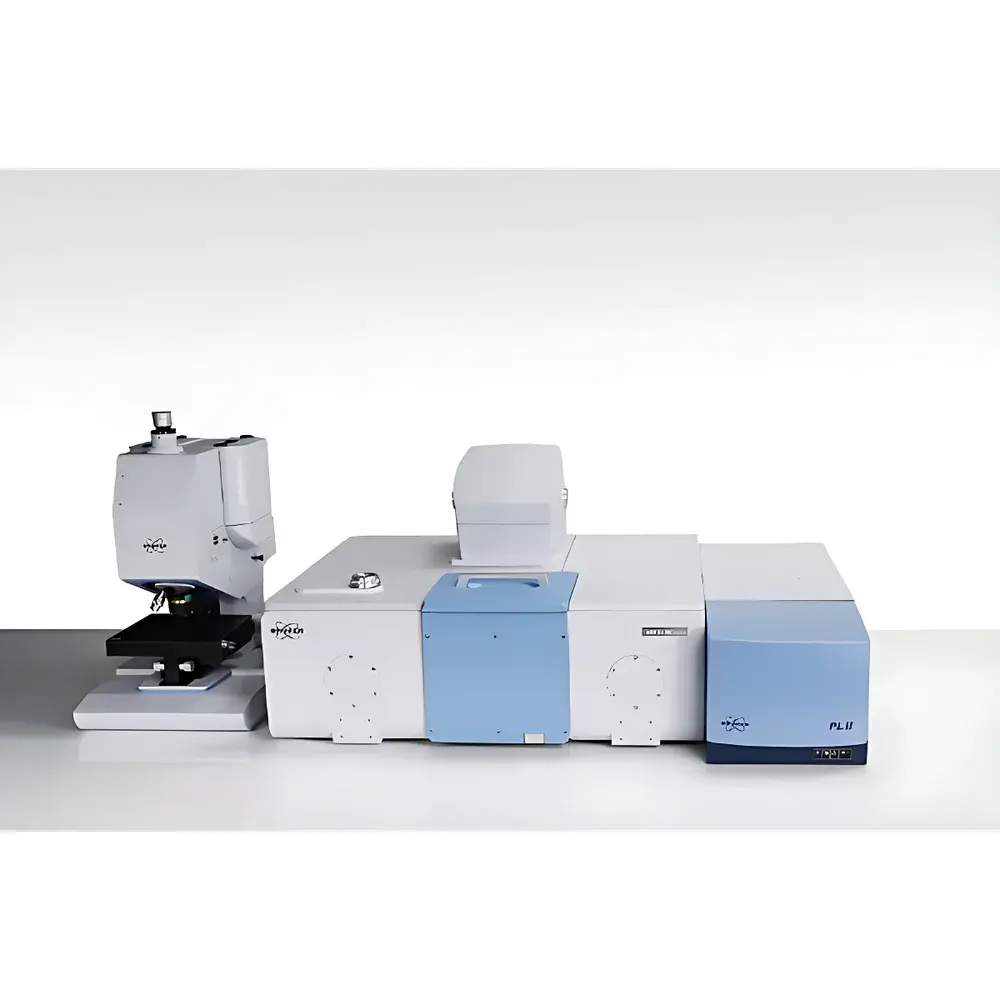
Bruker VERTEX NEO Ultra Vacuum Research-Grade Fourier Transform Infrared Spectrometer
| Brand | Bruker |
|---|---|
| Origin | Germany |
| Instrument Type | Laboratory FTIR |
| Model | VERTEX NEO Ultra |
| Spectral Resolution | 0.04 cm⁻¹ |
| Vacuum Operation | Yes |
| Detector Configuration | Up to 6 integrated detectors (MultiTect) |
| Beam Path Environment | Fully evacuated optical bench |
| ATR Capability | Vacuum-compatible attenuated total reflection module |
| Scan Modes | Step-scan (μs–ns–ms dynamics), Rapid-scan |
| Interferometer | UltraScan with linear air-bearing mirror drive |
| THz Extension | verTera module compatible |
| Optical Path Flexibility | 5 output ports, 4 beam splitters, 4 sources, 6 detectors — all switchable under vacuum |
Overview
The Bruker VERTEX NEO Ultra is a high-performance vacuum research-grade Fourier transform infrared (FTIR) spectrometer engineered for cutting-edge molecular spectroscopy in demanding academic, governmental, and industrial R&D laboratories. Operating under continuous high vacuum (≤10⁻³ mbar), the system eliminates atmospheric absorption—particularly from H₂O and CO₂—enabling unobstructed spectral acquisition across the full mid-IR to far-IR (FIR) range (typically 10,000–10 cm⁻¹), with optional extension into the terahertz (THz) regime via the verTera module. Its core interferometric architecture centers on the UltraScan interferometer, featuring a precision linear air-bearing mirror drive and active alignment control, delivering intrinsic mechanical stability and long-term phase accuracy. This design ensures exceptional wavenumber reproducibility (<0.001 cm⁻¹ per hour) and supports the instrument’s benchmark spectral resolution of 0.04 cm⁻¹—validated per ISO 13777 and ASTM E1421 standards for high-resolution IR instrumentation.
Key Features
- Vacuum-enclosed optical bench: Maintains <10⁻³ mbar pressure across the entire interferometer, beamsplitter, and detector compartments, eliminating vibrational–rotational water vapor and carbon dioxide lines that compromise spectral fidelity in ambient systems.
- UltraScan interferometer with linear air-bearing mirror drive: Delivers sub-nanometer mirror positioning repeatability and zero backlash, enabling stable step-scan acquisition over extended durations without recalibration.
- MultiTect detector architecture: Supports up to six cryogenically or thermoelectrically cooled detectors—including DTGS, MCT (broadband & narrowband), InSb, Si bolometer, and Golay cell—automatically selectable via motorized turret without breaking vacuum.
- verTera THz extension: Integrates seamlessly with the main vacuum chamber, allowing coherent time-domain spectroscopy (THz-TDS) from 0.1–7 THz (3–233 cm⁻¹) with synchronized pump–probe capability.
- Vacuum-compatible attenuated total reflection (ATR): The proprietary vacuum-ATR module maintains optical path vacuum while permitting ambient-pressure sample loading; enables rapid, contamination-free exchange of solids, liquids, and pastes without venting.
- Full vacuum switching matrix: Motorized selection of four sources (globar, silicon carbide, mercury arc, THz emitter), four beamsplitters (KBr, Mylar, polyethylene, quartz), five output ports (transmission, reflection, microscope, THz, external coupling), and six detectors—all actuated remotely under vacuum.
Sample Compatibility & Compliance
The VERTEX NEO Ultra accommodates diverse sample forms—including thin films, powders, single crystals, gases (in sealed cells), liquids, and biological tissues—via interchangeable accessories: high-vacuum transmission cells (path lengths 10 µm–100 mm), specular reflection stages, variable-angle grazing-incidence modules, and fiber-coupled probes. All vacuum interfaces conform to ISO 8573-1 Class 2 purity requirements. The system meets essential regulatory expectations for analytical instrumentation used in GLP and GMP environments: full audit trail logging (per FDA 21 CFR Part 11), electronic signature support, and hardware-level interlock monitoring for vacuum integrity, detector cooldown status, and source alignment. It complies with IEC 61000-6-3 (EMC) and IEC 61010-1 (safety), and its vacuum architecture aligns with ISO/IEC 17025 clause 5.5.2 regarding environmental influence control.
Software & Data Management
OPUS 8.5 software provides unified control of all hardware functions, including real-time vacuum diagnostics, automated component switching, and synchronized multi-modal acquisition (e.g., simultaneous step-scan IR + THz-TDS). Advanced processing modules include phase correction (Mertz), apodization optimization (Happ-Genzel, Blackman-Harris), and multidimensional correlation analysis (2D-COS). Data files are stored in Bruker’s proprietary OPUS format (IEEE 754-compliant binary) with embedded metadata—wavenumber calibration, vacuum pressure logs, detector bias settings, and user-defined experimental parameters. Export options include ASCII, JCAMP-DX, HDF5, and direct integration with MATLAB, Python (via Bruker’s PyOPUS API), and LabVIEW. Audit trails record every hardware command, parameter change, and file export event with timestamp, operator ID, and IP address—fully traceable for regulatory review.
Applications
The VERTEX NEO Ultra serves as a primary platform for fundamental and applied research requiring ultimate spectral fidelity and temporal resolution. Key use cases include: ultra-high-resolution gas-phase rovibrational analysis (e.g., isotopic fine structure in planetary atmospheres); low-frequency lattice mode characterization in quantum materials (phonons, magnons); ultrafast photoinduced dynamics in photocatalysts and perovskites (ns–µs step-scan kinetics); THz-driven carrier dynamics in 2D semiconductors; and label-free secondary structure quantification in membrane proteins under native-like hydration. Its vacuum-ATR configuration is widely adopted for in situ catalysis studies, electrochemical IR (EC-IR) at solid–liquid interfaces, and real-time polymer curing analysis under inert atmosphere.
FAQ
What vacuum level does the VERTEX NEO Ultra maintain, and how is it monitored?
The system sustains ≤10⁻³ mbar across the optical bench using dual-stage turbomolecular pumping, with real-time pressure readout via capacitance manometers and ion gauges integrated into the OPUS interface.
Can standard ATR crystals be used with the vacuum-ATR module?
Yes—the module accepts standard diamond, ZnSe, and Ge ATR elements; sealing is achieved via metal–glass compression gaskets compatible with UHV practices.
Is step-scan functionality available for all detector types?
Step-scan is fully supported for all detectors except room-temperature DTGS; MCT, InSb, and bolometric detectors operate synchronously with the interferometer mirror position encoder.
How is calibration traceability ensured?
Wavenumber calibration uses NIST-traceable polystyrene film (1601 cm⁻¹ band) and laser HeNe reference (1579.8 nm); intensity calibration employs certified blackbody sources per ISO 15312.
Does the system support remote operation in unattended mode?
Yes—OPUS includes scheduler-based automation, email/SMS alerts for vacuum loss or temperature excursions, and secure TLS 1.3–encrypted web access for off-site monitoring and control.




