
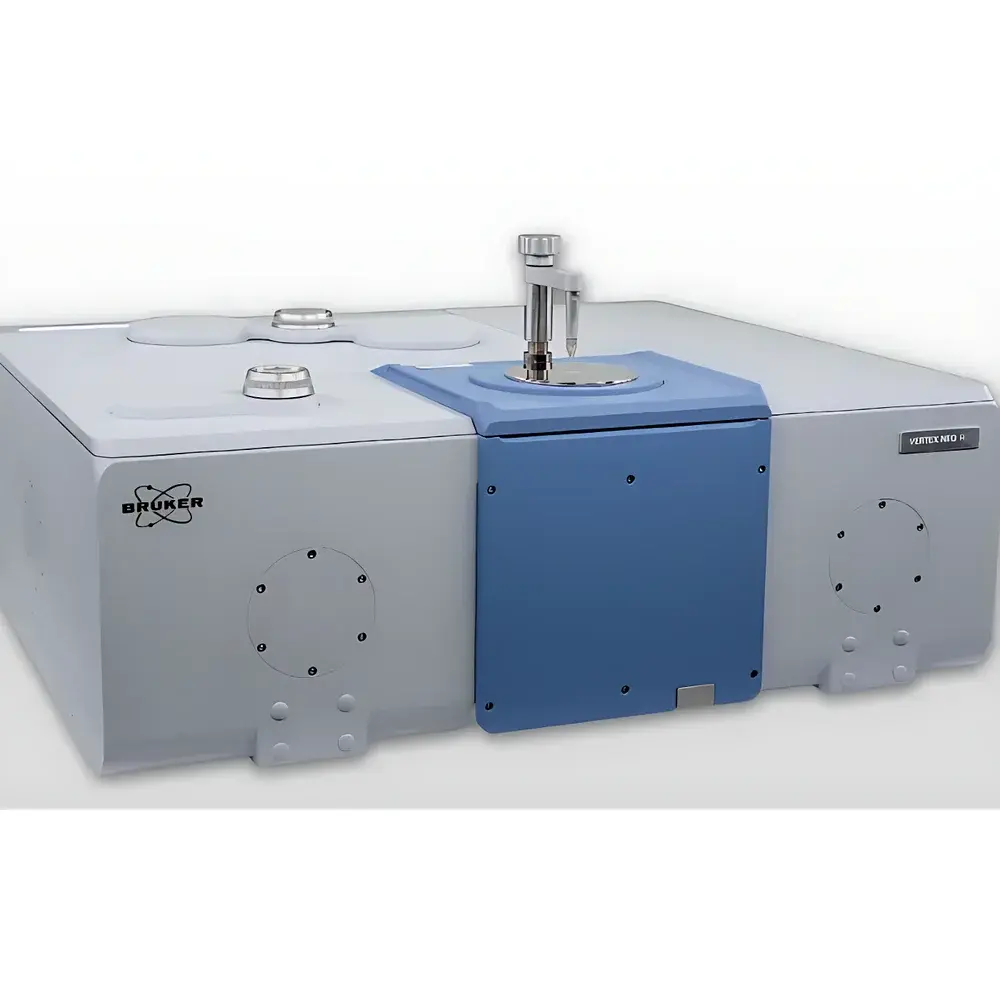
Bruker VERTEX NEO R Vacuum-Grade Research Fourier Transform Infrared (FTIR) Spectrometer
| Brand | Bruker |
|---|---|
| Origin | Germany |
| Model | VERTEX NEO R |
| Instrument Type | Laboratory FTIR Spectrometer |
| Vacuum Capability | Full Vacuum Optical Bench |
| Interferometer | RockSolid™ Permanent Alignment |
| Detector Technology | MultiTect™ Multi-Element Detector Platform |
| Instrument Class | Research-Grade FTIR |
| Compliance | Designed for ASTM E1421, ISO 17025-compliant laboratories, GLP/GMP-ready configuration options |
| Software | OPUS 8.5 with FDA 21 CFR Part 11–compliant audit trail and electronic signature modules |
Overview
The Bruker VERTEX NEO R is a vacuum-grade, research-class Fourier Transform Infrared (FTIR) spectrometer engineered for maximum spectral fidelity, long-term measurement stability, and experimental flexibility in demanding scientific environments. Unlike conventional purged or dry-air FTIR systems, the VERTEX NEO R integrates a fully evacuated optical bench—eliminating atmospheric absorption bands (e.g., CO₂ at 2350 cm⁻¹ and H₂O vapor across 1400–1900 cm⁻¹ and 3500–4000 cm⁻¹) to deliver unobstructed spectral coverage from the far-IR (down to 50 cm⁻¹) through the mid-IR and into the near-IR (up to 25,000 cm⁻¹). Its core measurement principle relies on Michelson interferometry with laser-controlled path difference scanning, enabling high-resolution (60,000:1 at 4 cm⁻¹ resolution, 1 min scan), and phase-corrected interferograms essential for quantitative chemometrics and time-resolved studies.
Key Features
- Full Vacuum Optical Bench: Maintains <10⁻² mbar pressure across the entire interferometer and beam path—enabling artifact-free spectroscopy in regions previously inaccessible without cryogenic pumping.
- RockSolid™ Interferometer: Monolithic, dynamically aligned design with permanent alignment stability; no moving mirrors or realignment required over instrument lifetime—ensuring reproducibility across years of operation and multi-user lab environments.
- MultiTect™ Detector Platform: Supports simultaneous or sequential mounting of up to four independent detectors—including DTGS, MCT (single- or dual-element), InSb, and bolometric far-IR options—without optical recalibration.
- Modular Beam Path Architecture: Standard 100 mm optical diameter accommodates custom accessories (e.g., in situ reaction cells, high-pressure ATR stages, synchrotron beamlines) with minimal vignetting or alignment drift.
- Vacuum-Compatible ATR Integration: Patented non-invasive vacuum-sealed ATR interface enables direct solid/liquid sampling under full vacuum—preserving sample integrity while eliminating purge gas interference in surface-sensitive measurements.
- Thermally Stable Optomechanics: All optical mounts and baseplates are fabricated from low-expansion Zerodur® and stabilized via active temperature control (±0.01 °C), minimizing thermal drift during extended kinetic or temperature-ramped experiments.
Sample Compatibility & Compliance
The VERTEX NEO R supports broad sample modalities—including transmission, reflection-absorption (RAIRS), photoacoustic (PAS), diffuse reflectance (DRIFTS), and grazing-angle ATR—under ambient, controlled atmosphere, or full vacuum conditions. It is routinely deployed in ISO/IEC 17025-accredited analytical laboratories for materials characterization, catalysis research, pharmaceutical polymorph screening, and semiconductor thin-film analysis. The system complies with key regulatory frameworks: software modules support 21 CFR Part 11 compliance (electronic signatures, audit trails, user access controls); hardware design meets IEC 61010-1 safety standards; and optical performance adheres to ASTM E1421 guidelines for FTIR instrument qualification and verification.
Software & Data Management
Controlled by OPUS 8.5—a modular, scriptable spectroscopy platform—the VERTEX NEO R provides integrated acquisition, processing, and reporting workflows. Advanced features include real-time interferogram diagnostics, automated vacuum status monitoring, detector saturation alerts, and spectral library search with hierarchical clustering (e.g., for polymer identification or contaminant profiling). Data files follow HDF5-based OPUS format, ensuring long-term archival integrity and interoperability with third-party chemometric tools (e.g., MATLAB, Python scikit-learn, Unscrambler X). For regulated environments, optional GxP packages provide full audit trail logging, role-based permissions, and electronic signature enforcement per FDA and EMA requirements.
Applications
- High-resolution vibrational spectroscopy of metastable intermediates in heterogeneous catalysis under operando vacuum conditions
- Quantitative analysis of trace moisture and residual solvents in lyophilized biopharmaceuticals (per USP & Ph. Eur. monographs)
- Far-IR fingerprinting of lattice modes in MOFs and 2D materials
- In situ monitoring of thin-film growth dynamics in UHV-CVD and ALD reactors
- Time-resolved FTIR of photoinduced electron transfer processes using step-scan mode (down to 10 ns time resolution)
- Correlative IR-microscopy with synchrotron IR beamlines (via standard SR-compatible beam coupling optics)
FAQ
What vacuum level does the VERTEX NEO R maintain, and how is it monitored?
The system achieves and sustains <1×10⁻² mbar across the optical bench using a hybrid turbomolecular/diaphragm pump configuration; real-time pressure is continuously logged in OPUS and triggers automatic shutdown if thresholds are exceeded.
Can the VERTEX NEO R be upgraded with time-resolved capabilities?
Yes—optional step-scan electronics and synchronized external trigger I/O enable microsecond- to nanosecond-resolved kinetics, compatible with laser pump-probe and rapid-scan modulation schemes.
Is the RockSolid™ interferometer field-serviceable?
No—its monolithic construction eliminates field alignment; service is limited to module-level replacement under Bruker’s certified calibration protocol, ensuring metrological continuity.
Does the system support automated sample changers under vacuum?
Yes—third-party vacuum-compatible autosamplers (e.g., Harrick Auto-ATR, Specac HTS-XT) integrate via standardized RS-232/USB protocols and are fully scriptable in OPUS.
How is detector selection managed during acquisition?
MultiTect™ hardware enables seamless switching between detectors within a single experiment sequence; OPUS automatically applies correct responsivity, noise, and linearity corrections based on active detector ID.




