
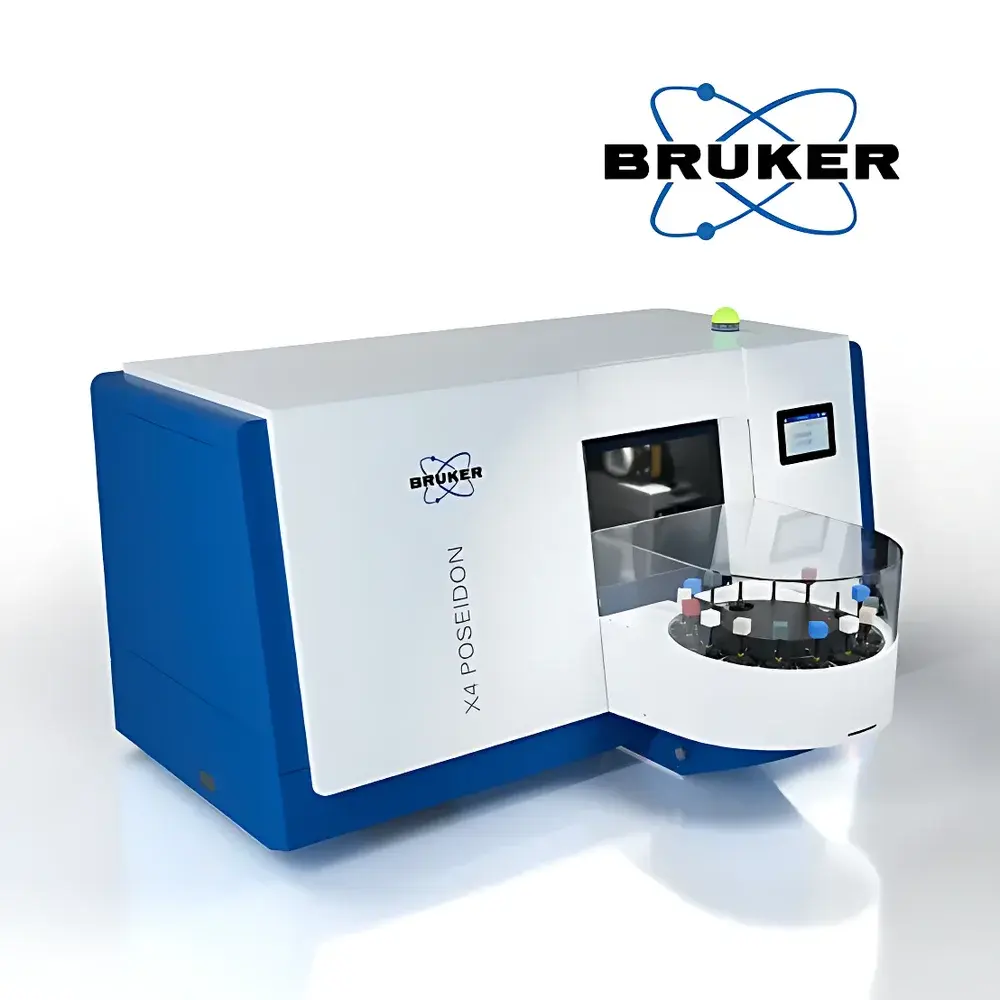
Bruker X4 POSEIDON Modular X-ray Microtomography System
| Brand | Bruker |
|---|---|
| Origin | Belgium |
| Manufacturer Type | Authorized Distributor |
| Origin Category | Imported |
| Model | X4 POSEIDON |
| Detector Type | High-Resolution sCMOS Semiconductor Sensor |
| Scanning Mode | Translation-Rotation (TR) |
| Spatial Resolution | ≤2 µm (JIMA-verified) |
| System Architecture | Modular, Field-Upgradable |
Overview
The Bruker X4 POSEIDON is a high-performance, modular X-ray microtomography (XRM) system engineered for non-destructive 3D and 4D characterization of internal microstructures at sub-micron to nanoscale spatial resolution. Operating on the principle of cone-beam X-ray computed tomography (CBCT), it reconstructs volumetric datasets from hundreds to thousands of projection images acquired as the sample undergoes precise translational and rotational motion (TR scanning geometry). Designed for both laboratory-based research and industrial quality assurance, the system delivers quantitative morphological, dimensional, and density-based analysis without physical sectioning—enabling longitudinal studies of structural evolution under in situ or operando conditions including thermal cycling, mechanical loading, and fluid flow.
Key Features
- Modular Hardware Architecture: Supports interchangeable X-ray sources (transmission and reflection target configurations), dual-detector bays (flat-panel detector for rapid large-field-of-view acquisition; high-dynamic-range sCMOS sensor for <2 µm isotropic voxel resolution), and plug-and-play peripheral modules including 15-position automated sample changers and motorized in situ stages.
- GEM Plus Geometric Magnification Enhancement: An optimized optical path design that increases effective magnification while preserving flux efficiency—delivering up to 1.5× higher spatial resolution and 4× faster scan throughput compared to conventional geometric magnification (GEM) implementations.
- True 4D Imaging Capability: Enables time-resolved micro-CT with sub-minute temporal resolution, supporting dynamic process monitoring such as phase transformation, crack propagation, pore network evolution, and electrochemical degradation in batteries or fuel cells.
- Field-Upgradeable Design: No system downtime required for hardware expansion—second detectors, additional motion axes, or environmental chambers can be integrated on-site without factory return or firmware revalidation.
- Robust Mechanical Stability: Precision granite base, air-bearing rotation stage, and active vibration isolation ensure measurement repeatability and long-term geometric fidelity critical for metrology-grade applications.
Sample Compatibility & Compliance
The X4 POSEIDON accommodates samples ranging from <1 mm to 300 mm in diameter and up to 500 mm in height, with maximum mass capacity of 5 kg. Compatible with standard NIST-traceable phantoms for resolution and contrast verification (e.g., ISO/IEC 17025-compliant calibration protocols). Meets electromagnetic compatibility (EMC) requirements per EN 61326-1 and radiation safety standards per IEC 61000-6-3 and local regulatory frameworks (e.g., FDA 21 CFR Part 1020.40 for X-ray equipment). Software audit trails and user-access controls support GLP/GMP environments and compliance with ISO 9001, ISO/IEC 17025, and ASTM E1441 (Standard Practice for Computed Tomography).
Software & Data Management
The bundled 3DxSUITE software suite provides an integrated workflow—from acquisition protocol definition and real-time reconstruction (GPU-accelerated FDK and iterative algorithms) to quantitative analysis (porosity, particle size distribution, fiber orientation, wall thickness mapping) and export to industry-standard formats (DICOM, TIFF stack, STL, VTK). Its graphical interface supports customizable dashboards, parameter auto-optimization based on sample attenuation, and full scriptability via Python API. All processing steps are logged with timestamped metadata, enabling full traceability and alignment with FDA 21 CFR Part 11 requirements for electronic records and signatures. Raw projection data and reconstructed volumes are stored in vendor-neutral HDF5 containers with embedded calibration metadata.
Applications
- Failure analysis and defect detection in semiconductor packaging, solder joints, and advanced interconnects
- Quantitative pore network modeling and permeability simulation in geological core samples and catalyst substrates
- In situ mechanical testing of additively manufactured metals and composites under tensile/compressive load
- Microstructural evolution studies in solid-state batteries during charge/discharge cycles
- Morphometric analysis of biomedical scaffolds, bone implants, and soft-tissue mimics
- Non-destructive inspection of aerospace components (turbine blades, honeycomb structures) for voids, delamination, and foreign object debris
FAQ
What is the minimum achievable voxel size under standard operating conditions?
The system achieves ≤2 µm isotropic voxel resolution when using the sCMOS detector with optimal source-to-object and object-to-detector distances, validated per JIMA resolution test patterns (ISO/IEC 16063-31).
Does the system support automated batch scanning of multiple samples?
Yes—the optional 15-position robotic sample changer enables unattended sequential scanning with programmable exposure and geometry presets.
Can the software generate reports compliant with ISO/IEC 17025 documentation requirements?
Yes—3DxSUITE includes configurable report templates with embedded calibration certificates, uncertainty estimates, and digital signatures aligned with ISO/IEC 17025 Clause 7.8.
Is remote operation and monitoring supported?
Full remote access is enabled via secure TLS-encrypted VNC or web-based dashboard interfaces, allowing real-time supervision and intervention from off-site locations.
How is radiation safety managed during operation?
The system incorporates interlocked lead-shielded enclosure, dose-rate monitoring sensors, and automatic beam shutdown triggered by door opening or motion detection—fully compliant with ALARA principles and national radiation protection regulations.



