
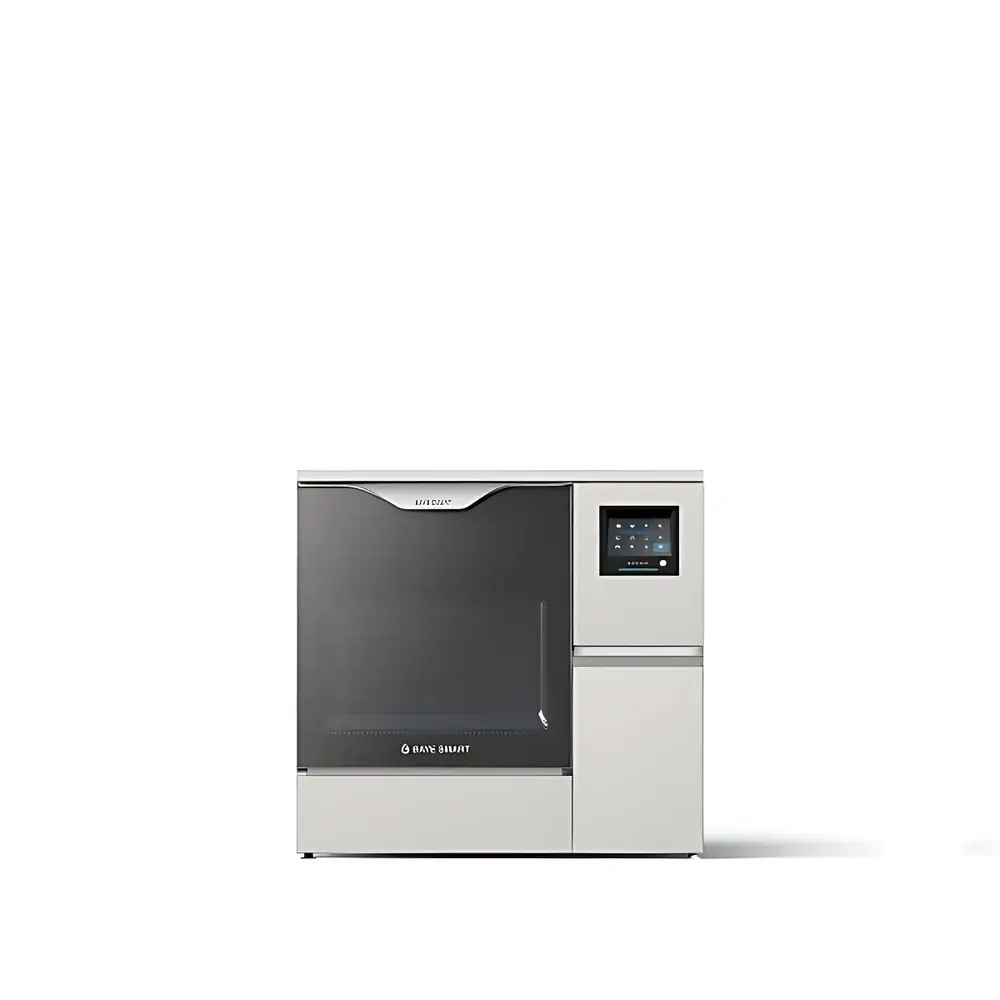
BS280CD Automatic Laboratory Bottle Washer
| Brand | BAYE SMART |
|---|---|
| Origin | Shanghai, China |
| Model | BS280CD |
| External Dimensions (L×W×D) | 900 × 710 × 845 mm |
| Cabinet Material | Black Explosion-Proof Glass + Brushed Stainless Steel |
| Chamber Material | SUS 316L Mirror-Finish Stainless Steel |
| Chamber Welding | Laser-Welded |
| Surface Roughness | Ra = 0.2 µm (large-area), Ra = 0.4 µm (small-area) |
| Capacity | 280 × 25 mL Volumetric Flasks per Cycle |
| Basket Configuration | 2 Adjustable Layers, Modular & Interchangeable |
| Loading Flexibility | Optimized for Partial Loads |
| Cleaning Method | High-Pressure Spray Wash |
| Control System | Microprocessor-Based with Intelligent Touchscreen Interface |
| Circulation Pump | Variable-Speed, Max Flow Rate 600 L/min |
| Reagent Storage Compartment | Integrated |
| Conductivity Monitoring | Real-Time Onboard Sensor |
| Full Process Data Logging | Timestamped, Audit-Trail Enabled |
| IoT Connectivity | Ethernet/Wi-Fi Enabled for Remote Monitoring & Diagnostics |
| Compliance | EN ISO 15883-1:2009, EN ISO 15883-2:2009, FDA 21 CFR Part 11, Chinese Pharmaceutical GMP Validation Guidelines (2003), China Pharmaceutical Industry EHS Guidelines (2020) |
Overview
The BS280CD Automatic Laboratory Bottle Washer is an engineered solution for high-integrity cleaning of precision glassware—particularly volumetric flasks, burettes, pipettes, and other calibration-grade labware—in regulated pharmaceutical, biotechnology, and contract research environments. Built on a validated spray-wash principle, it delivers reproducible, residue-free cleaning through precisely controlled thermal, mechanical, and chemical parameters. Unlike batch ultrasonic or manual rinsing systems, the BS280CD employs a dual-layer, fully configurable basket system coupled with a variable-speed, high-capacity circulation pump (up to 600 L/min) to ensure uniform impingement force across all load configurations—including partial loads—without compromising cleaning efficacy. Its chamber, constructed from laser-welded SUS 316L stainless steel with mirror-finish surface finish (Ra ≤ 0.2 µm over large areas), minimizes microbial adhesion and facilitates visual inspection and routine verification per ISO 15883-1 requirements.
Key Features
- Laser-welded SUS 316L chamber with ultra-smooth mirror finish (Ra = 0.2 µm on flat surfaces; Ra = 0.4 µm in corners/joints) to support cleaning validation and reduce biofilm risk
- Modular two-tier basket system with tool-free reconfiguration—enables simultaneous processing of heterogeneous glassware types (e.g., 25 mL flasks, 100 mL cylinders, narrow-neck vials)
- Intelligent microprocessor control with 7-inch capacitive touchscreen interface, supporting multi-language UI and user-defined cycle programming
- Real-time conductivity monitoring integrated into the final rinse loop, enabling automatic endpoint detection for water purity compliance (USP , EP 2.2.42)
- Onboard data logger capturing timestamped records of temperature, pressure, conductivity, cycle phase duration, and pump speed—fully compliant with FDA 21 CFR Part 11 audit-trail requirements
- Built-in reagent storage cabinet with segregated compartments for alkaline, acidic, and neutral detergents—designed for leak-proof containment and controlled dispensing
- IoT-enabled architecture supporting secure Ethernet and Wi-Fi connectivity for remote diagnostics, firmware updates, and integration with LIMS or MES platforms
Sample Compatibility & Compliance
The BS280CD accommodates standard laboratory glassware up to 300 mm in height and 120 mm in diameter, with optimized fixtures for 25 mL volumetric flasks (280 units per cycle). It supports cleaning protocols aligned with EN ISO 15883-1:2009 (general requirements) and EN ISO 15883-2:2009 (performance requirements for washer-disinfectors), including thermometric mapping, chemical concentration verification, and residual protein/ATP testing. All electronic records meet ALCOA+ principles (Attributable, Legible, Contemporaneous, Original, Accurate, Complete, Consistent, Enduring, Available) and are exportable in CSV/PDF formats for regulatory submission. The system is pre-validated for use in GMP environments per Chinese Pharmaceutical GMP Validation Guidelines (2003) and conforms to environmental, health, and safety benchmarks outlined in the China Pharmaceutical Industry EHS Guidelines (2020).
Software & Data Management
The embedded control software provides role-based access (Operator, Supervisor, Administrator) with password protection and session timeout. Each cleaning cycle generates a unique digital signature, linking operator ID, timestamp, parameter set, and real-time sensor logs. Audit trails are immutable and stored locally for ≥12 months; optional cloud backup is available via encrypted TLS 1.2 transmission. Data export supports direct integration with electronic lab notebooks (ELN) and quality management systems (QMS). Software updates follow a documented change control process and include version-controlled release notes traceable to ICH Q9/Q10 frameworks.
Applications
- Pre-validation cleaning of glassware prior to analytical method transfer (e.g., HPLC, GC, titration)
- Routine decontamination of volumetric equipment in QC laboratories operating under USP, EP, or ChP monographs
- Residue removal from API synthesis vessels and sampling tools in pilot-scale manufacturing suites
- Supporting cleaning validation studies (e.g., worst-case load definition, swab recovery assessment, rinse water analysis)
- Automated preparation of sterile-grade glassware for microbiological assay media preparation
FAQ
Does the BS280CD support IQ/OQ/PQ documentation packages?
Yes—comprehensive qualification templates (including test protocols, acceptance criteria, and raw data worksheets) are provided as part of the standard delivery package.
Can the system be integrated into an existing facility automation network?
Yes—it features Modbus TCP and OPC UA interfaces for bidirectional communication with SCADA, BMS, or central process control systems.
Is detergent compatibility verified for specific formulations?
BAYE SMART provides a list of validated detergents (including Alconox®-type alkaline cleaners and citric acid-based neutralizers); custom validation support is available upon request.
What maintenance intervals are recommended for the circulation pump and conductivity sensor?
Pump inspection is scheduled every 500 cycles or quarterly; conductivity sensor calibration is required before each shift using NIST-traceable KCl standards.
How is cybersecurity addressed in the IoT functionality?
All remote connections employ certificate-based authentication, TLS 1.2 encryption, and configurable firewall rules; no default credentials are shipped with the device.



