
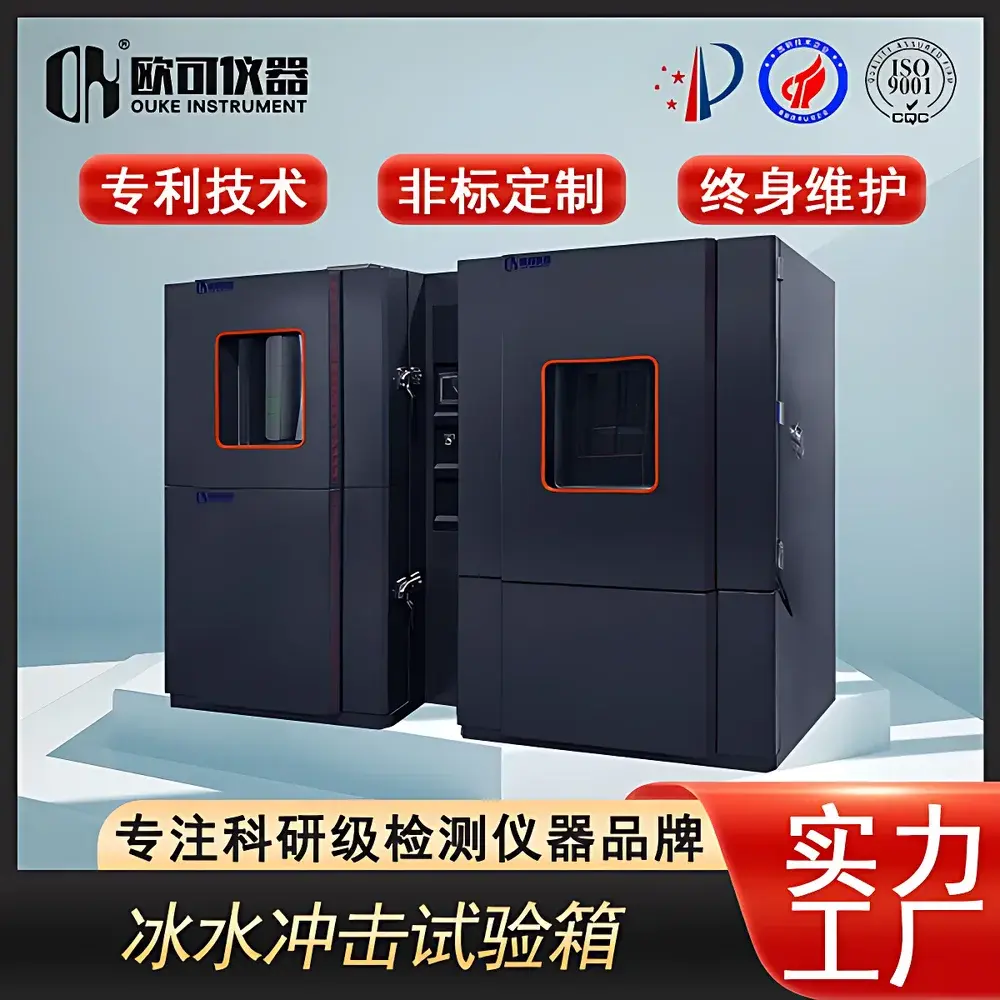
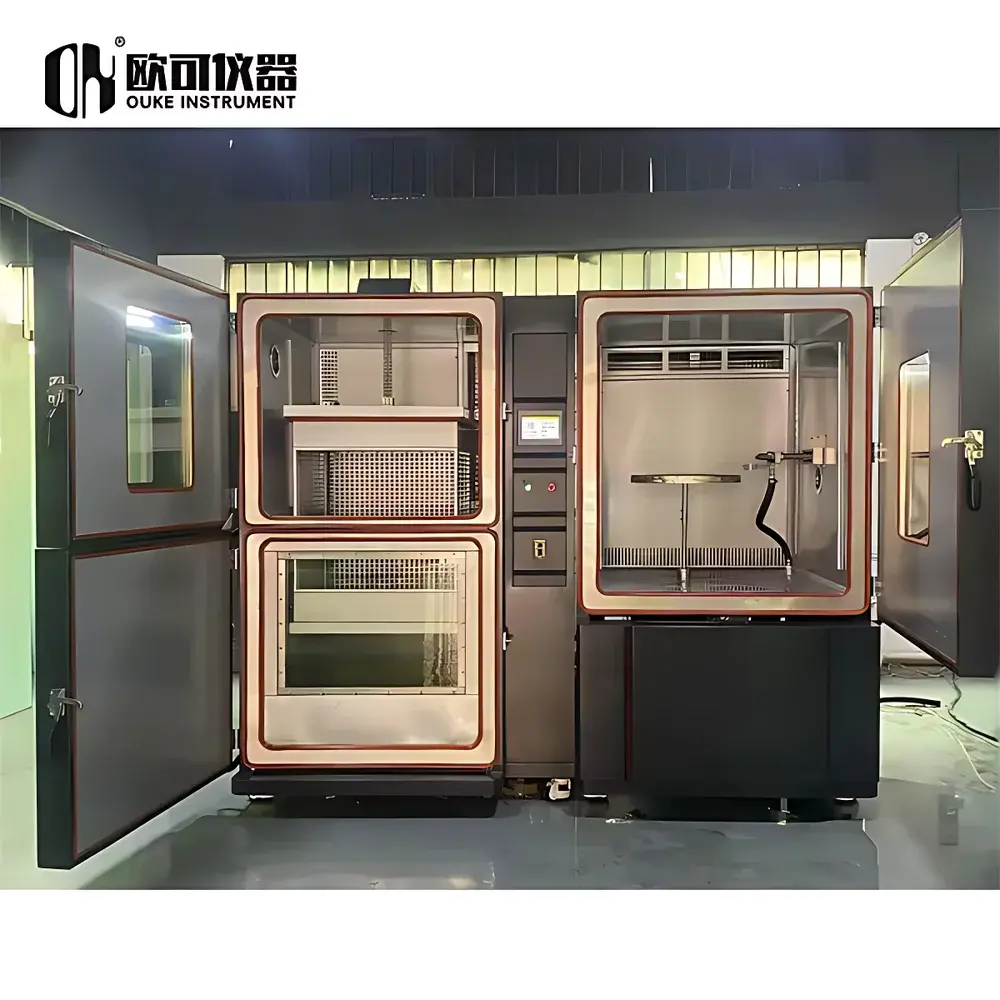
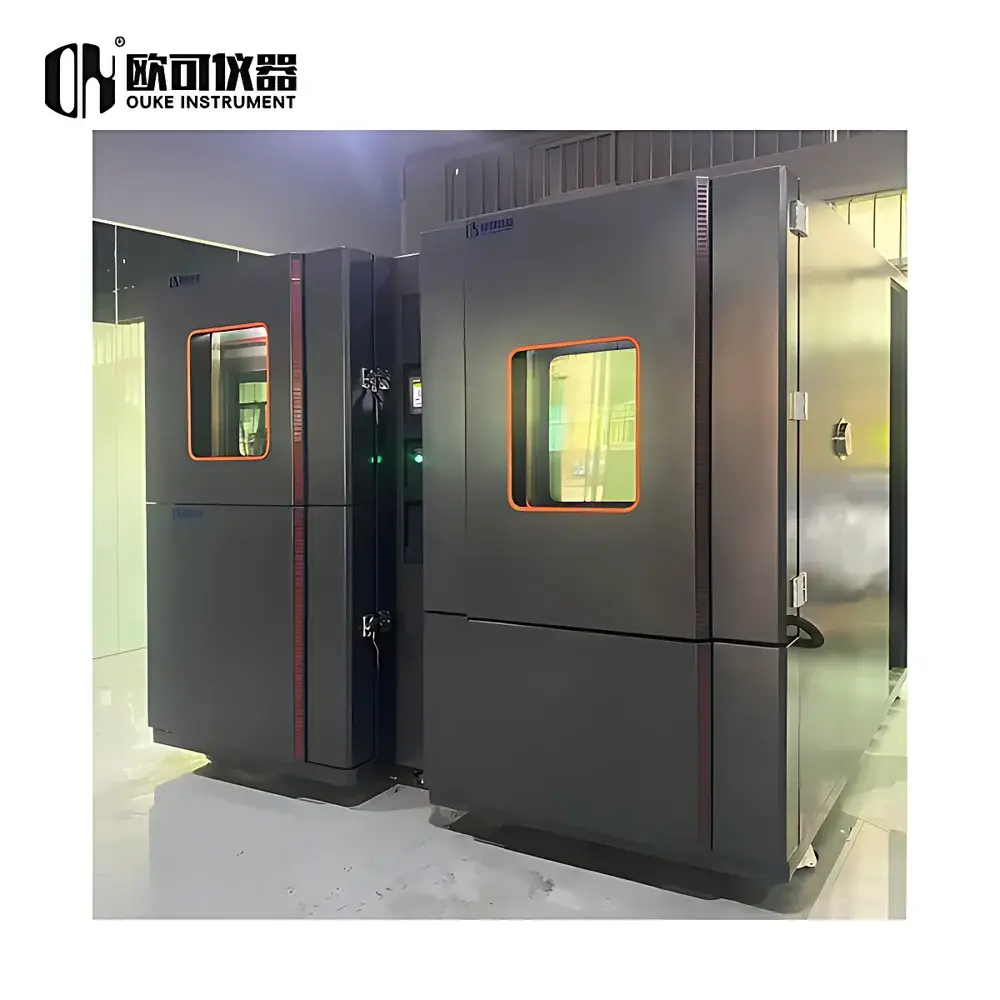
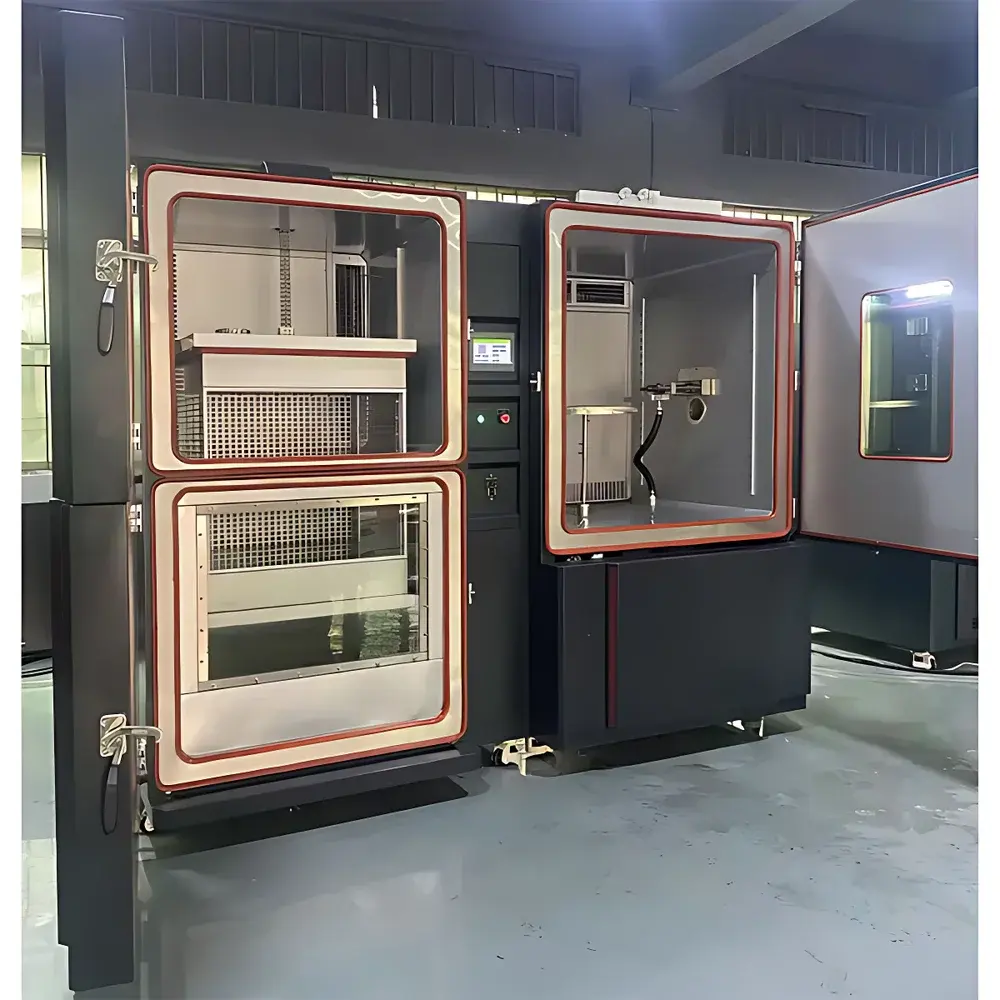
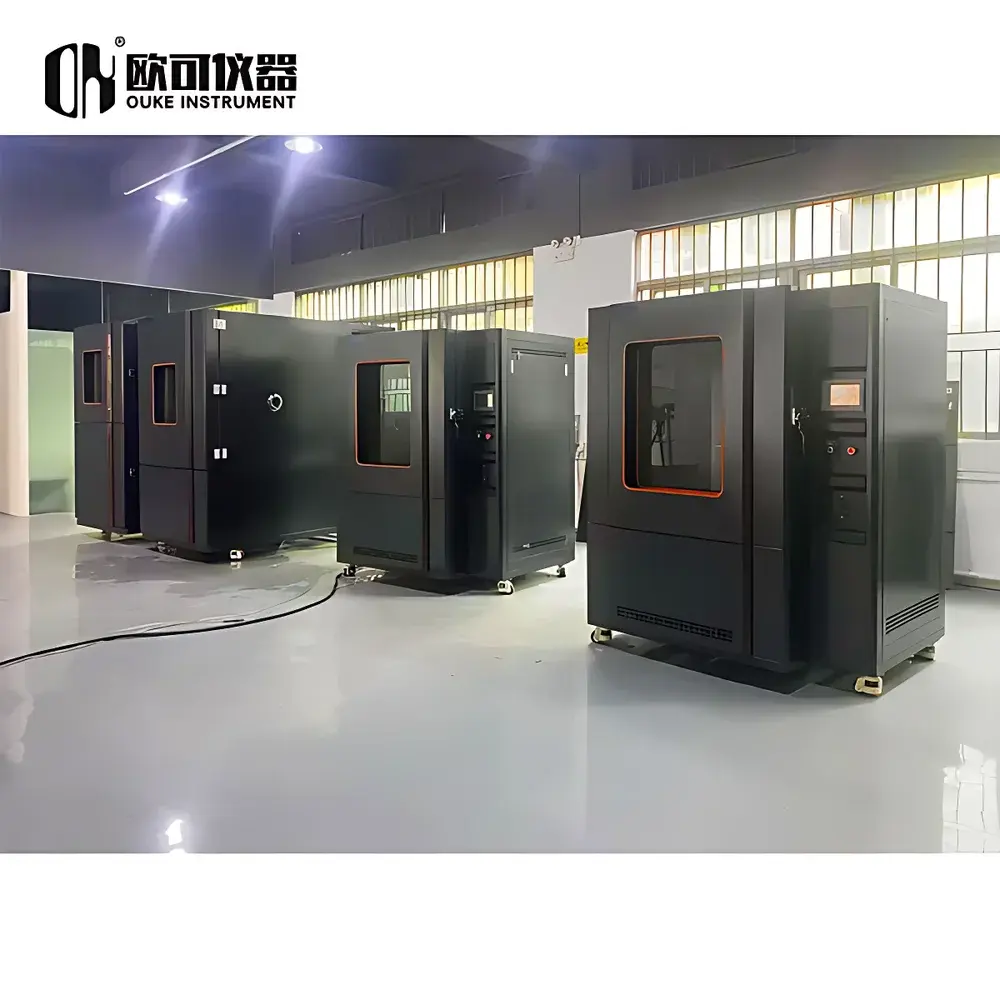
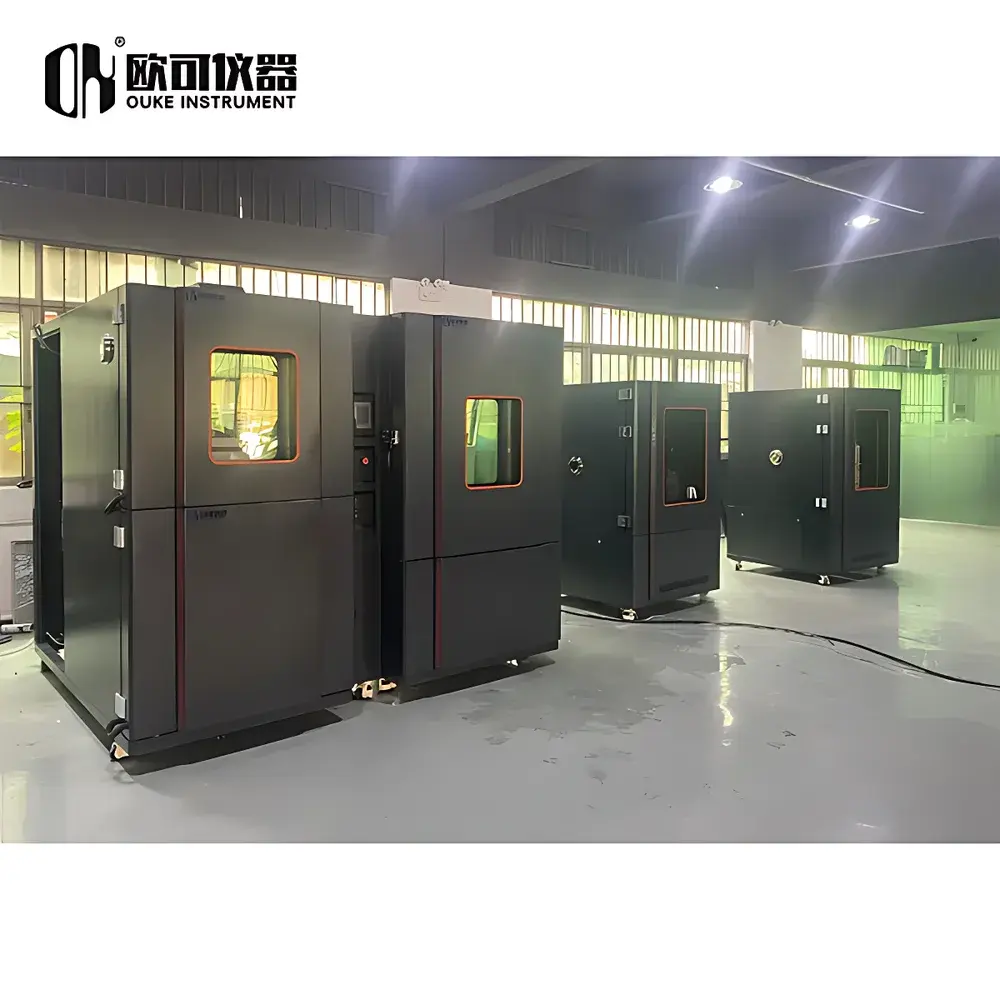
OK-BSCJ-1000 Ice-Water Thermal Shock Test Chamber
| Brand | OK Instruments |
|---|---|
| Origin | Guangdong, China |
| Manufacturer Type | Direct Manufacturer |
| Model | OK-BSCJ-1000 |
| Temperature Shock Range | −40 °C to +150 °C |
| Water Temperature Control Range | 0 °C to 4 °C |
| Spray Pressure | Up to 1000 kPa |
| Transfer Time | ≤10 s |
| Cycle Count Programmable | 1–999 |
Overview
The OK-BSCJ-1000 Ice-Water Thermal Shock Test Chamber is an engineered solution for evaluating thermal-mechanical reliability under extreme transient thermal loading conditions. Unlike conventional thermal shock chambers or IP-rated water ingress testers, this system replicates the physics of rapid interfacial heat transfer induced by high-velocity, sub-zero liquid impact on thermally preconditioned components. Its operational principle centers on controlled Couette-type thermal stress generation: a specimen is first stabilized at elevated temperature (e.g., +80 °C to +120 °C) in a preheating zone, then transferred with ≤10 s dwell time into a spray chamber where it is subjected to precisely metered ice-water (0–4 °C) delivered at regulated pressure (up to 1000 kPa) via multi-axis adjustable nozzles. This induces localized thermal gradients exceeding 100 K/s at material surfaces—conditions directly representative of real-world scenarios such as automotive under-hood components encountering slush during cold-weather operation or aerospace structural elements exposed to de-icing fluid after high-altitude flight.
Key Features
- Integrated dual-zone architecture: independent high-temperature pre-treatment chamber (−40 °C to +150 °C) and dedicated spray impact chamber with active water temperature stabilization (0 °C to 4 °C)
- High-fidelity spray system: stainless-steel nozzle array with programmable angular orientation, flow rate (0.5–5 L/min), and pressure (200–1000 kPa), compliant with VW PV 1210 nozzle geometry specifications
- Automated sample transfer mechanism: pneumatic linear actuator with position feedback ensures repeatable ≤10 s transition time between zones—critical for minimizing thermal decay prior to impact
- Closed-loop water circulation: refrigerated chiller unit with inline filtration, conductivity monitoring, and automatic ice replenishment logic to maintain stable 0–4 °C operating range across 100+ cycles
- Industrial-grade control system: embedded PLC with HMI interface supporting full parameter logging (temperature, pressure, timing, cycle count), audit trail, and exportable CSV data files
- Compliance-ready design: hardware and firmware architecture aligned with GLP/GMP documentation requirements; optional 21 CFR Part 11-compliant electronic signature module available
Sample Compatibility & Compliance
The OK-BSCJ-1000 accommodates specimens up to 600 mm × 600 mm × 400 mm (W×D×H), including engine manifolds, brake calipers, battery enclosures, ECU housings, lighting assemblies, and aircraft landing gear brackets. It supports standardized mounting fixtures compatible with ISO 19453-5 mechanical anchoring provisions. The chamber meets functional equivalence requirements for multiple international test standards, including but not limited to: VW PV 1210 (Section 5.3.2 – Ice-Water Spray Test), GMW 15200 (Section 7.4.2 – Thermal Shock with Liquid Impact), MBN 10546, FLTM BO 162-04, VDA 621-415, and ISO 19453-5. All critical parameters—including water temperature stability (±0.5 °C), spray pressure accuracy (±20 kPa), and transfer timing repeatability (±0.3 s)—are traceably verifiable using NIST-traceable calibration protocols.
Software & Data Management
Control software operates on a real-time deterministic kernel, enabling synchronized acquisition of up to 16 analog channels (thermocouples, pressure transducers, flow meters) at 10 Hz sampling rate. Test sequences are defined via hierarchical script language supporting conditional branching, loop nesting, and interlock logic (e.g., “proceed only if chamber temperature deviation < ±1 °C for ≥60 s”). Raw data is stored in encrypted binary format with SHA-256 hash integrity verification. Export modules generate ASTM E2918-compliant test reports containing metadata (operator ID, calibration dates, environmental ambient logs), parameter traces, and pass/fail annotations per cycle. Audit trails record all user actions—including parameter edits, manual overrides, and calibration events—with timestamp, IP address, and role-based access level.
Applications
- Automotive: validation of thermal fatigue resistance in aluminum die-cast engine blocks, exhaust manifolds, turbocharger housings, and EV battery thermal interface materials
- Aerospace: qualification of composite wing leading-edge panels and hydraulic actuator seals under simulated de-icing fluid impact post-cruise thermal soak
- Industrial electronics: assessment of conformal coating adhesion, potting compound delamination, and PCB-level solder joint integrity in outdoor power converters and 5G base station enclosures
- R&D laboratories: fundamental studies of crack initiation thresholds in polymer-metal hybrids under asymmetric thermal shock loading
- Quality assurance: incoming inspection of supplier components against OEM thermal shock acceptance criteria (e.g., zero visible cracking after 50 cycles per PV 1210)
FAQ
What distinguishes ice-water thermal shock testing from standard thermal cycling or IPX9K testing?
Ice-water thermal shock uniquely combines sustained high-temperature preconditioning with impulsive low-temperature liquid impact—inducing biaxial tensile stresses at phase boundaries that neither dry thermal cycling nor static immersion can replicate.
Is the OK-BSCJ-1000 suitable for testing sealed electronic enclosures?
Yes—its spray configuration and chamber sealing meet the mechanical impact intensity requirements of ISO 19453-5 Annex B for electric drive systems; however, ingress verification must be performed separately per IEC 60529 protocols.
How is water temperature maintained at 0–4 °C over extended test durations?
Via a dual-stage refrigeration circuit with cascade evaporator design, integrated ice reservoir buffer, and PID-controlled glycol-water coolant loop; temperature drift is actively compensated using real-time RTD feedback.
Can the system support custom test profiles beyond published standards?
Absolutely—the scripting engine allows full definition of non-linear ramp rates, variable dwell times, dynamic pressure modulation, and conditional termination logic based on sensor thresholds.
What calibration documentation is provided with shipment?
Each unit ships with a factory calibration certificate covering temperature uniformity (per IEC 60068-3-5), spray pressure linearity (per ISO 5167), and transfer timing accuracy—traceable to CNAS-accredited reference standards.



