
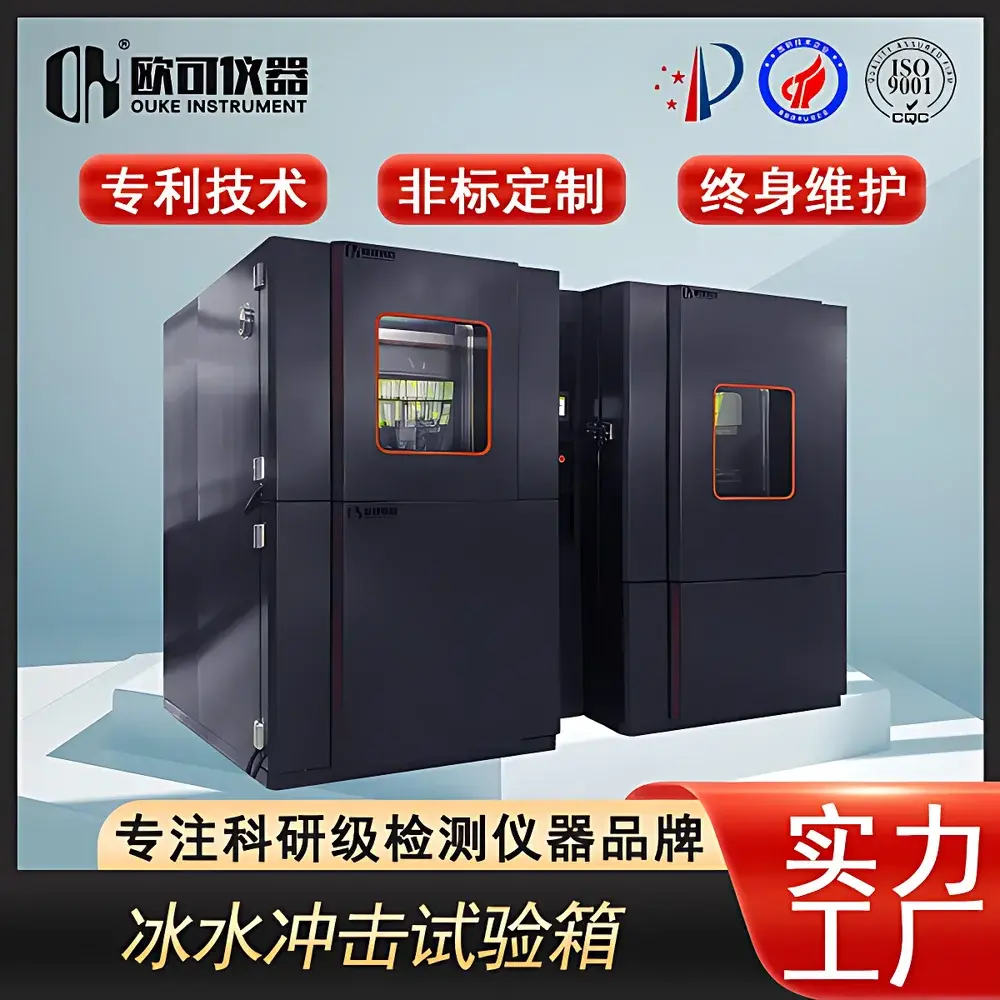
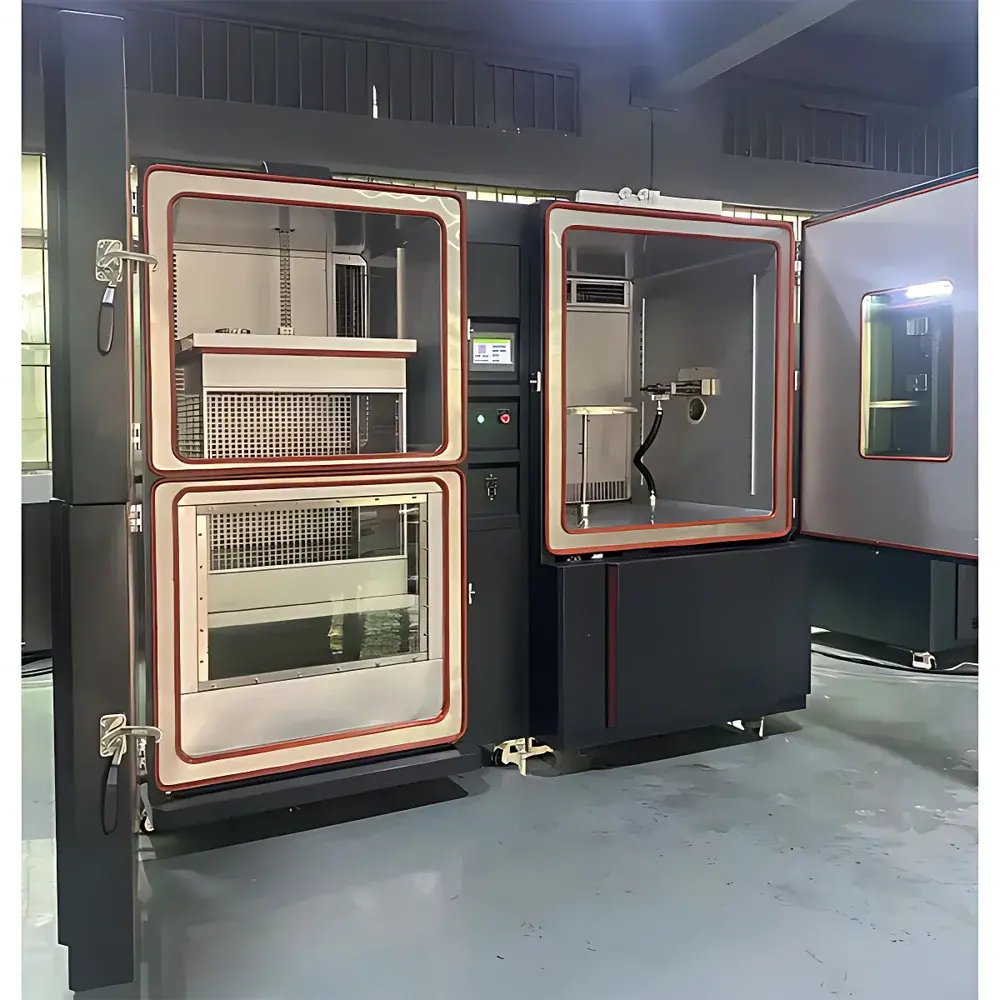
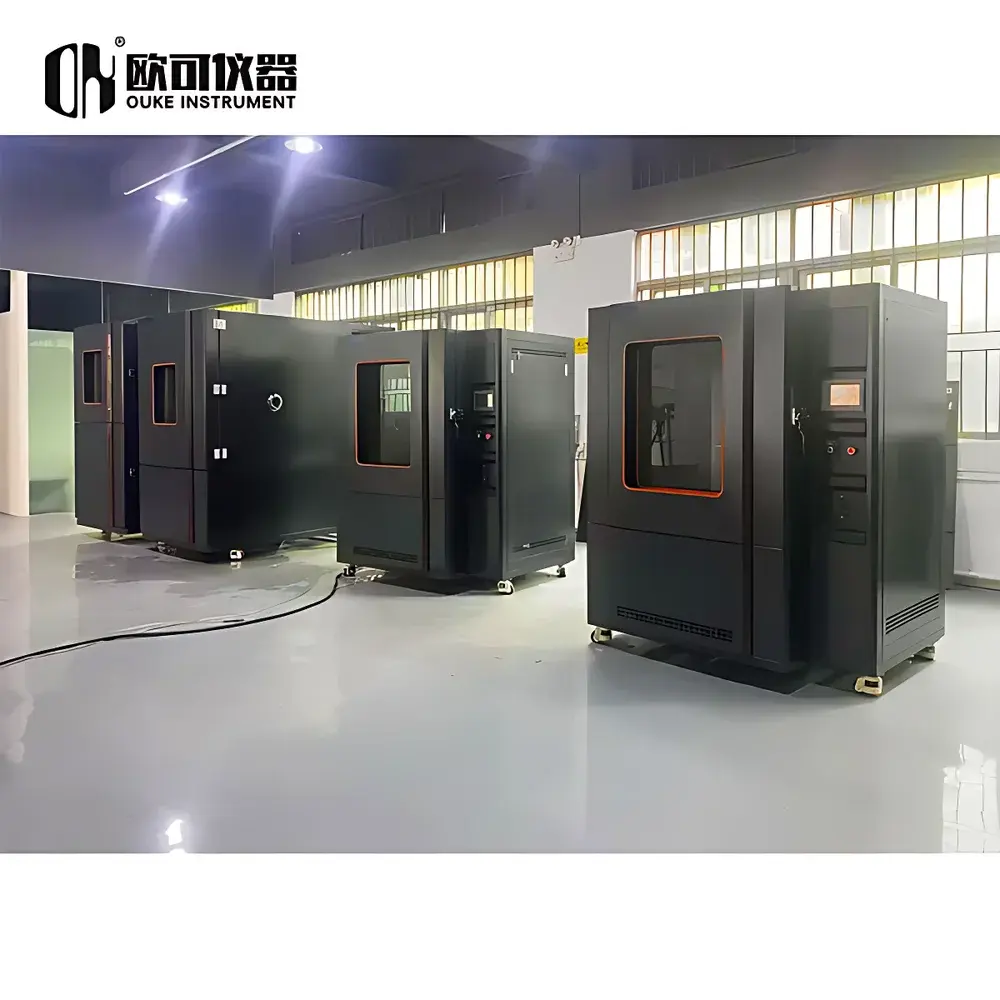
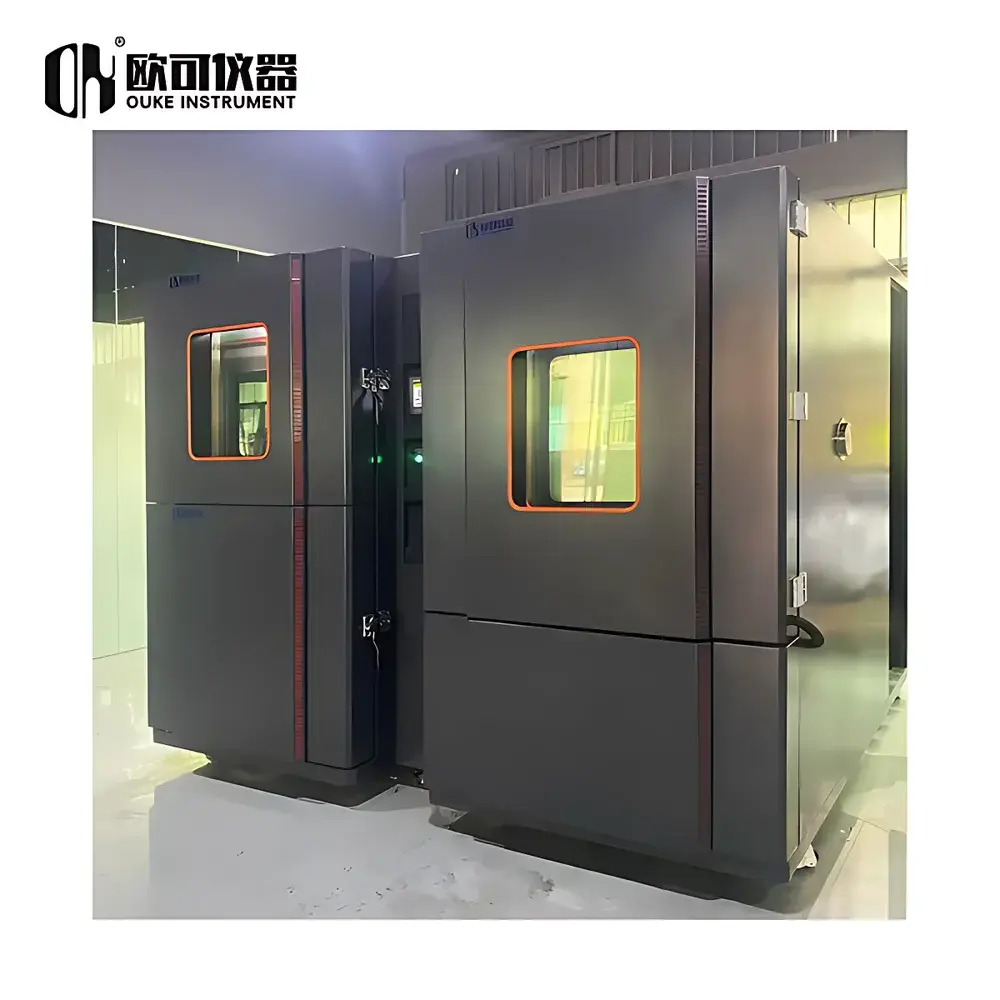
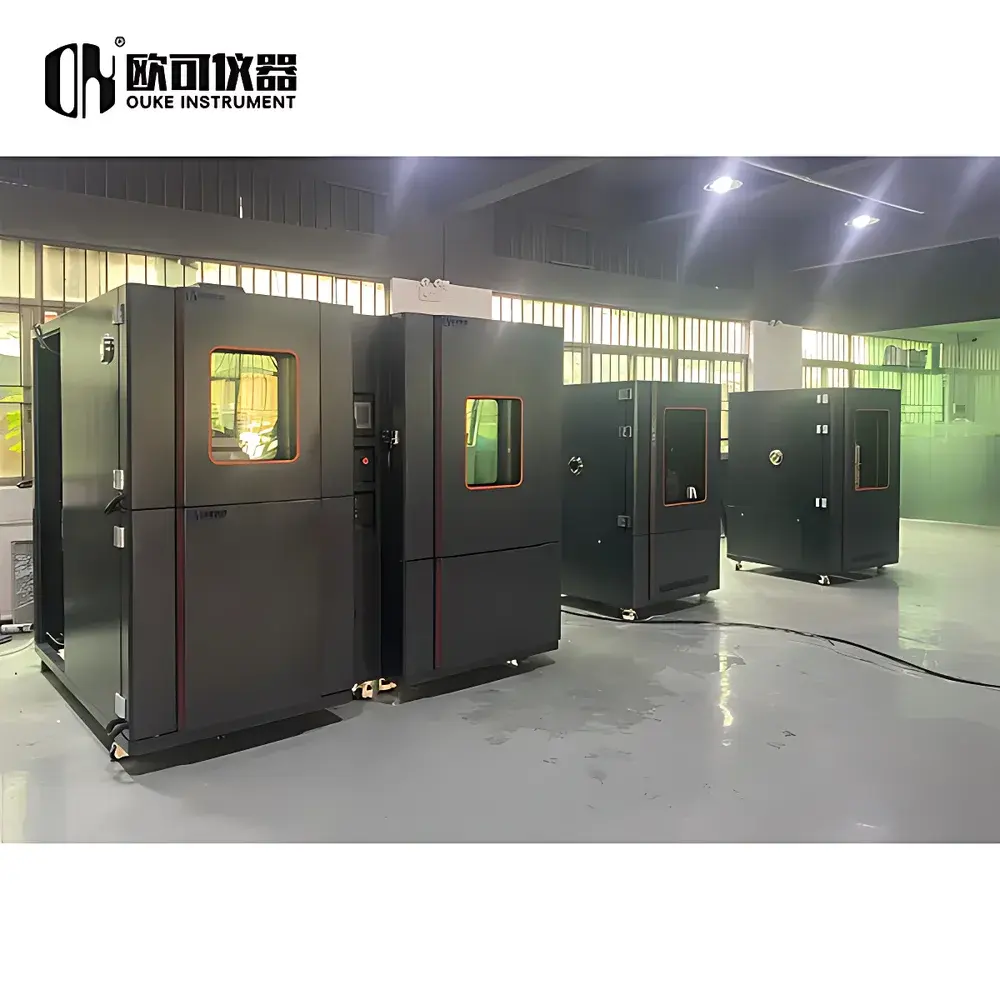
OK-BSCJ-1002 Ice-Water Immersion Thermal Shock Test Chamber
| Brand | OK Instruments |
|---|---|
| Origin | Guangdong, China |
| Manufacturer Type | Direct Manufacturer |
| Model | OK-BSCJ-1002 |
| High-Temperature Range | +150 °C |
| Low-Temperature Range | −45 °C |
| Thermal Shock Range | −45 °C to +150 °C |
| Temperature Stability | ±2 °C |
Overview
The OK-BSCJ-1002 Ice-Water Immersion Thermal Shock Test Chamber is an engineered solution for simulating rapid thermal transients induced by direct impingement of sub-zero aqueous media onto components preconditioned at elevated temperatures. Unlike conventional liquid-to-liquid or air-to-air thermal shock chambers, this system implements a rigorously controlled two-phase test sequence—thermal preconditioning followed by high-intensity, low-temperature water jet exposure—to replicate real-world thermal-mechanical stress conditions encountered in automotive, aerospace, and outdoor electronics applications. Its operational principle is grounded in transient heat transfer dynamics: when a hot surface (e.g., engine block at +80 °C) is subjected to a turbulent jet of ice-water mixture (~0–4 °C), steep thermal gradients generate localized compressive and tensile stresses at material interfaces, accelerating fatigue crack initiation, seal delamination, coating spallation, and interfacial adhesion failure. The chamber is designed to meet the stringent physical and temporal requirements of industry-critical standards including VW PV 1210, GMW 15200, and MBN 10546.
Key Features
- Integrated dual-zone architecture: independent high-temperature pre-conditioning chamber (+150 °C max) and dedicated ice-water impact zone with precision-controlled nozzle array
- Refrigerated water circulation system maintaining stable bath temperature between 0 °C and 4 °C via closed-loop chiller and ice-mixture buffer reservoir
- Adjustable high-pressure spray manifold with ≥6 independently orientable nozzles; flow rate and pressure configurable up to 1000 kPa (145 psi)
- Automated sample transfer mechanism achieving ≤10-second transition time from hot zone to impact zone—critical for minimizing thermal decay prior to shock
- Robust stainless-steel construction with insulated double-wall chamber walls and corrosion-resistant internal wetted surfaces
- Programmable logic controller (PLC) with touchscreen HMI enabling full parameterization of cycle count, dwell times, spray duration (1–300 s), and post-impact drainage/drying sequences
Sample Compatibility & Compliance
The OK-BSCJ-1002 accommodates specimens up to 1000 × 800 × 600 mm (W × D × H) and supports both rigid and semi-flexible assemblies—including cast aluminum engine components, brake calipers, EV battery enclosures, avionics housings, and LED lighting modules. It satisfies mechanical and environmental compliance prerequisites for ISO/IEC 17025-accredited laboratories conducting qualification testing under OEM-specific protocols. The system’s thermal stability (±2 °C) and water temperature repeatability (< ±0.5 °C over 30-min continuous operation) align with traceability requirements for GLP and GMP-regulated validation studies. While not certified to UL or CE as a standalone appliance, its subsystems comply with IEC 61000-6-2 (immunity) and IEC 61000-6-4 (emission) standards. Documentation includes factory calibration certificates for temperature sensors (PT100 Class A), pressure transducers, and flow meters—all traceable to NIM (China National Institute of Metrology).
Software & Data Management
The embedded control software provides real-time logging of all critical parameters—including chamber air temperature, water bath temperature, spray pressure, elapsed transfer time, and cumulative cycle count—with timestamped CSV export capability. Audit trails record operator login events, parameter modifications, and emergency stop activations—supporting FDA 21 CFR Part 11 compliance when deployed in regulated environments. Optional Ethernet/IP or Modbus TCP integration enables centralized monitoring within enterprise MES or LIMS platforms. All data files are stored on internal industrial-grade SSD with redundant backup via USB 3.0 port. No cloud connectivity is enabled by default; remote access requires on-premise firewall configuration and authenticated VPN tunneling.
Applications
- Automotive: Validation of thermal shock resistance in powertrain components (turbochargers, exhaust manifolds), braking systems (calipers, rotors), ADAS sensor housings, and headlamp assemblies per VW PV 1210 Clause 5.3.2
- Aerospace: Assessment of ice-shedding behavior and structural integrity of landing gear actuators and nacelle components exposed to de-icing fluid splash during cold-soak landings
- Renewable Energy: Reliability screening of photovoltaic inverters and wind turbine pitch controllers subjected to desert-to-rain thermal cycling
- Industrial Electronics: Evaluation of ingress protection robustness and solder joint reliability in outdoor telecom cabinets operating under ISO 19453-5 thermal cycling profiles
- R&D Labs: Accelerated failure mode analysis (FMEA) for polymer composites, elastomeric seals, and multi-material bonded joints under combined thermo-hydraulic loading
FAQ
What distinguishes ice-water immersion testing from standard thermal shock or IPX9K testing?
Ice-water immersion combines sustained high-temperature preconditioning with abrupt convective cooling via low-temperature liquid jet—inducing unique interfacial thermal stresses absent in air-based shock or purely mechanical water ingress tests.
Does the OK-BSCJ-1002 support VW PV 1210-compliant test execution out-of-the-box?
Yes—the system ships preconfigured with PV 1210 Cycle A and Cycle B templates, including default settings for water temperature (2 ± 0.5 °C), spray pressure (800–1000 kPa), and maximum transfer time (10 s). Final validation per Section 6.2 remains the responsibility of the end-user laboratory.
Can the chamber accommodate non-standard coolant formulations, such as glycol-water mixtures or de-icing fluid simulants?
The wetted path is compatible with pH-neutral aqueous solutions up to 30% ethylene glycol concentration; however, corrosive or particulate-laden fluids require optional stainless-steel filtration upgrades and prior chemical compatibility review.
Is third-party calibration and IQ/OQ documentation available?
OK Instruments provides optional installation qualification (IQ) and operational qualification (OQ) packages performed by ISO/IEC 17025-accredited field engineers, including thermocouple mapping, pressure linearity verification, and cycle timing validation reports.
What maintenance intervals are recommended for long-term reliability?
Daily visual inspection of nozzles and filters; quarterly chiller refrigerant charge verification and pump seal replacement; annual recalibration of all primary sensors per manufacturer-specified procedures.



