
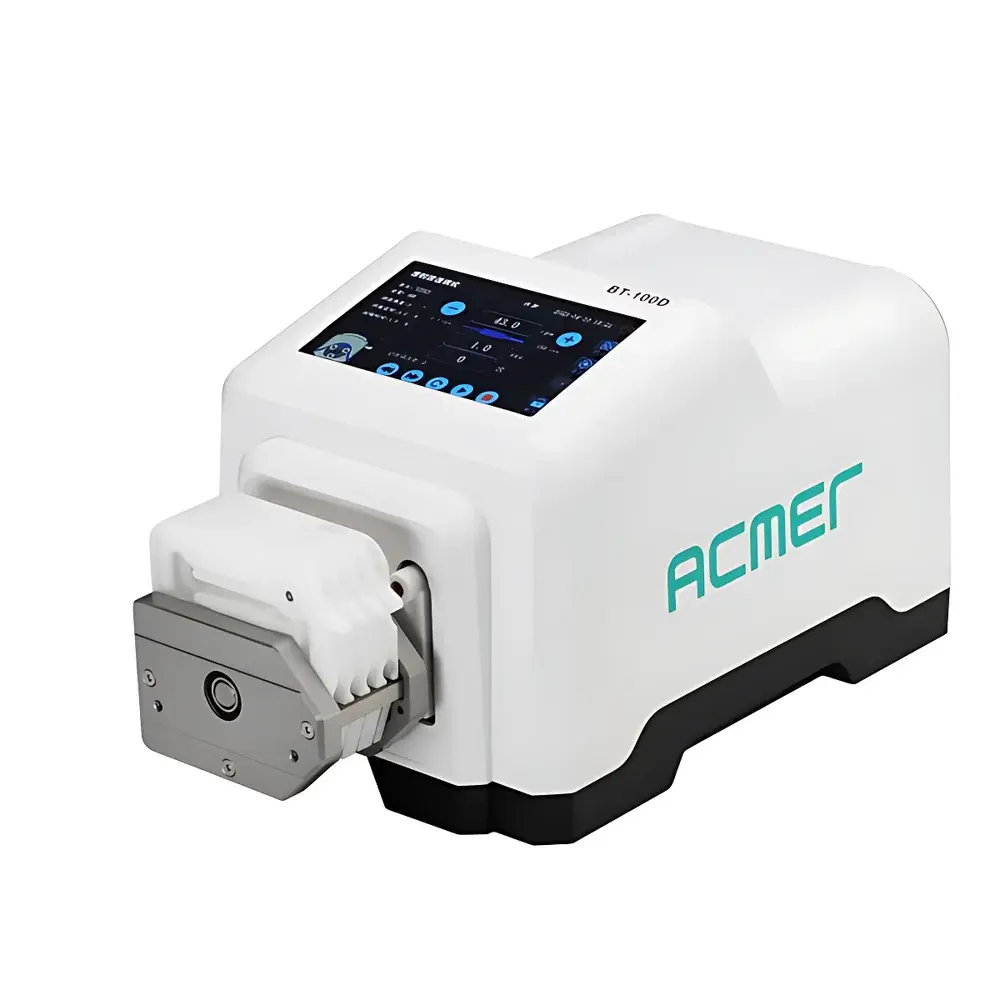
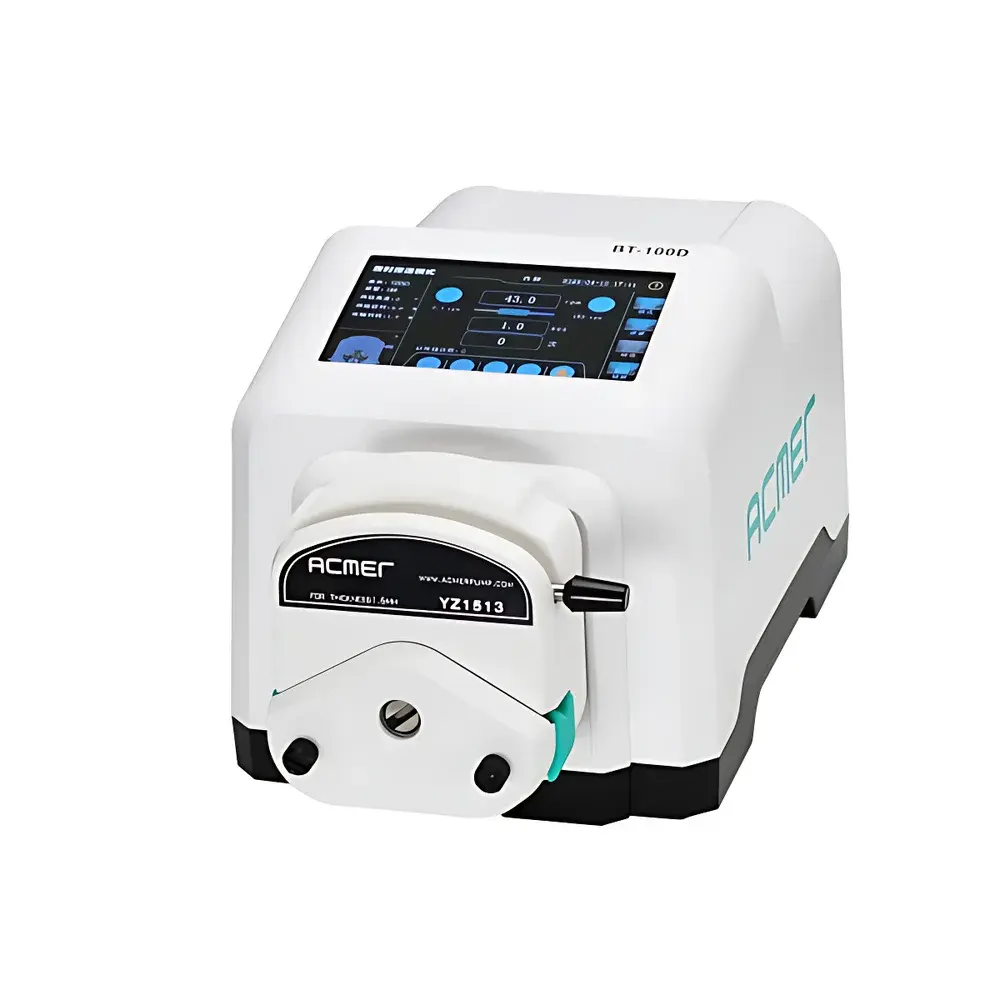
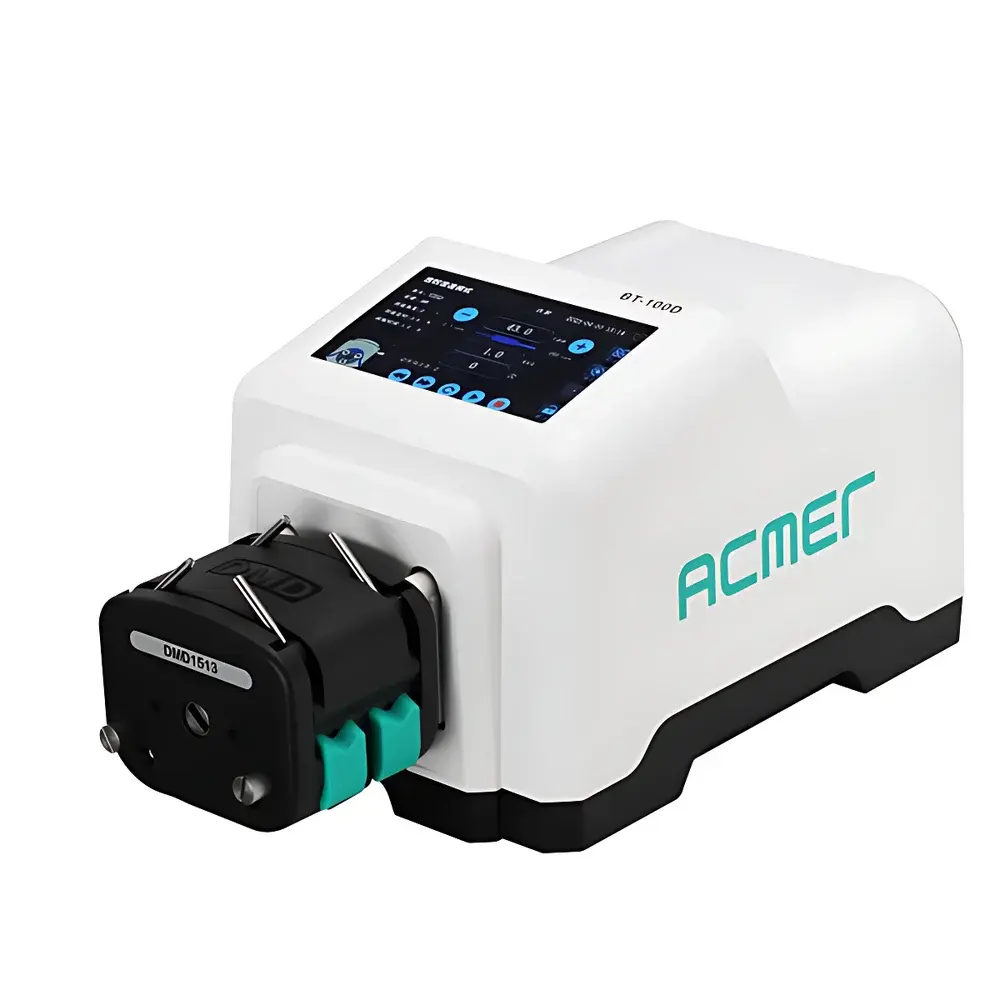
BT-100D Distribution-Mode Peristaltic Pump by Acmer
| Brand | Acmer |
|---|---|
| Origin | Hebei, China |
| Manufacturer Type | Authorized Distributor |
| Instrument Type | Peristaltic Pump |
| Model | BT-100D |
| Flow Rate Range | 0.00013–560 mL/min |
| Speed | 150 rpm |
| Control Interface | RS485/USB (configurable address, baud rate 1200–9600 bps) |
| External Control | 5–24 V TTL-level start/stop signal |
| Status Outputs | Run/Stop, Direction, Alarm |
| Leak Detection | Optional visual and audible alarm |
| Calibration Modes | Volumetric and flow-based |
| Density Compensation | Supported for mass-based dispensing |
| Real-time Adjustment | On-the-fly volume/flow fine-tuning during operation |
| Pause Function | Supported in both distribution and transfer modes |
| Display Guidance | Dynamic range validation for user-defined parameters |
Overview
The BT-100D Distribution-Mode Peristaltic Pump is an engineered solution for precise, repeatable liquid handling in analytical laboratories, bioprocessing workflows, and quality control environments. Designed around the principle of positive displacement via peristaltic compression—where rollers sequentially compress a flexible tubing segment to propel fluid without contact between the pump mechanism and the medium—the BT-100D eliminates cross-contamination risks and supports sterile or aggressive chemical applications. Its core architecture prioritizes metrological integrity: flow accuracy is maintained across its full operational range (0.00013–560 mL/min) through high-resolution speed control (150 rpm maximum) and calibrated tube deformation dynamics. Unlike basic transfer pumps, the BT-100D implements true distribution logic—enabling discrete, programmable aliquot delivery with volumetric repeatability traceable to internal calibration routines.
Key Features
- Dual-mode operation: configurable as continuous transfer pump or discrete-volume distributor with programmable dispense cycles
- Volumetric and flow-rate calibration protocols compliant with ISO 8573-1 and ASTM D3405 guidelines for fluid metering verification
- Real-time parameter adjustment: modify target volume or flow rate during active operation without interrupting motor sequence
- Density-compensated dispensing: input fluid density to convert volumetric setpoints into mass-equivalent outputs—critical for gravimetric QC procedures
- Integrated pause functionality: suspend dispensing mid-cycle for manual intervention or process synchronization
- Optional leak detection module: optical sensor + piezoelectric buzzer activation upon tubing rupture or disconnection, meeting IEC 61000-4-2 ESD immunity requirements
- Industrial-grade control interface: RS485 Modbus RTU and USB virtual COM port support multi-pump daisy-chaining and host integration (e.g., LabVIEW, Python pySerial)
- External TTL control compatibility: 5–24 V logic signals enable seamless integration into PLC-driven automation lines or safety interlock systems
Sample Compatibility & Compliance
The BT-100D accommodates standard peristaltic tubing materials including Pharmapure® silicone, Tygon® LFL, and Viton®—validated for use with aqueous buffers, organic solvents (e.g., acetonitrile, IPA), and mildly corrosive reagents (pH 2–12). Tubing selection directly governs chemical resistance, pressure rating (max. 0.2 MPa at 150 rpm), and particulate tolerance. The pump meets CE marking requirements under Directive 2014/30/EU (EMC) and 2014/35/EU (LVD), and its firmware architecture supports audit-trail-ready operation when paired with validated host software—aligning with FDA 21 CFR Part 11 data integrity expectations for electronic records in regulated labs.
Software & Data Management
Acmer’s proprietary PC software (Windows/Linux/macOS) provides full configuration of dispensing sequences, calibration tables, and alarm thresholds. All parameter changes—including real-time adjustments—are timestamped and logged with operator ID fields. USB and RS485 interfaces support bidirectional communication: status registers (run state, direction, error flags) are polled at user-defined intervals; calibration coefficients are stored in non-volatile memory with write-protection. For GLP/GMP environments, the system exports CSV-formatted logs compatible with LIMS ingestion and supports digital signature-enabled report generation.
Applications
- Automated sample dilution series preparation for HPLC and ICP-MS calibration standards
- Controlled reagent addition in titration and enzymatic assay platforms
- Cell culture media exchange in bioreactor feeding loops
- Low-flow solvent delivery in microfluidic chip priming and cleaning protocols
- Gravimetric dosing of high-value catalysts or reference standards where mass-based accuracy supersedes volumetric assumptions
- Integration into modular QC workstations requiring synchronized start/stop signals from external sensors or PLCs
FAQ
What tubing sizes are supported by the BT-100D?
Standard configurations accommodate inner diameters from 0.5 mm to 4.8 mm, with recommended wall thicknesses of 0.8–1.6 mm for optimal occlusion and fatigue life.
Is the pump suitable for sterile applications?
Yes—when used with gamma-irradiated, USP Class VI-certified silicone tubing and operated in laminar-flow hoods or isolators, it meets ISO 14644-1 Class 5 cleanroom requirements for aseptic liquid transfer.
How is calibration traceability established?
Users perform two-point volumetric calibration using certified glassware (e.g., Class A burettes); calibration coefficients are stored with date/time stamps and operator ID, satisfying ISO/IEC 17025 documentation requirements.
Can multiple BT-100D units be synchronized?
Yes—via RS485 Modbus RTU with configurable node addresses, enabling master-slave timing coordination for parallel dispensing tasks.
Does the system support 21 CFR Part 11 compliance?
The hardware supports electronic signatures and audit trails when deployed with validated third-party software and administrative controls (e.g., role-based access, password policies, and change management SOPs).



