
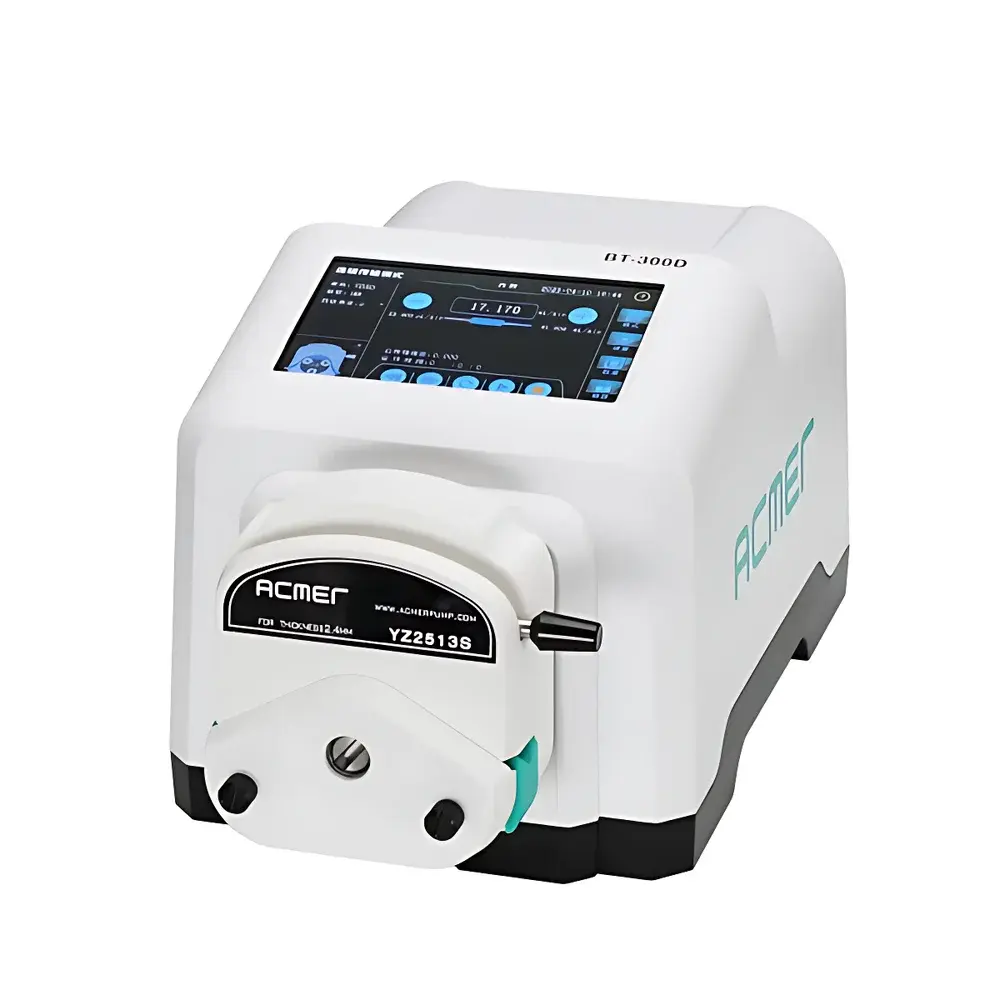
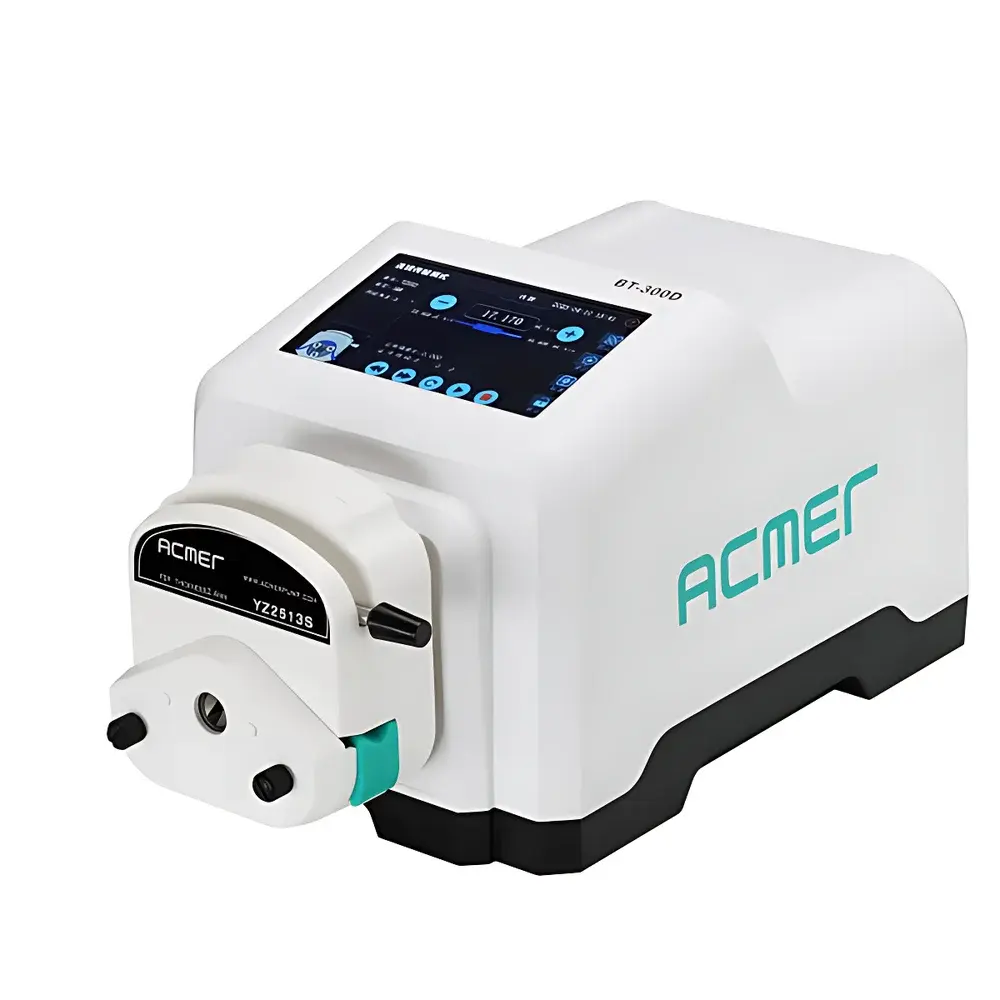
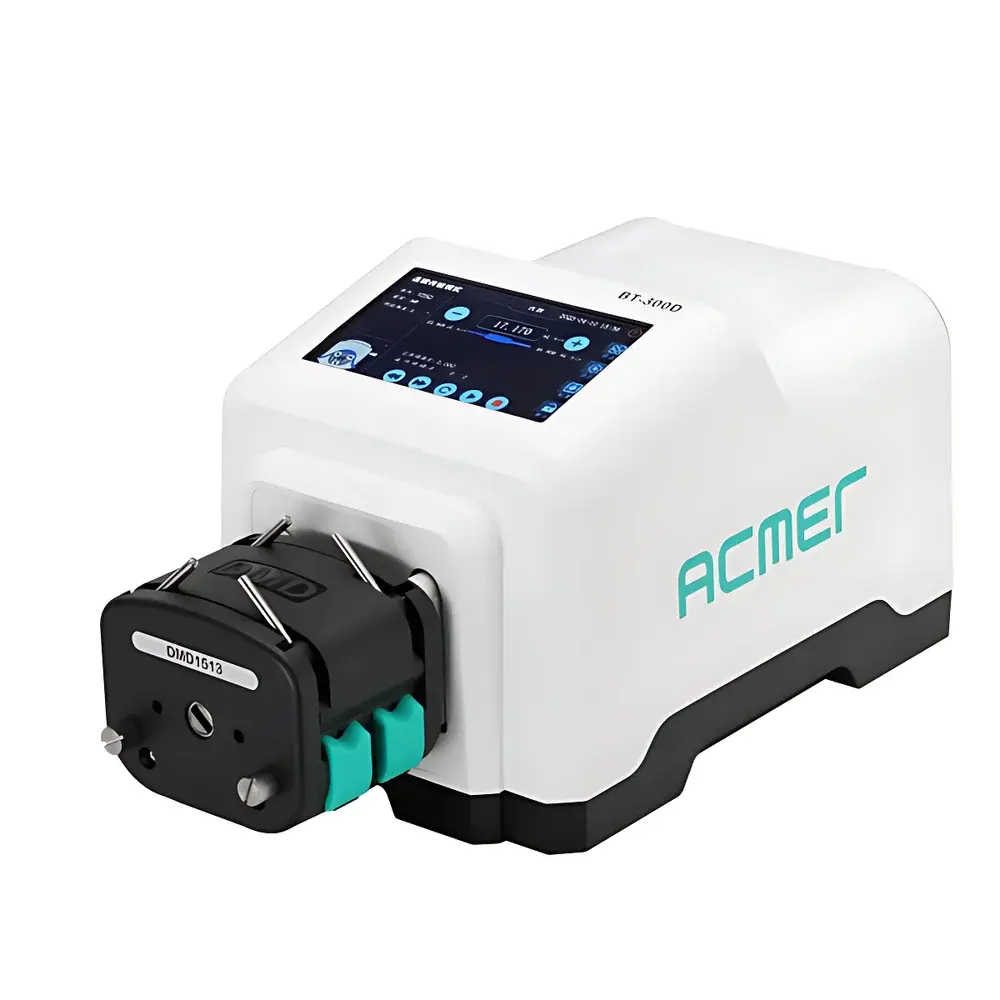
BT-300D Peristaltic Pump by Acmer
| Brand | Acmer |
|---|---|
| Origin | Hebei, China |
| Manufacturer Type | Authorized Distributor |
| Instrument Type | Peristaltic Pump |
| Model | BT-300D |
| Flow Rate Range | 0.0063–1730 mL/min |
| Speed | 400 rpm |
| Control Interface | External TTL/DC (5–24 V) |
| Alarm Output | Visual & Audible Leak Detection (Optional) |
| Unit Mode | Volumetric (mL, µL) or Gravimetric (g, mg) via Density Input |
| Operation Modes | Dispensing, Transfer, Continuous, Timed, Volume-Based |
| Calibration | Multi-point Flow/Liquid Volume Calibration |
| Real-time Adjustment | Flow rate and dispense volume adjustable during operation |
| Pause Function | Supported during dispensing or transfer |
| Status Outputs | Run/Stop, Direction, Fault Alarm |
Overview
The BT-300D Peristaltic Pump by Acmer is an industrial-grade, microprocessor-controlled peristaltic pump engineered for high-precision liquid handling in laboratory, bioprocessing, and analytical environments. Operating on the principle of positive displacement through occlusion—where rollers compress flexible tubing to propel fluid without contact between the pump mechanism and the medium—the BT-300D eliminates risk of contamination, cross-sample carryover, or valve-induced dead volume. Its wide dynamic flow range (0.0063–1730 mL/min) supports applications from nanoliter-scale reagent dosing in assay development to bulk buffer transfer in chromatography system priming or fermentation feed control. Designed for integration into automated workflows, the pump features bidirectional rotation, programmable dispensing cycles, and real-time parameter adjustment—making it suitable for GLP-compliant QC labs, R&D facilities, and pilot-scale process development.
Key Features
- Precision dispensing modes: Supports volume-based, time-based, continuous-flow, and timed-interval dispensing with repeatable accuracy across the full flow range.
- Multi-point calibration: Enables volumetric or gravimetric calibration using user-defined standards; accommodates density input for mass-based dispensing (e.g., converting mL to g when handling viscous or density-variable solutions).
- Real-time operational flexibility: Flow rate and target dispense volume can be modified on-the-fly during active operation—critical for iterative optimization in method development or adaptive process control.
- Pause/resume functionality: Halts fluid delivery at any point during dispensing or transfer sequences while preserving position and state for seamless continuation.
- Integrated leak detection (optional): Monitors tubing integrity via optical or capacitive sensing; triggers simultaneous LED indicator activation and audible alarm upon fluid escape—supporting ICH Q7 and ISO 9001 preventive maintenance protocols.
- Industrial-grade external control interface: Accepts TTL or DC-level start/stop commands (5–24 V), with isolated digital outputs for run status, direction, and fault signaling—enabling synchronization with PLCs, LIMS, or custom LabVIEW/HAL-based automation frameworks.
Sample Compatibility & Compliance
The BT-300D is compatible with a broad spectrum of chemically resistant tubing materials—including PharMed® BPT, Tygon® LFL, and silicone formulations—ensuring compatibility with aqueous buffers, organic solvents, acids, and biological media. No wetted parts beyond the tubing eliminate cleaning validation burden and support single-use system integration. The pump meets CE marking requirements for electromagnetic compatibility (EN 61326-1) and low-voltage safety (EN 61010-1). While not intrinsically rated for hazardous locations, its design aligns with general laboratory equipment safety expectations under ISO/IEC 17025-accredited environments. For regulated industries, audit trails may be generated externally via connected SCADA or data acquisition systems supporting FDA 21 CFR Part 11 electronic record requirements.
Software & Data Management
The BT-300D operates as a standalone instrument with front-panel keypad navigation and LCD display showing real-time flow rate, cumulative volume, rotational speed, and system status. It does not include embedded software or cloud connectivity; however, its analog/digital I/O architecture facilitates integration with third-party control platforms. When paired with Acmer’s optional PC-based configuration utility (Windows-compatible, USB virtual COM port), users can define multi-step dispensing programs, save calibration profiles, and export log files (.csv) containing timestamped volume, speed, and alarm events—supporting traceability in ISO 13485 medical device manufacturing or USP analytical instrument qualification.
Applications
- Automated sample dilution and standard preparation in environmental testing (EPA Method 200.8, ISO 11885)
- Continuous nutrient feeding in microbial or mammalian cell culture bioreactors
- Mobile phase delivery in preparative HPLC and SFC systems requiring pulse-free flow
- Reagent metering in ELISA, PCR setup, and clinical chemistry analyzers
- In-line filtration system priming and backflush sequencing
- Calibration fluid delivery for conductivity, pH, and DO sensor verification
FAQ
What tubing sizes are supported by the BT-300D?
The pump head is configured for standard peristaltic tubing with inner diameters ranging from 0.1 mm to 6.4 mm—compatible with common sizes such as 0.5 mm, 1.6 mm, 3.2 mm, and 6.4 mm ID. Tube selection directly determines achievable flow range and pressure capability.
Does the BT-300D support RS-232 or Modbus communication?
No—communication is limited to discrete I/O signals (start/stop, direction, alarm) and analog voltage output for speed feedback. Serial or fieldbus protocols require external signal conversion hardware.
Can the pump operate continuously for extended periods?
Yes—designed for 24/7 operation with thermal management and brushless DC motor architecture; recommended duty cycle depends on tubing material, flow rate, and ambient temperature per Acmer’s published MTBF documentation.
Is gravimetric dispensing traceable to NIST standards?
Gravimetric mode relies on user-input density values and calibrated balance readings; the pump itself does not perform mass measurement—it converts volume targets using entered density. Full traceability requires integration with ISO/IEC 17025-accredited weighing instrumentation.
How is calibration verified during routine use?
Users perform periodic volumetric checks using Class A glassware or certified flow meters per ASTM D3242 or ISO 4064-2; Acmer provides calibration certificate templates aligned with ILAC-MRA requirements for internal QA documentation.



