
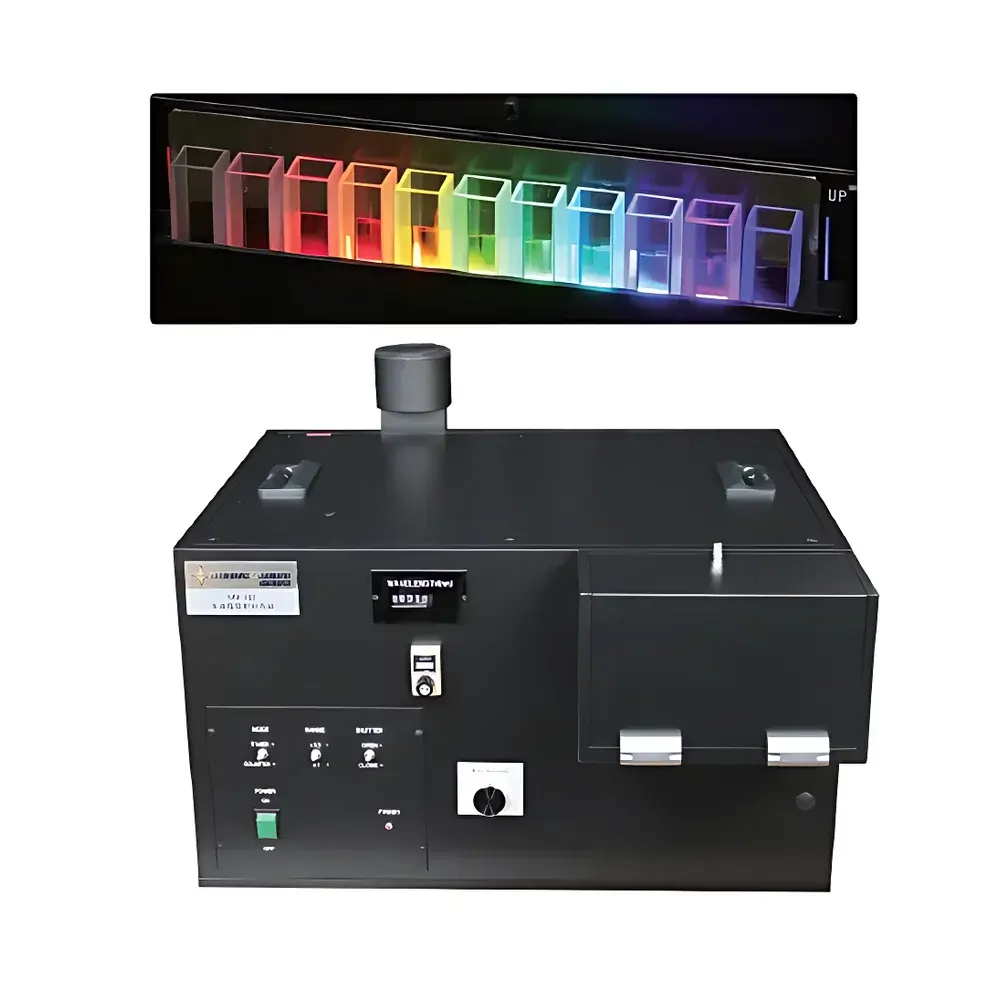
Bunkoukeiki NIJI-2 Photostability Testing Chamber
| Brand | Bunkoukeiki |
|---|---|
| Origin | Japan |
| Model | NIJI-2 |
| Light Source | 150 W Xenon Arc Lamp |
| Spectral Range | 300–1150 nm |
| Bandwidth Options | 5, 10, or 20 nm (FWHM) |
| Irradiance | ≥1 mW/cm² (≥40 μmol·m⁻²·s⁻¹) |
| Illuminated Area Diameter | ≥Φ3 mm |
| Optical Delivery | SMA-coupled Φ3 mm Fiber, 1 m Length |
| Calibration Sensor | Integrated Silicon Photodiode Detector |
| Control Interface | Embedded LED Indicator + Manual Shutter |
| Dimensions (W×D×H) | 230 × 295 × 414 mm (excluding protrusions |
| Compliance | Designed for ICH Q1B, ISO 10993-12, and USP <1107> photostability protocols |
Overview
The Bunkoukeiki NIJI-2 Photostability Testing Chamber is a precision-engineered, benchtop instrument designed to deliver controlled, spectrally defined irradiation for pharmaceutical photostability assessment in accordance with ICH Q1B guidelines. It employs a stabilized 150 W xenon arc lamp as its broadband light source, generating continuous output across the biologically and chemically relevant spectrum—from deep UV (300 nm) through visible light to near-infrared (1150 nm). Unlike broad-spectrum fluorescent or LED-based systems, the xenon source provides high spectral fidelity and intensity stability over time, enabling reproducible simulation of daylight exposure conditions. The system integrates a tunable monochromator with selectable bandwidths (5 nm, 10 nm, or 20 nm FWHM), allowing users to isolate specific wavelength bands for mechanistic degradation studies or compliance-driven narrowband testing. Irradiance is continuously monitored in real time via an embedded silicon photodiode calibrated traceably to NIST-traceable standards, ensuring measurement integrity across the full spectral range.
Key Features
- Stabilized 150 W xenon arc lamp with low temporal drift (<±2% over 1 hour), engineered for long-term radiometric consistency.
- Monochromator-based spectral selection with user-selectable bandwidths (5/10/20 nm FWHM), supporting both full-spectrum and targeted wavelength irradiation protocols.
- Real-time irradiance monitoring using an integrated, temperature-compensated silicon photodiode detector—calibrated in mW/cm² and convertible to photon flux (μmol·m⁻²·s⁻¹) for photochemical quantification.
- Flexible optical delivery via a 1 m, SMA-terminated Φ3 mm quartz fiber optic cable, enabling remote sample illumination without thermal coupling or spatial constraints.
- Manual shutter mechanism with tactile feedback and visual indicator, providing precise control over exposure duration and eliminating electronic timing dependencies.
- Compact, self-contained architecture (230 × 295 × 414 mm) requiring only standard laboratory bench space—no external chiller, power conditioner, or exhaust ducting required.
Sample Compatibility & Compliance
The NIJI-2 accommodates a wide range of pharmaceutical sample formats including vials, ampoules, blister packs, and solid dosage forms mounted on custom holders or standard petri dishes. Its collimated, fiber-delivered beam minimizes thermal load on temperature-sensitive samples while maintaining irradiance uniformity across the Φ3 mm target zone. The instrument is explicitly configured to support ICH Q1B Option 1 (broad-spectrum daylight simulation) and Option 2 (near-UV and visible light exposure), with spectral output verifiable via optional external spectroradiometry. All irradiance values are referenced to ISO/CIE standard measurement geometries and comply with the reporting requirements of USP <1107>, EP 2.2.76, and JP 18 photostability chapters. Traceable calibration documentation—including diode responsivity curves and lamp aging profiles—is provided with each unit to support GLP/GMP audit readiness.
Software & Data Management
The NIJI-2 operates in a hardware-controlled, firmware-managed mode with no proprietary software dependency—ensuring deterministic operation and eliminating version compatibility risks. All operational parameters (shutter state, lamp status, and real-time irradiance) are displayed via front-panel LED indicators, supporting manual protocol execution in regulated environments where computer validation is not desired. For laboratories requiring electronic recordkeeping, the integrated photodiode output is accessible via analog voltage (0–5 V) or RS-232 interface, enabling direct logging into validated LIMS or ELN platforms compliant with FDA 21 CFR Part 11. Audit trails, user access logs, and irradiance history can be maintained externally without modifying the instrument’s embedded firmware—preserving its qualification status during routine use.
Applications
- ICH Q1B-compliant photostability stress testing of APIs and finished drug products under Option 1 (daylight) and Option 2 (UV/visible) conditions.
- Wavelength-specific photochemical degradation pathway analysis, particularly for compounds exhibiting band-limited reactivity (e.g., nitroaromatics, ketones, or photosensitizers).
- Validation of light-protective packaging performance by comparing degradation kinetics under identical irradiance profiles with and without barrier materials.
- Supporting regulatory submissions requiring documented irradiance spectra, dose accumulation, and photoproduct identification per ICH M4Q(R2) and FDA guidance on photochemistry.
- Research applications in photobiology, polymer photodegradation, and material science where controlled, quantified polychromatic exposure is essential.
FAQ
Does the NIJI-2 meet ICH Q1B requirements for photostability testing?
Yes—the spectral output, irradiance stability, and monitoring capabilities are aligned with ICH Q1B Option 1 and Option 2 specifications. Full spectral characterization reports and calibration certificates are supplied.
Can the irradiance be adjusted or programmed over time?
Irradiance is stabilized at design output; fine-tuning is achieved via neutral density filters (optional accessory). Time-based modulation requires external shutter control or integration with programmable logic controllers.
Is temperature control integrated into the chamber?
No—the NIJI-2 is an irradiation-only system. Ambient temperature must be managed separately using climate-controlled rooms or external incubators to meet ICH Q1B thermal stipulations.
What maintenance is required for the xenon lamp?
Lamp lifetime is rated at ≥1,000 hours at nominal power. Replacement is performed via front-access module; alignment verification is recommended after each swap using the included alignment jig.
How is traceability ensured for photometric measurements?
Each unit ships with a factory calibration certificate referencing NIST-traceable standards, including spectral responsivity data for the integrated silicon detector and lamp spectral irradiance maps.






