
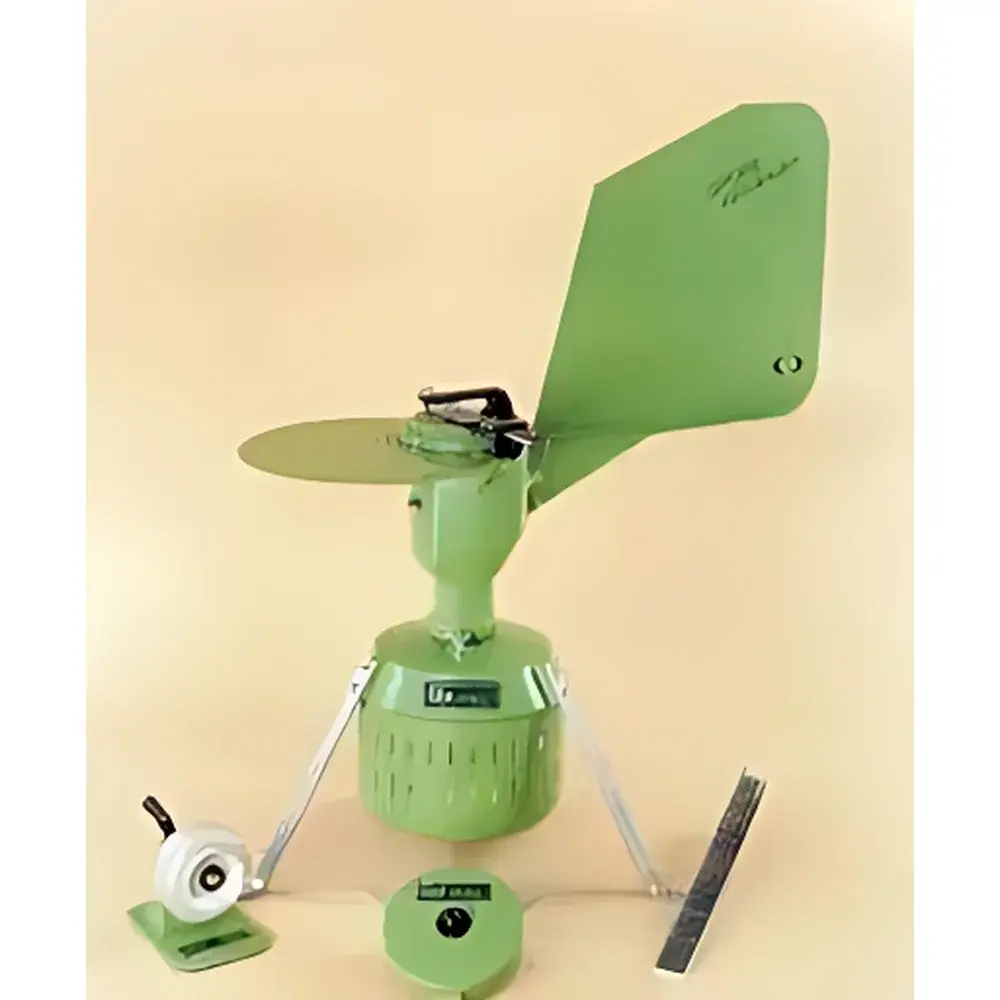
Burkard Hirst-1 7-Day/24-Hour Volumetric Spore Trap
| Brand | Burkard |
|---|---|
| Origin | United Kingdom |
| Model | Hirst-1 |
| Sampling Duration | 7 days (standard), optional 24-hour mode |
| Airflow Rate | 10 L/min |
| Orifice Dimensions | 2 mm × 14 mm |
| Drum Advancement | 2 mm/h |
| Clock Mechanism | Precision 7-jewel bearing movement |
| Sampling Surface | Adhesive polyester tape (200 mm standard scale) |
| Height | 94 cm |
| Sampling Radius | 53 cm |
| Sampling Area | 0.882 m² |
| Power Supply | 12 VDC, 240 VAC 50 Hz, or 110 VAC 60 Hz |
| Net Weight | 16 kg |
| Total Shipping Weight | 30 kg |
| Package Dimensions | 60 × 70 × 80 cm |
| Construction | Anodized aluminum housing with enamel-coated steel components |
Overview
The Burkard Hirst-1 7-Day/24-Hour Volumetric Spore Trap is a field-proven, gravimetric air sampling instrument engineered for long-term, unattended monitoring of airborne biological particulates—including fungal spores, pollen, and other respirable bioaerosols in the 1–10 µm aerodynamic diameter range. Based on the classic Hirst-type impactor principle first described in *Annals of Applied Biology* (1952, Vol. 39, pp. 257–265), the Hirst-1 employs inertial impaction onto a continuously moving adhesive tape surface to achieve quantitative, time-resolved collection. Air is drawn through a calibrated rectangular orifice (2 mm × 14 mm) at a constant volumetric flow rate of 10 L/min, generating sufficient particle inertia to deposit viable and non-viable spores onto a transparent polyester tape mounted on a precision drum. The drum advances at a fixed linear speed of 2 mm/h—driven by a robust, temperature-stable 7-jewel bearing clockwork mechanism—enabling direct temporal resolution of diurnal and weekly spore concentration profiles without manual intervention.
Key Features
- Unattended 7-day continuous operation with optional 24-hour configuration
- Volumetrically calibrated airflow (10 L/min) maintained via integrated vacuum pump with adjustable potentiometer or micrometer control
- Precision 7-jewel bearing clock mechanism ensures consistent drum advancement (2 mm/h) across ambient temperature fluctuations
- Interchangeable orifices optimized for enhanced collection efficiency of particles 1–10 µm in aerodynamic diameter
- Dual-power capability: operates from mains supply (240 VAC 50 Hz or 110 VAC 60 Hz), 12 VDC battery, or hybrid configurations
- Optional solar power kit includes compact 330 × 175 × 35 mm photovoltaic panel (1 kg), charge controller, and deep-cycle battery for fully autonomous 24/7 deployment
- Weather-resistant construction: anodized aluminum frame and enamel-coated steel components ensure corrosion resistance under prolonged outdoor exposure
- Integrated wind vane enables passive orientation to prevailing wind direction, improving representative sampling in variable meteorological conditions
- Ergonomic design: total system weight 30 kg (net instrument 16 kg) supports portable field deployment; drum loading facilitated by precision roller guide
Sample Compatibility & Compliance
The Hirst-1 is validated for collection and subsequent microscopic identification of a broad spectrum of airborne bioparticulates, including but not limited to Alternaria, Cladosporium, Aspergillus, Penicillium, and arboreal and herbaceous pollen grains. Its standardized orifice geometry, fixed airflow rate, and traceable tape advancement enable quantitative comparison across geographically dispersed monitoring networks. The instrument conforms to methodology referenced in ISO 21527-1:2008 (Microbiology of food and animal feeding stuffs — Horizontal method for the enumeration of yeasts and moulds — Part 1: Colony count technique in products with low microbial counts) and supports data generation aligned with WHO/EU guidance on allergenic pollen monitoring. While not intrinsically GLP/GMP-certified, its mechanical traceability, reproducible tape calibration (200 mm standard scale), and stable clockwork drive support audit-ready documentation when integrated into formal environmental surveillance protocols.
Software & Data Management
The Hirst-1 is a hardware-only, analog volumetric sampler—no embedded electronics or firmware are included. Data acquisition is inherently manual: collected tapes are removed post-sampling and analyzed microscopically using standardized counting grids (e.g., phase-contrast or brightfield microscopy at 400× magnification). Each 2 mm tape increment corresponds to one hour of sampling; full 7-day tapes yield 168 discrete hourly segments. Laboratories routinely digitize analysis workflows using image-capture systems paired with validated counting software (e.g., ImageJ macros compliant with EN 16813:2017). For regulatory traceability, users maintain logbooks documenting tape lot numbers, sampling start/end times, orifice ID, calibration verification dates, and environmental metadata (temperature, RH, wind speed)—practices consistent with FDA 21 CFR Part 11–aligned record-keeping where electronic records are generated downstream.
Applications
- Aerobiological surveillance for public health early warning systems (e.g., forecasting fungal allergy seasons)
- Environmental impact assessments near composting facilities, agricultural operations, or biowaste processing sites
- Validation of HVAC filtration efficacy in pharmaceutical cleanrooms and hospital isolation units
- Long-term ecological studies tracking phenological shifts in pollen release relative to climate variables
- Baseline monitoring for indoor air quality investigations in moisture-damaged buildings
- Reference-grade calibration and intercomparison studies for optical particle counters and real-time bioaerosol sensors
- Regulatory compliance monitoring under national air quality frameworks requiring spore-specific metrics (e.g., UK’s National Pollen and Aerobiology Research Unit protocols)
FAQ
What is the minimum detectable spore concentration using the Hirst-1?
The detection limit depends on microscope operator proficiency, tape adhesion uniformity, and spore morphology—but typical practical limits range from 1–5 spores/m³ for common taxa when analyzing full 24-hour tape segments.
Can the Hirst-1 be used indoors?
Yes, though its design prioritizes outdoor deployment; indoor use requires careful placement to avoid turbulence-induced sampling bias and should include concurrent meteorological logging for data interpretation.
Is tape replacement required daily?
No—tape is loaded once per sampling campaign (7 days or 24 hours); the 200 mm scale allows precise temporal segmentation without mid-run intervention.
Does Burkard provide calibration certificates?
Flow calibration is performed at the factory using NIST-traceable rotameters; users receive a certificate of conformance with each unit, and periodic recalibration is recommended annually or after mechanical servicing.
How does the solar kit ensure nighttime operation?
The integrated charge controller regulates energy storage in the sealed lead-acid battery during daylight hours, enabling uninterrupted 24-hour pump operation regardless of illumination conditions.



