
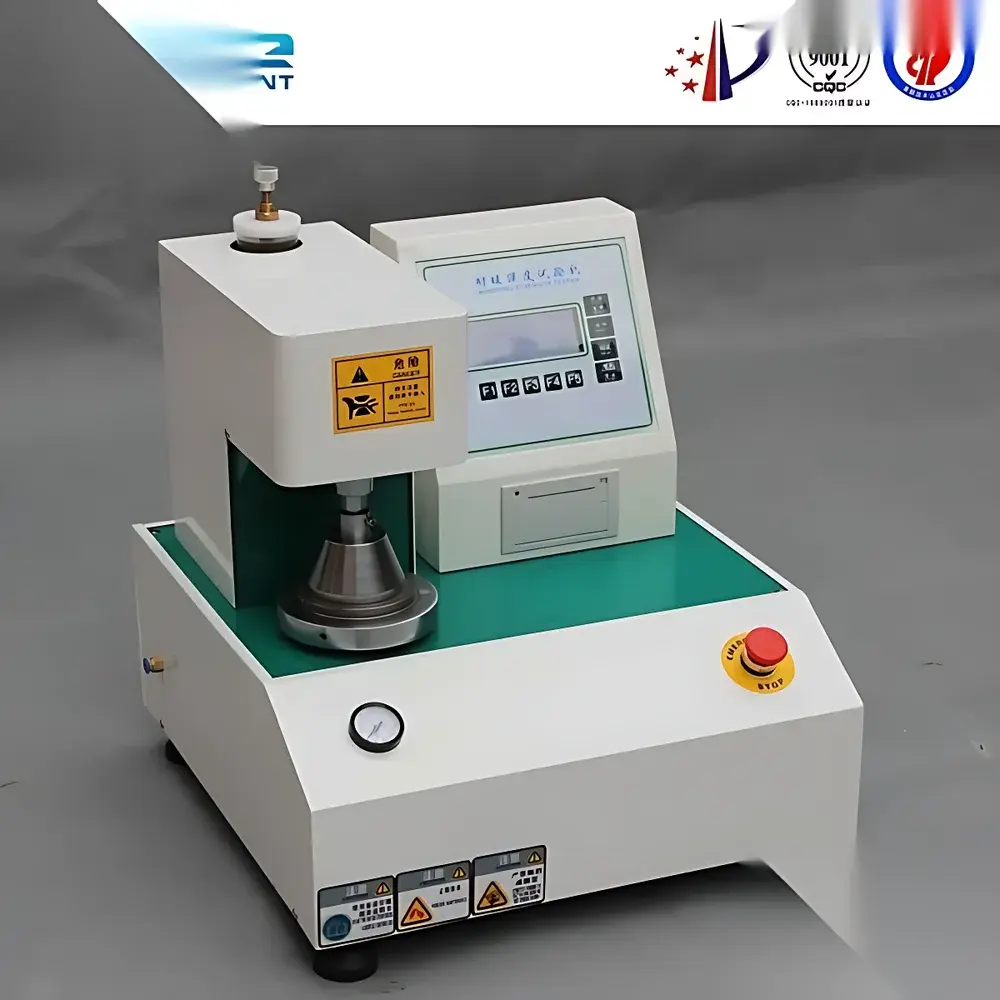
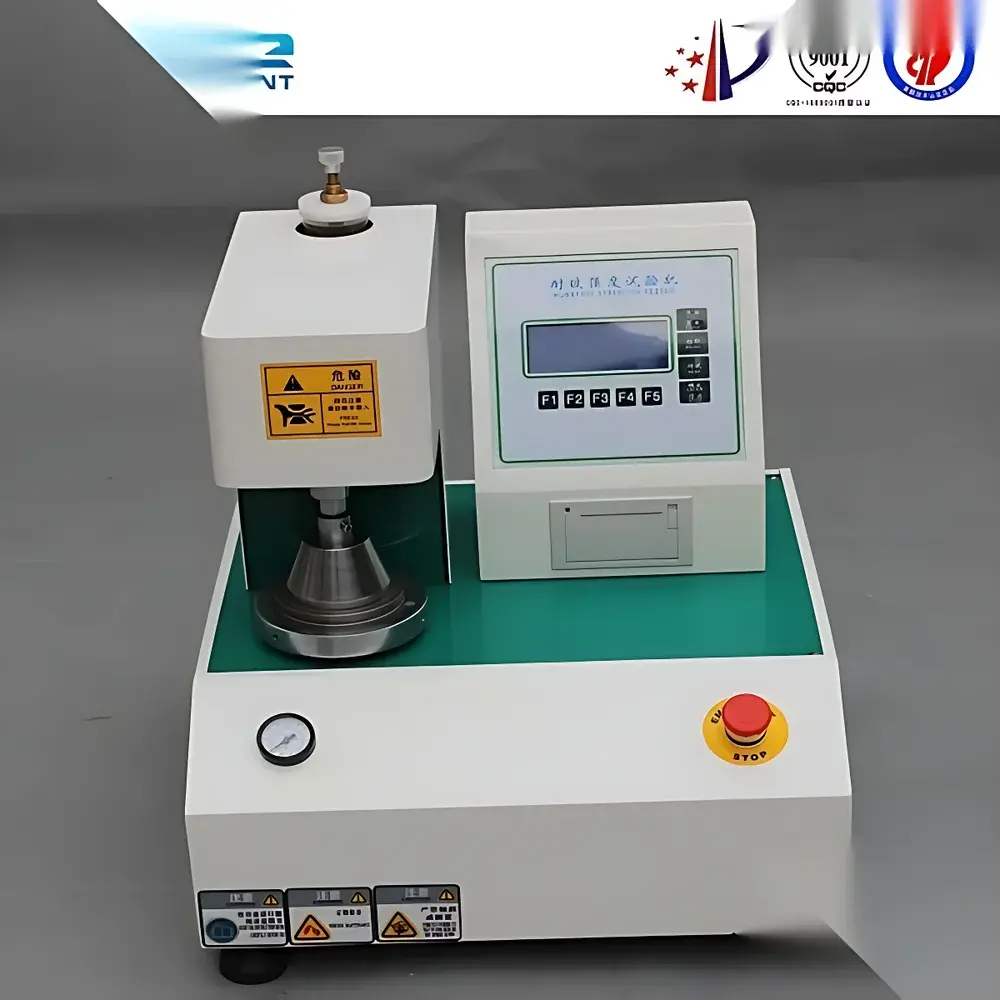
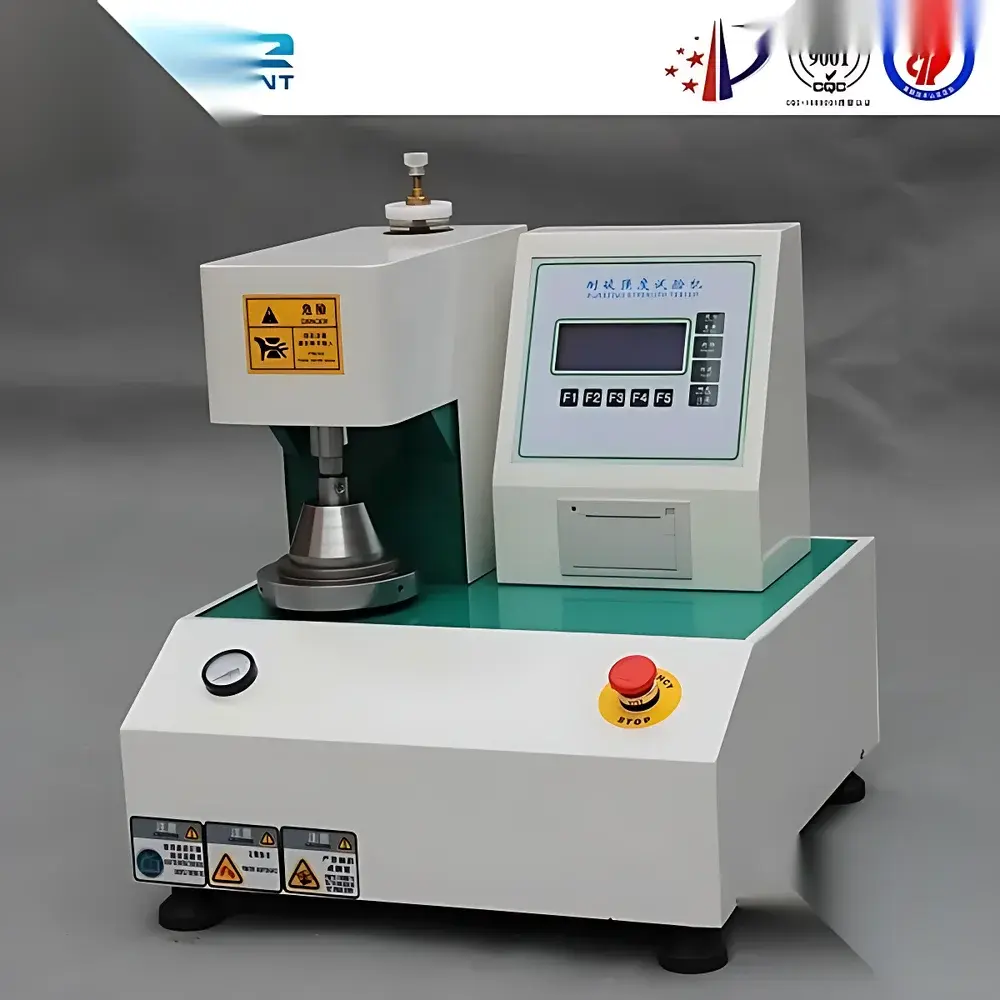
Bursting Strength Tester for Corrugated Boxes
| Brand | Generic |
|---|---|
| Origin | Imported |
| Manufacturer Type | Authorized Distributor |
| Price | USD 630 (FOB) |
| Standards Compliance | ISO 2759, ASTM D2210, TAPPI T403, GB/T 6545, JIS L1004/L1018/L1031, QB/T 1057 |
| Test Principle | Hydraulic (Silicone Oil-Based) Diaphragm Bursting |
| Clamping Method | Pneumatic Dual-Plate Clamp |
| Display | High-Resolution LCD with Onboard Data Storage (50 Tests) |
| Output | Integrated Thermal Printer |
| Safety | Emergency Stop Button, Real-Time Air Pressure Gauge |
| Sample Thickness Range | Up to 18 mm |
| Repeatability | ≤±2.0% (per ISO 2759 Annex B) |
Overview
The Bursting Strength Tester for Corrugated Boxes is a precision-engineered hydraulic testing instrument designed to quantify the bursting resistance of corrugated fiberboard, solid fiberboard, and other planar packaging materials. It operates on the fundamental principle of controlled diaphragm expansion: a flexible silicone oil–filled rubber diaphragm is hydraulically pressurized beneath a rigid, pneumatically clamped specimen until rupture occurs. The peak pressure—recorded in kilopascals (kPa)—directly reflects the material’s resistance to localized puncture and internal stress propagation under uniform radial loading. Unlike tensile or compressive strength tests, bursting strength captures the combined effect of fiber tensile strength, inter-fiber bonding integrity, and structural resilience against dynamic point-load failure—making it a critical QC parameter for logistics durability assessment. This instrument satisfies the mechanical test requirements defined in ISO 2759, ASTM D2210, TAPPI T403, and China’s GB/T 6545, ensuring data comparability across global supply chains and regulatory audits.
Key Features
- Hydraulic actuation system utilizing high-stability silicone oil—eliminates corrosion risks associated with traditional glycerin-water mixtures and extends service life of the pressure chamber and diaphragm assembly.
- Pneumatic dual-plate clamping mechanism ensures consistent, operator-independent sample fixation at 1.0 ± 0.1 MPa air pressure, minimizing edge slippage and pre-test deformation.
- Microprocessor-controlled load ramping with automatic rupture detection: system halts immediately upon pressure plateau collapse and returns the platen to home position without manual intervention.
- Backlit high-resolution LCD interface displays real-time pressure curve, peak burst value (kPa), date/time stamp, and test sequence ID; supports English-language menu navigation.
- Onboard non-volatile memory stores up to 50 complete test records—including burst strength, date, operator ID (user-input field), and pass/fail flag—retained during power loss.
- Integrated thermal printer outputs calibrated test reports compliant with GLP documentation standards: includes instrument ID, calibration due date, standard reference used, and raw kPa value with unit conversion (to lbf/in² if required).
- Dual-safety architecture: front-panel emergency stop switch interrupts all actuators and solenoids, while a calibrated analog air pressure gauge enables continuous verification of clamp integrity prior to each test cycle.
Sample Compatibility & Compliance
This tester accommodates flat, non-porous sheet materials up to 18 mm in thickness and 175 mm × 175 mm in planar dimension—including single- and multi-wall corrugated board (A-, B-, C-, E-, F-flute), solid bleached sulfate (SBS), recycled fiberboard, laminated kraft composites, synthetic leather, and tightly woven textiles. All mechanical and metrological performance criteria align with ISO/IEC 17025 traceability frameworks when paired with NIST-traceable pressure calibrators. Test reports generated meet documentation requirements for ISO 9001:2015 Clause 8.5.2 (Identification and traceability) and support FDA 21 CFR Part 11 readiness when integrated with validated LIMS platforms via RS-232 serial export.
Software & Data Management
While standalone operation requires no PC, optional RS-232 serial interface enables bidirectional communication with laboratory information management systems (LIMS) or custom QA databases. ASCII-formatted output includes ISO-compliant metadata headers (e.g., “STD:ISO2759-2021”, “CAL:2024-06-15”, “OPR:QA-07”) preceding each burst value. Firmware supports user-defined pass/fail thresholds per material grade; exceeding limits triggers audible alert and flags record for review. Audit trail functionality logs all parameter changes—including clamp pressure adjustments and calibration resets—with timestamp and operator code.
Applications
- Corrugated box manufacturers validating board grade conformity prior to die-cutting and folding.
- E-commerce fulfillment centers establishing maximum safe stack height for outbound pallets based on empirical burst strength vs. static compression correlation models.
- Automotive component suppliers verifying protective packaging integrity for shock-sensitive assemblies (e.g., ECUs, sensors) under warehouse-level humidity cycling.
- Footwear and luggage OEMs assessing synthetic leather burst resistance as proxy for seam pull-out resistance in carry-handle attachment zones.
- Food packaging R&D labs comparing barrier-coated paperboard formulations for retort sterilization survivability.
- Third-party certification bodies conducting accredited testing per ISTA 3A or ASTM D642 protocols where bursting strength serves as input to compression modeling.
FAQ
What is the recommended recalibration interval for this instrument?
Per ISO 2759 Annex C and internal quality policy, hydraulic pressure transducers shall be verified every 12 months using a NIST-traceable deadweight tester; diaphragm replacement is advised after 10,000 cycles or visible elastomer fatigue.
Can this tester evaluate wet-strength paperboard?
Yes—provided specimens are conditioned per ISO 187 (23°C ±1°C, 50% RH ±2%) prior to testing; optional humidity-controlled test chambers (sold separately) maintain environmental stability during burst event.
Is silicone oil servicing performed by the user or requires factory support?
Silicone oil top-up and diaphragm inspection are field-serviceable operations documented in the included technical manual; full hydraulic system flush requires certified technician dispatch.
Does the thermal printer support barcode label generation?
No—the printer outputs only alphanumeric test summaries; barcode integration requires external label software linked via RS-232 to the instrument’s data stream.
How is compliance with FDA 21 CFR Part 11 addressed?
The device itself is not Part 11–certified, but its audit-ready output format (time-stamped, operator-logged, uneditable printouts) satisfies predicate rule requirements when deployed within a validated procedural framework governed by site-specific SOPs.



