
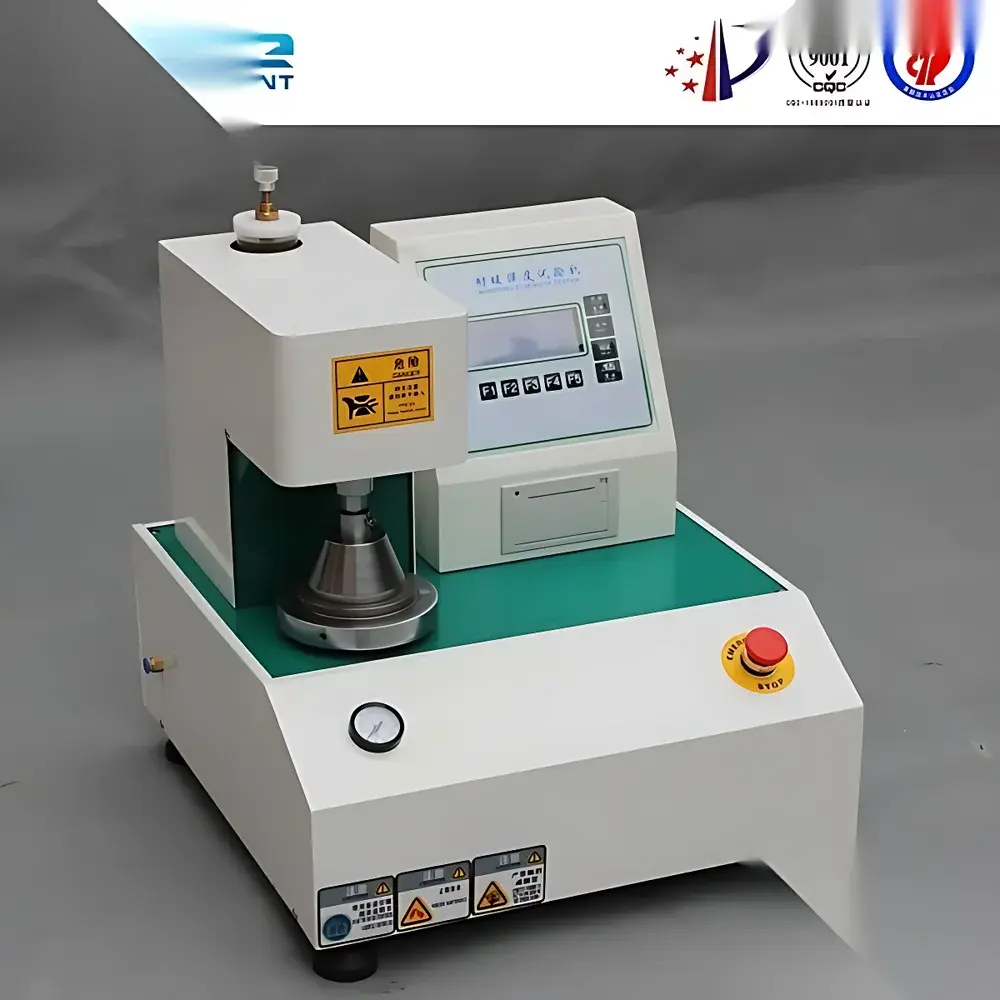
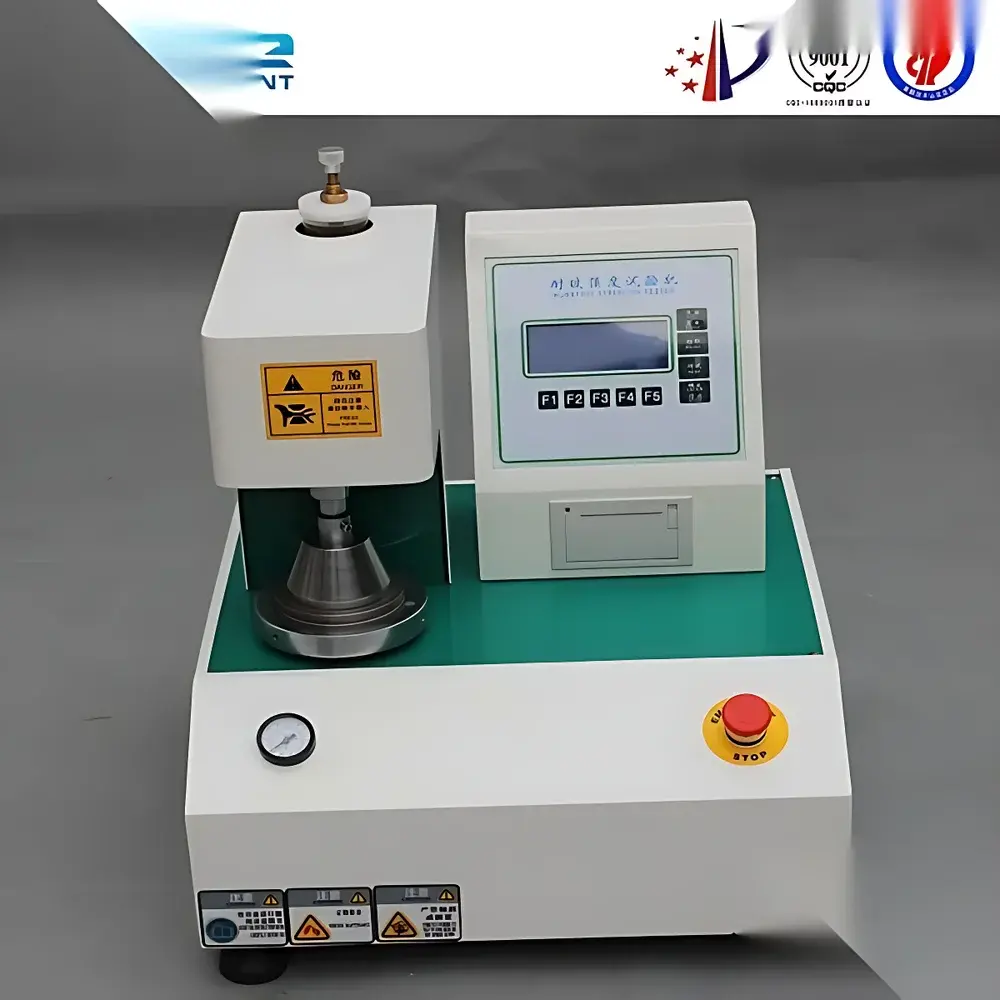
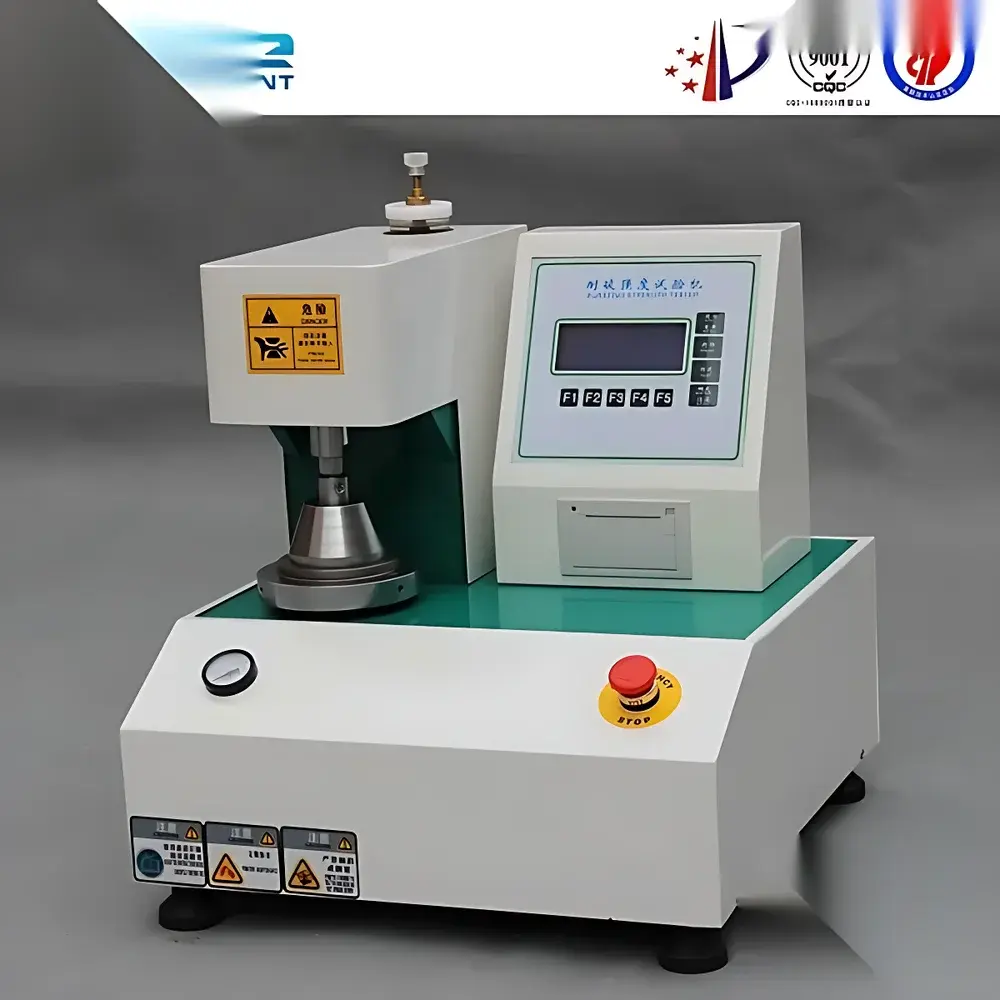
Bursting Strength Tester for Corrugated Boxes
| Brand | OEM |
|---|---|
| Origin | Imported |
| Manufacturer Type | Authorized Distributor |
| Price | USD 630 (FOB) |
| Standards Compliance | ISO 2759, ASTM D2210, TAPPI T403, GB/T 6545, JIS L1004/L1018/L1031, QB/T 1057 |
Overview
The Bursting Strength Tester for Corrugated Boxes is a precision-engineered mechanical testing instrument designed to quantify the resistance of paperboard and corrugated fiberboard to rupture under uniformly increasing hydraulic (or pneumatic-hydraulic hybrid) pressure. Based on the Mullen principle—where a flexible diaphragm applies radial, isotropic pressure against a clamped specimen until failure—the device measures bursting strength in kilopascals (kPa) or pounds per square inch (psi), directly correlating to the structural integrity of packaging under static stacking loads and dynamic handling stresses. This tester is not a universal tensile machine but a dedicated, standardized platform calibrated specifically for board-level burst resistance evaluation per international regulatory frameworks governing packaging performance validation.
Key Features
- Pneumatically actuated sample clamping system ensures consistent, repeatable clamping force across all test cycles—eliminating operator-induced variability and meeting ISO 2759’s requirement for uniform edge restraint.
- High-resolution LCD interface with real-time pressure curve visualization and numeric display of peak bursting force, elapsed time-to-failure, and test mode status.
- Automated test sequence: auto-clamp → pressurize → detect rupture → halt pressurization → return platen to home position—fully compliant with ASTM D2210’s procedural timing and termination criteria.
- Integrated silicon-oil-based hydraulic medium replaces traditional glycerin-water mixtures, reducing oxidation risk, minimizing maintenance intervals, and extending diaphragm service life by >40% under continuous lab operation.
- Onboard data storage capacity for up to 50 test records, each timestamped and indexed with burst value, unit, and test date—enabling traceability without external software dependency.
- Dual safety architecture: hardware-based emergency stop switch (IEC 60204-1 compliant) and pressure-limit override circuitry preventing over-pressurization beyond 1.2 MPa nominal range.
- Front-panel analog pressure gauge provides independent verification of system pressure—critical for GLP audit readiness and cross-checking digital sensor calibration.
- Thermal-stable aluminum alloy frame with vibration-dampening base minimizes environmental noise interference during low-force (<100 kPa) measurements on lightweight linerboards.
Sample Compatibility & Compliance
The instrument accepts flat, non-curling specimens measuring 100 mm × 100 mm (standard per ISO 2759 and GB/T 6545), accommodating single-wall, double-wall, and triple-wall corrugated boards; solid bleached sulfate (SBS) and recycled containerboard; laminated kraft composites; and coated synthetic leather or textile substrates used in premium packaging. All test protocols adhere strictly to method-defined conditioning requirements (ISO 187:23°C ±1°C / 50% RH ±2% for 24 h prior to testing). Full compliance documentation—including factory calibration certificates traceable to NIST standards, uncertainty budgets per ISO/IEC 17025, and conformity statements for EN 61000-6-2 (EMC) and EN 61000-6-4—is supplied with each unit.
Software & Data Management
While standalone operation requires no PC connection, optional USB-C interface enables export of stored test records as CSV files compatible with LIMS platforms (e.g., LabWare, Thermo Fisher SampleManager). The embedded firmware supports audit trail functionality: every parameter change (e.g., unit toggle, zero offset adjustment) is logged with user ID placeholder, timestamp, and pre-/post-value—satisfying FDA 21 CFR Part 11 electronic record requirements when paired with institutional electronic signature policy. Firmware updates are delivered via signed .bin files verified through SHA-256 hash matching, ensuring integrity during field deployment.
Applications
- Validation of corrugated box design against anticipated warehouse stack heights per ASTM D642 methodology.
- QC release testing of incoming linerboard and medium rolls at paper mills and converting facilities.
- Comparative analysis of starch vs. synthetic adhesive bond strength in flute formation.
- Accelerated aging studies assessing moisture-induced degradation of burst resistance in tropical climate simulations.
- Supplier qualification audits requiring third-party witnessed testing per IECQ QC 080000 or ISO 9001 clause 8.6.
- Supporting ISTA 3A/3E transport simulation reports where burst strength serves as a pass/fail gate for package integrity.
FAQ
What is the maximum measurable bursting strength?
The standard configuration measures up to 6000 kPa (870 psi) with ±0.5% full-scale accuracy, verified annually using certified reference standards from PTB Braunschweig.
Does the tester support automatic calibration verification?
Yes—integrated self-test routine validates zero drift and linearity before each test session using internal pressure transducer diagnostics.
Can it test wet-strength papers per ISO 3781?
With optional humidity-controlled specimen chamber (accessory part #BST-HC-01), samples can be conditioned and tested at defined RH levels up to 95% RH.
Is printer output required for ISO/IEC 17025 accreditation?
No—digital records meet Clause 7.5.2; however, the thermal printer provides immediate hardcopy for shift handover logs or customer-facing reports.
How often does the silicone oil require replacement?
Under typical usage (≤20 tests/day), oil replacement is recommended every 18 months or after 5,000 cycles—documented in the maintenance logbook included with shipment.



