
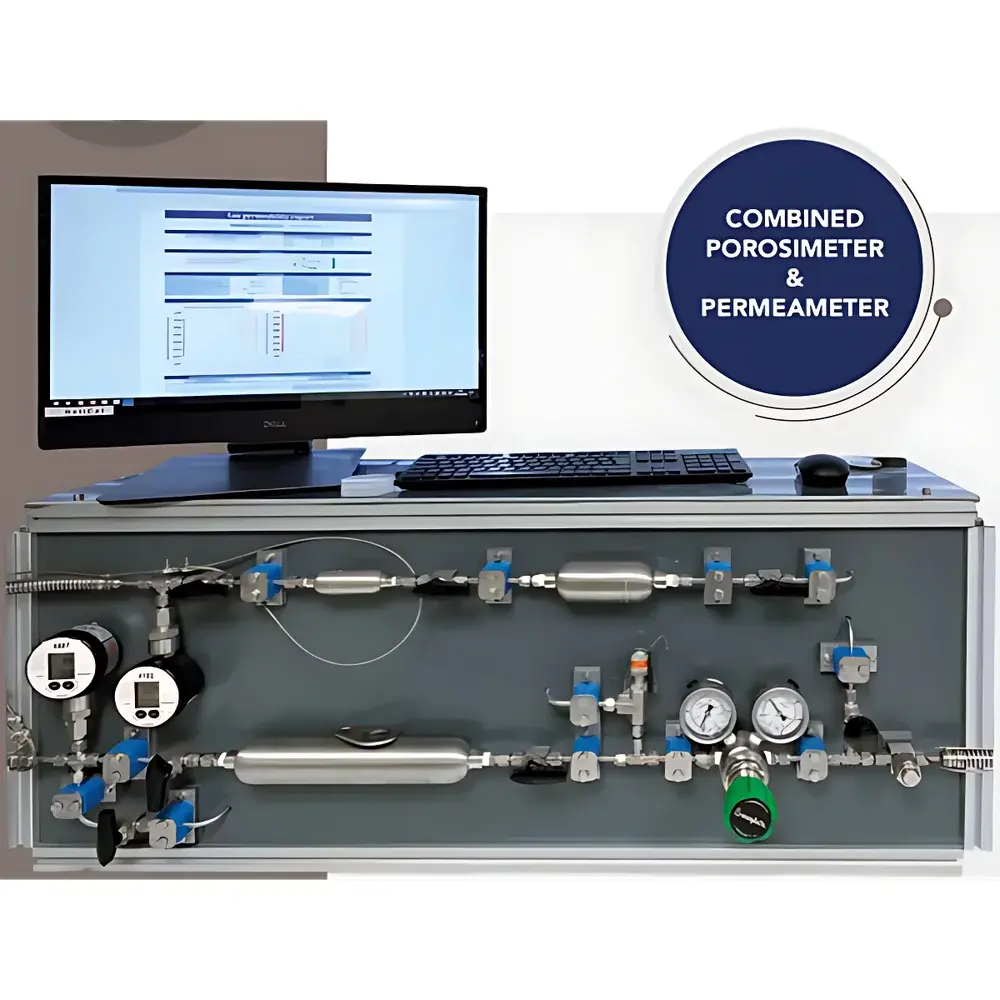
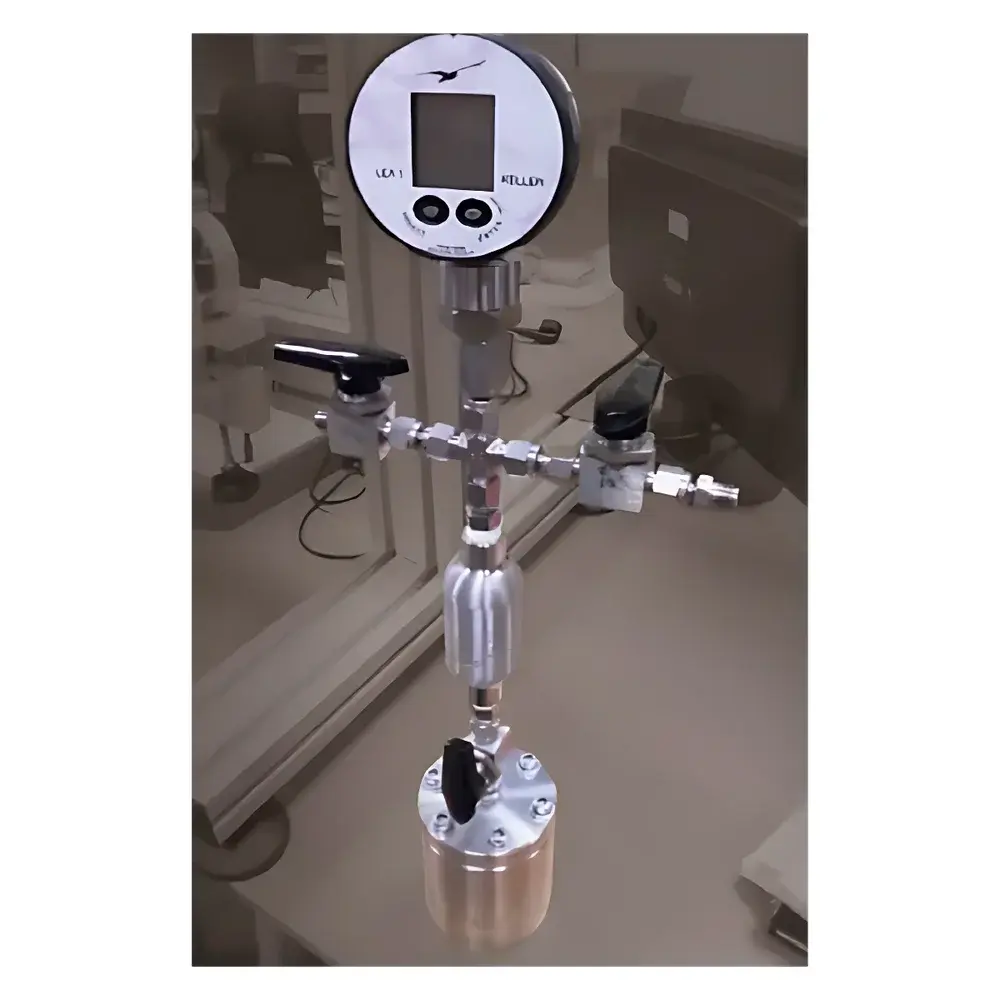
C2P Porosity and Permeability Analyzer
| Brand | Irian |
|---|---|
| Origin | France |
| Model | C2P |
| Import Status | Imported Instrument |
| Distribution Type | Authorized Distributor |
Overview
The C2P Porosity and Permeability Analyzer is a benchtop laboratory instrument engineered for the simultaneous, non-destructive quantification of absolute porosity and intrinsic permeability in rigid and semi-rigid solid materials. It operates on the principle of gas expansion (Boyle’s law-based pycnometry) coupled with steady-state Darcy flow measurement under controlled differential pressure. Designed for routine quality control and R&D applications in materials science, geoscience, ceramics, powder metallurgy, and filtration media development, the C2P delivers high reproducibility in both open-pore volume fraction (porosity, %) and gas-phase permeability (mD or µm²) across samples with pore diameters ranging from 10 nm to 500 µm. Its modular architecture integrates a dual-sensor pressure manifold, temperature-stabilized sample chamber, and calibrated mass flow controller—ensuring traceable measurements compliant with ISO 15701 (determination of permeability of porous sintered metals), ASTM D2854 (apparent density of activated carbon), and ISO 5017 (determination of apparent porosity of refractory products).
Key Features
- Integrated dual-mode measurement: Automated sequential execution of helium pycnometry (for skeletal density and total porosity) and nitrogen/air Darcy permeability testing (for intrinsic permeability at defined ΔP)
- Sample capacity: Accommodates cylindrical or irregular specimens up to 50 mm diameter × 60 mm height; compatible with standard core holders (ASTM D5084 geometry)
- Pressure control: High-resolution digital pressure regulators (0.01 kPa resolution) enabling precise ΔP steps from 1–200 kPa for permeability profiling
- Temperature stabilization: Peltier-controlled chamber (±0.1 °C stability) minimizes thermal drift during multi-point permeability scans
- Gas handling system: Dual-gas inlet (He/N₂) with automated purge-and-fill sequence; integrated moisture trap and particle filter to protect sensors
- Calibration traceability: Factory-calibrated against NIST-traceable reference standards; user-accessible calibration verification routines per ISO/IEC 17025 requirements
Sample Compatibility & Compliance
The C2P supports a broad range of low-to-medium permeability solids including sintered metal filters, ceramic membranes, geological core plugs (sandstone, limestone, shale), catalyst pellets, battery electrode substrates, and porous polymers. Sample preparation follows standardized protocols outlined in ISO 15701 Annex A and ASTM D6537. The instrument complies with CE marking directives (2014/30/EU EMC, 2014/35/EU LVD), meets IEC 61000-6-3 emission limits, and supports GLP/GMP documentation workflows through audit-trail-enabled software (see Software section). All measurement outputs are fully traceable to SI units via internal gravimetric and volumetric references.
Software & Data Management
The C2P is operated via Irian’s proprietary WinPoros™ v4.2 software, a Windows-based platform supporting local installation and network deployment. The interface provides real-time visualization of pressure transients, flow stabilization curves, and porosity-permeability cross-plots. Data export is available in CSV, XML, and PDF formats—with embedded metadata (operator ID, timestamp, environmental conditions, calibration status). For regulated environments, WinPoros™ includes 21 CFR Part 11-compliant features: electronic signatures, role-based access control, immutable audit trails, and automatic backup to network drives. Raw sensor logs and intermediate calculation files are retained for full reprocessing capability—essential for method validation and regulatory submissions.
Applications
- Quality assurance of porous filters used in pharmaceutical sterile filtration (per USP and ISO 4003)
- Permeability grading of catalyst support materials in petrochemical R&D
- Pore structure characterization of anode/cathode substrates in solid-state battery development
- Core analysis for reservoir simulation modeling in upstream oil & gas laboratories
- Comparative evaluation of sintering parameters in metal injection molding (MIM) process optimization
- Validation of pore interconnectivity in additive-manufactured lattice structures (ASTM F3122)
FAQ
What gases can be used for permeability measurement?
Nitrogen is the default test gas per ISO 15701; helium may be selected for low-permeability samples requiring higher diffusivity. Custom gas mixtures require prior validation.
Is sample drying required before testing?
Yes—samples must be dried to constant mass per ISO 15701 Section 6.2. Optional vacuum desiccation module (accessory C2P-DRY) is available.
Can the C2P measure effective permeability to liquids?
No—the C2P is configured exclusively for gas-phase permeability. Liquid permeability requires separate capillary flow porometry or hydraulic conductivity setups.
Does the system support automated batch processing?
Yes—WinPoros™ supports queued measurement sequences for up to 24 samples with auto-loading via optional robotic sample handler (C2P-RS24).
What maintenance intervals are recommended?
Pressure transducers require annual recalibration; gas filters should be replaced every 6 months or after 500 test cycles, whichever occurs first.



