
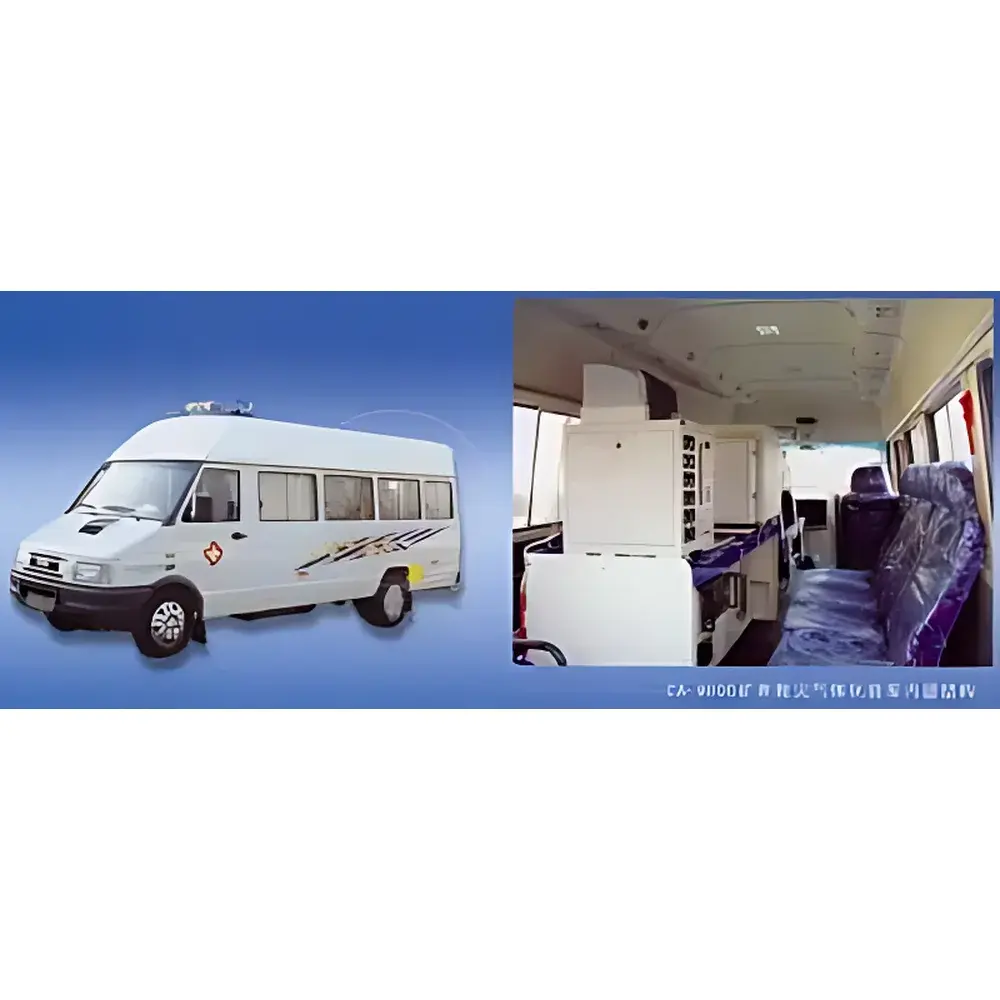
CA-9000 Mine Emergency Gas Analysis Mobile Laboratory Vehicle
| Origin | Beijing, China |
|---|---|
| Manufacturer Type | Authorized Distributor |
| Origin Category | Domestic (PRC) |
| Model | CA-9000 |
| Pricing | Available Upon Request |
Overview
The CA-9000 Mine Emergency Gas Analysis Mobile Laboratory Vehicle is a purpose-engineered, vehicle-mounted analytical platform designed for rapid deployment in coal mine emergency response scenarios. Built on a mid-size commercial van chassis and fully integrated with either the GC-4008B Coal Mine–Specific Gas Chromatograph or the GC-4085 Multi-Point Mine Gas Automatic Chromatographic Analyzer—both certified with China’s Coal Mine Safety Mark (MA)—the system delivers laboratory-grade gas quantification directly at incident sites. Its core measurement principle relies on gas chromatography (GC) with flame ionization detection (FID) and/or thermal conductivity detection (TCD), enabling precise separation and concentration determination of key hazard gases including CH₄, CO, C₂H₂, C₂H₄, C₂H₆, H₂, O₂, and CO₂. Engineered for operational continuity under field conditions, the CA-9000 incorporates structural reinforcement, climate-controlled instrument compartments, and redundant power management to sustain analytical integrity during transit and on-site operation.
Key Features
- Seismically optimized vibration-damping mounting system compliant with ISO 5343 for mobile instrumentation, ensuring column stability and retention time reproducibility across rough terrain typical of mining access roads.
- Pre-configured dual-power architecture: integrated uninterruptible power supply (UPS) with deep-cycle batteries and automatic generator start-up, supporting continuous GC operation for ≥8 hours without external grid connection.
- Onboard compressed gas manifold with certified high-purity carrier gases (He or N₂), zero-air, and calibration standards (certified multi-gas mixtures traceable to NIM/GB standards), pre-installed and pressure-regulated per ASTM D6245 requirements.
- Real-time data acquisition and visualization via embedded industrial PC running proprietary GC control software; results exportable in CSV, PDF, and XML formats compatible with mine safety information systems.
- Modular interface port for direct coupling with the SG-2003 Spontaneous Combustion Monitoring Bundle Tube System, enabling automated, unattended sampling from up to 32 distributed underground monitoring points without manual intervention.
- Full onboard consumables kit: spare columns (PLOT Al₂O₃/KCl and Hayesep D), septa, liners, filters, and validated QC check standards—pre-positioned for immediate deployment within ≤15 minutes of arrival.
Sample Compatibility & Compliance
The CA-9000 accepts gaseous samples collected via stainless-steel sampling cylinders, Tedlar® bags, or direct bundle-tube aspiration. It supports both discrete point sampling (e.g., ballon-sampled headspace from fire zones) and continuous stream analysis. All GC methods are developed and validated in accordance with GB/T 13729–2019 (Coal Mine Gas Chromatographic Analysis Method), AQ 1013–2005 (Safety Standard for Mine Gas Detection Instruments), and ISO 6142–2 (Gas Mixtures — Preparation by Pressure Method). The vehicle’s electrical system meets GB 3836.1–2021 (Explosion-Proof Electrical Equipment for Mining), and its structural modifications comply with national road transport safety regulations for special-purpose vehicles (GB 7258–2017).
Software & Data Management
The embedded acquisition software provides method scheduling, peak integration with baseline correction algorithms, automated calibration curve generation (linear and quadratic), and audit-trail logging per GLP principles. All analytical events—including instrument parameters, calibration history, user logins, and raw chromatograms—are timestamped and digitally signed. Data files adhere to ASTM E2524–22 (Standard Practice for Electronic Records in Analytical Laboratories) and support 21 CFR Part 11–compliant electronic signatures when deployed in regulated mine safety management systems. Remote diagnostics and firmware updates are supported via encrypted LTE module with configurable firewall policies.
Applications
- Rapid assessment of spontaneous combustion risk through real-time ethylene (C₂H₄) and acetylene (C₂H₂) trend analysis in return airways.
- Post-blast atmosphere verification for CH₄/O₂ ratio compliance prior to re-entry (per AQ 1029–2019).
- Fire zone boundary mapping via sequential sampling along ventilation ducts or boreholes.
- Validation of fixed-point online gas monitoring systems (e.g., KJ90, JSG-7) through mobile reference measurements.
- Regulatory reporting for provincial coal safety bureaus, including mandatory submission of GC-generated gas concentration logs during Level II/III emergency responses.
FAQ
Does the CA-9000 meet international explosion-proof certification standards such as ATEX or IECEx?
No—the CA-9000 is certified exclusively to Chinese national standards (GB 3836 series) and carries the MA safety mark required for use in PRC coal mines. It is not ATEX- or IECEx-certified.
Can the GC-4085 analyzer be upgraded to support sulfur compound detection (e.g., SO₂, H₂S)?
Yes—upon request, the system can be configured with a sulfur-specific pulsed flame photometric detector (PFPD) and appropriate column chemistry, subject to additional validation per GB/T 33645–2017.
What is the minimum detectable concentration for CO using the standard FID/TCD configuration?
The validated limit of quantitation (LOQ) for CO is 0.5 ppm (v/v) with a relative standard deviation (RSD) of ≤3.2% (n=6) under routine field operating conditions.
Is remote data transmission to central mine dispatch centers supported out-of-the-box?
Yes—the vehicle includes OPC UA server functionality and Modbus TCP gateway, enabling seamless integration with SCADA platforms used by major state-owned coal enterprises (e.g., China Energy, Shenhua Group).
How frequently must the onboard calibration gases be recertified?
Per GB/T 5274–2018, certified reference materials must be replaced or re-certified every 12 months—or after 200 injections—whichever occurs first. The system logs all calibration events automatically.
Related Products







