
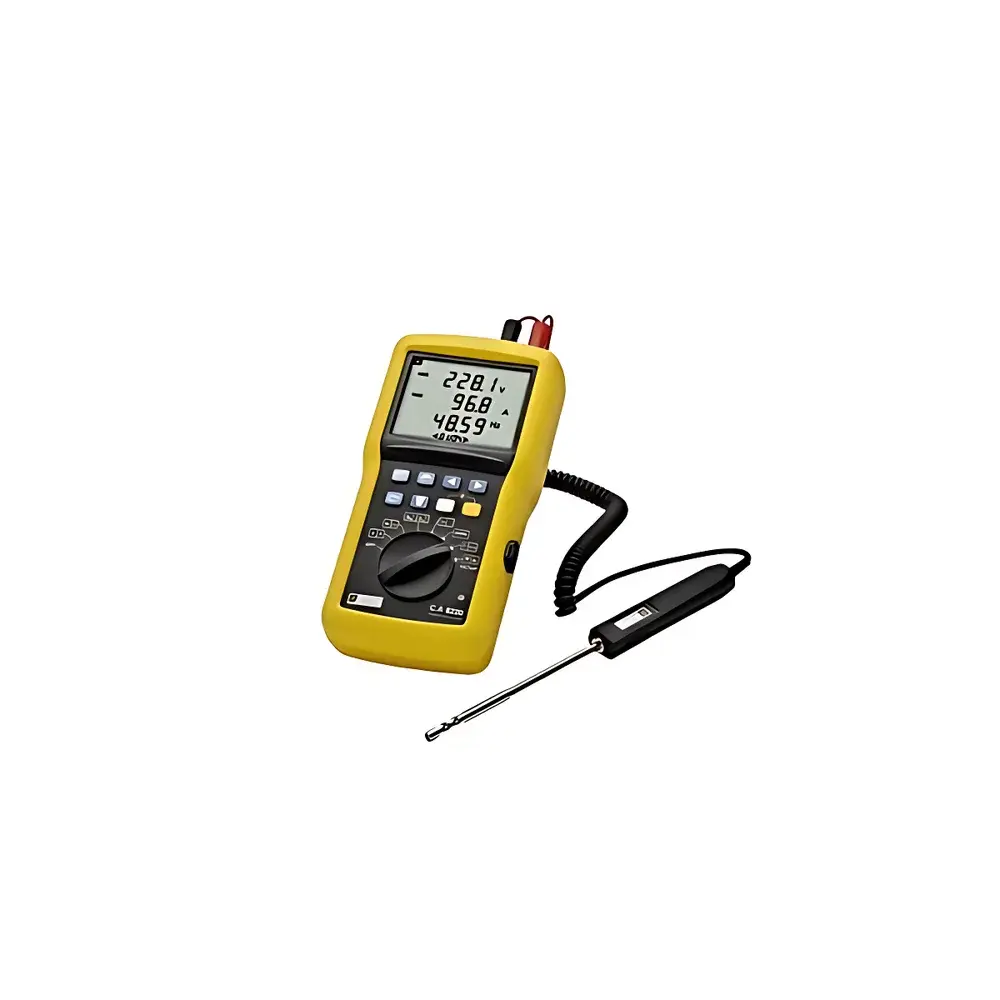
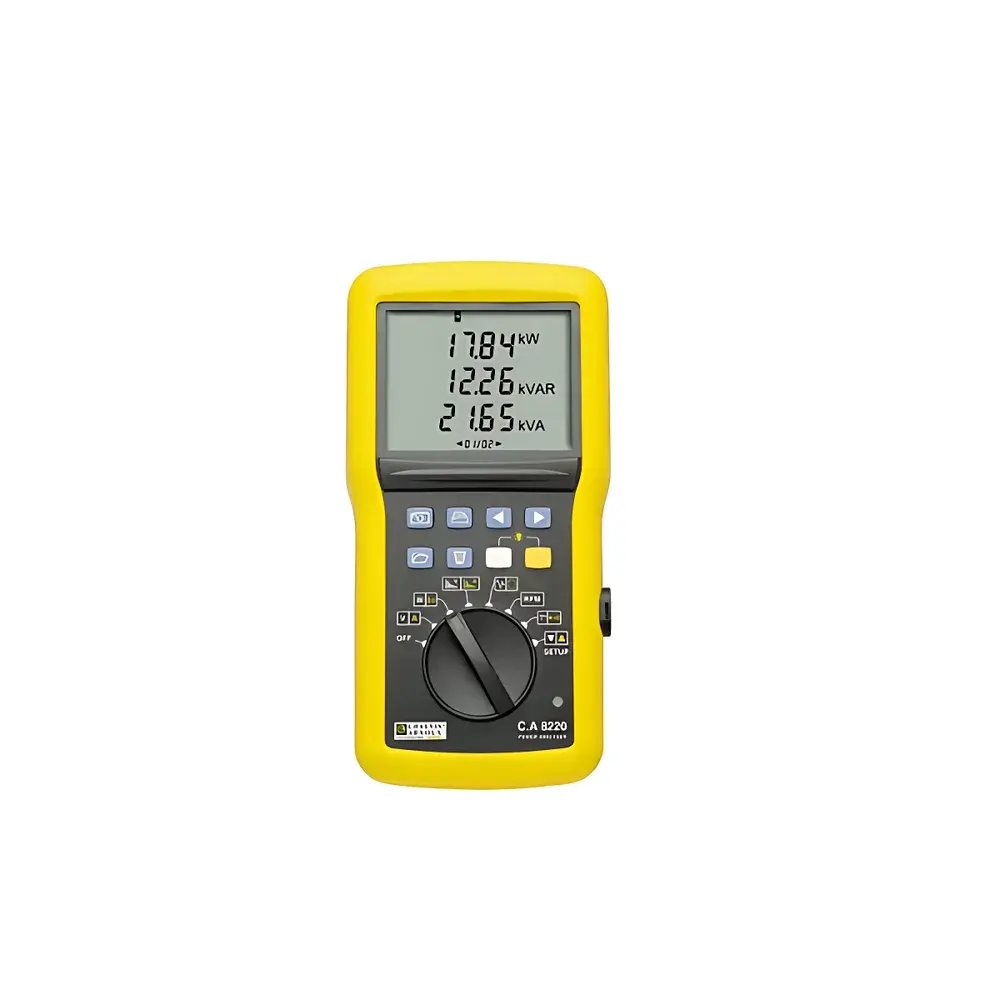
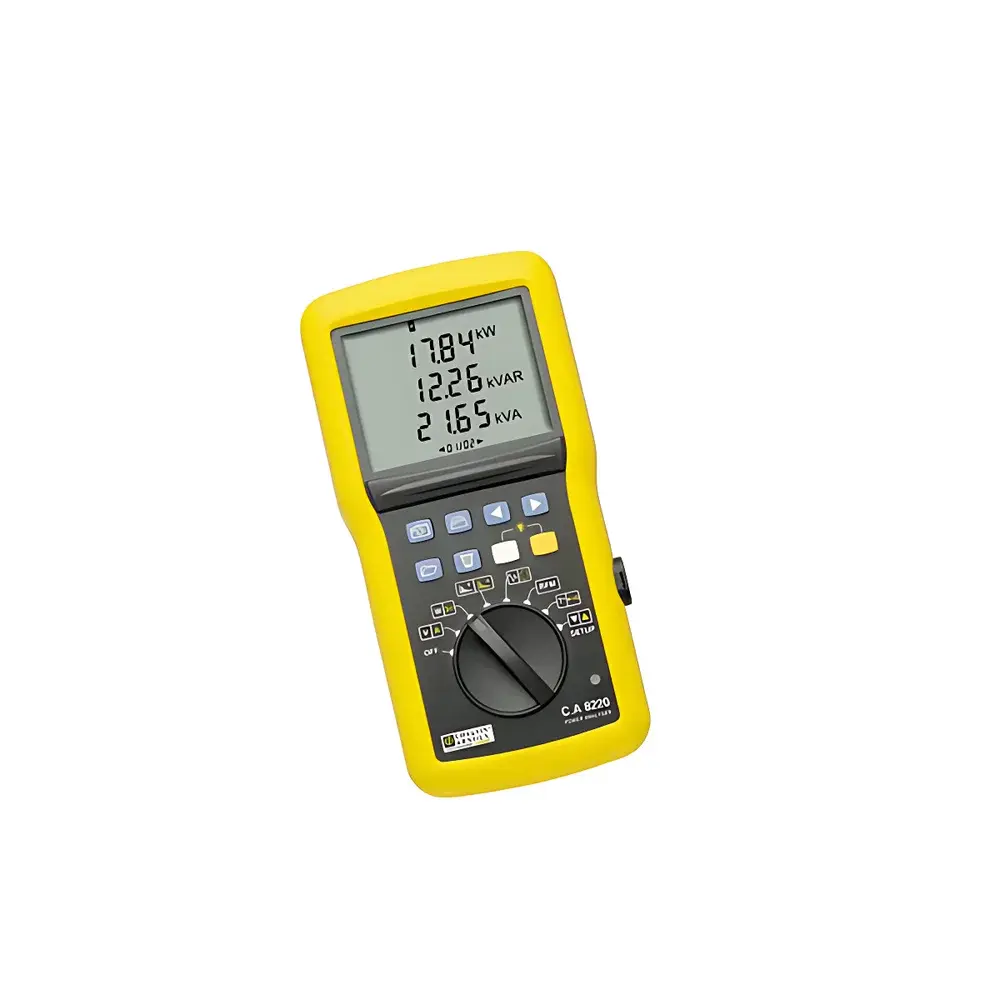
CA Technologies CA8220 Motor Power Analyzer
| Brand | CA (France) |
|---|---|
| Origin | France |
| Model | CA8220 |
| Voltage Range | 6–600 V AC/DC (True RMS), ±(0.5% + 2 digits) |
| Current Range | 100 mA–6500 A AC (clamp-dependent), ±(0.5% + 1 digit) |
| Frequency Range | 40–70 Hz |
| THD Measurement | up to 50th harmonic (voltage & current), THD-F and THD-R |
| Motor Speed | 6–120,000 rpm, ±0.5% |
| Temperature (Pt100) | −200 °C to +850 °C, ±(1% + 10 digits) |
| Resistance | 0.0–2000 Ω, ±(0.5% + 2 Ω) |
| Display | 173-segment backlit LCD |
| Data Logging | Internal storage with time-stamped records |
| Connectivity | RS232 & USB |
| Safety Rating | IEC 61010-1, CAT III 600 V |
| Ingress Protection | IP54 |
| Dimensions | 211 × 108 × 60 mm |
| Weight | 840 g (with batteries) |
Overview
The CA Technologies CA8220 Motor Power Analyzer is a portable, field-deployable instrumentation system engineered for comprehensive electrical and electromechanical characterization of rotating machinery—particularly induction and synchronous motors—in industrial, utility, and maintenance environments. Built upon a dual-domain measurement architecture, it simultaneously acquires and correlates electrical parameters (voltage, current, power, harmonics, phase sequence) with mechanical operational metrics (rotational speed, winding temperature) via optional external transducers. Its core measurement methodology adheres to IEEE 115 and IEC 61000-4-30 Class S compliance principles for power quality monitoring, while its motor-specific functionality supports predictive maintenance workflows aligned with ISO 55001 asset management frameworks. The device operates as a standalone diagnostic tool or integrates into broader condition monitoring systems via standardized serial data export.
Key Features
- Simultaneous acquisition of true RMS voltage (6–600 V AC/DC) and current (up to 6500 A AC with appropriate clamp sensors), with class-leading accuracy per IEC 61000-4-30 Annex B: ±(0.5% + 2 digits) for voltage and ±(0.5% + 1 digit) for AC current.
- Real-time computation of active (W), reactive (var), and apparent (VA) power; displacement power factor (DPF); and conventional power factor (PF) for both single-phase and balanced three-phase systems.
- Comprehensive harmonic analysis up to the 50th order—including magnitude, phase angle, and percentage relative to fundamental—with support for both THD-F (fundamental-based) and THD-R (RMS-based) calculation modes per IEC 61000-2-2 and IEEE 519.
- Dedicated motor diagnostics mode enabling synchronized capture of inrush current waveforms—including peak amplitude, duration, and decay profile—with automatic timestamping and event-triggered storage.
- Integrated support for external Pt100 RTD probes (−200 °C to +850 °C) and optical or magnetic speed sensors (6–120,000 rpm), allowing concurrent thermal and rotational assessment during energized operation.
- Ruggedized enclosure rated IP54 for dust and water resistance, conforming to IEC 61010-1 CAT III 600 V safety requirements; powered by six AA alkaline cells for extended field deployment without external power sources.
Sample Compatibility & Compliance
The CA8220 is designed for direct connection to low-voltage AC and DC distribution systems feeding motors up to 2 MW nominal output. It accommodates standard Rogowski coils, flexible current clamps, and rigid jaw clamps (e.g., CA 43, CA 45 series) without recalibration. All electrical measurements comply with IEC 61000-4-30 Class S for power quality instrumentation and meet the uncertainty budgets defined in EN 50160 for supply voltage characteristics. Thermal measurements using Pt100 sensors satisfy IEC 60751 tolerance Class B specifications. The instrument’s firmware implements audit-trail-capable data logging compliant with GLP principles, and raw measurement files are exportable in CSV format for traceability in regulated environments (e.g., pharmaceutical or food processing facilities subject to FDA 21 CFR Part 11).
Software & Data Management
Data retrieval occurs via bidirectional RS232 or USB interface using CA’s proprietary PC application—compatible with Windows 10/11—supporting configuration upload/download, waveform visualization, harmonic spectrum plotting, and customizable report generation (PDF/Excel). Each stored record includes embedded metadata: timestamp (RTC-synchronized), measurement mode, sensor ID, and environmental conditions (ambient temperature/humidity logged at time of capture). Internal memory retains up to 10,000 time-stamped parameter sets with user-defined sampling intervals (1 s to 1 h). Firmware updates are delivered through signed binary packages to ensure integrity and version control across fleet deployments.
Applications
- Motor inrush current profiling and electromagnetic torque estimation during startup transients.
- Phase sequence verification prior to commissioning or after rewiring of three-phase motor circuits.
- Thermal rise monitoring of stator windings under load to detect insulation degradation or cooling inefficiencies.
- Power factor correction assessment and capacitor bank sizing validation.
- Harmonic distortion mapping to identify nonlinear load interactions affecting motor efficiency and bearing currents.
- Baseline performance benchmarking for critical rotating assets in preventive and predictive maintenance programs.
- Energy consumption auditing (kWh, kvarh, kVAh) across feeder circuits to support ISO 50001 energy management system implementation.
FAQ
Does the CA8220 support unbalanced three-phase measurements?
It calculates power and harmonics assuming balanced conditions; for unbalanced systems, individual phase measurements must be recorded separately and post-processed.
Can harmonic data be exported for FFT analysis in third-party software?
Yes—harmonic magnitude and phase data for orders 1–50 are exportable as tab-delimited ASCII files compatible with MATLAB, Python (NumPy/Pandas), and DIAdem.
Is calibration traceable to national standards?
All factory calibrations are performed against primary standards maintained at CA’s accredited metrology lab (ISO/IEC 17025 certified), with full certificate of calibration provided upon request.
What is the maximum sampling rate for transient capture during motor startup?
The device captures voltage and current waveforms at 10.24 kS/s per channel, sufficient to resolve sub-cycle events such as contactor bounce or semiconductor switching artifacts.
Does the instrument support Modbus RTU or other industrial protocols?
No—communication is limited to ASCII-based serial commands over RS232/USB; integration with SCADA or DCS requires custom middleware or gateway translation.




