
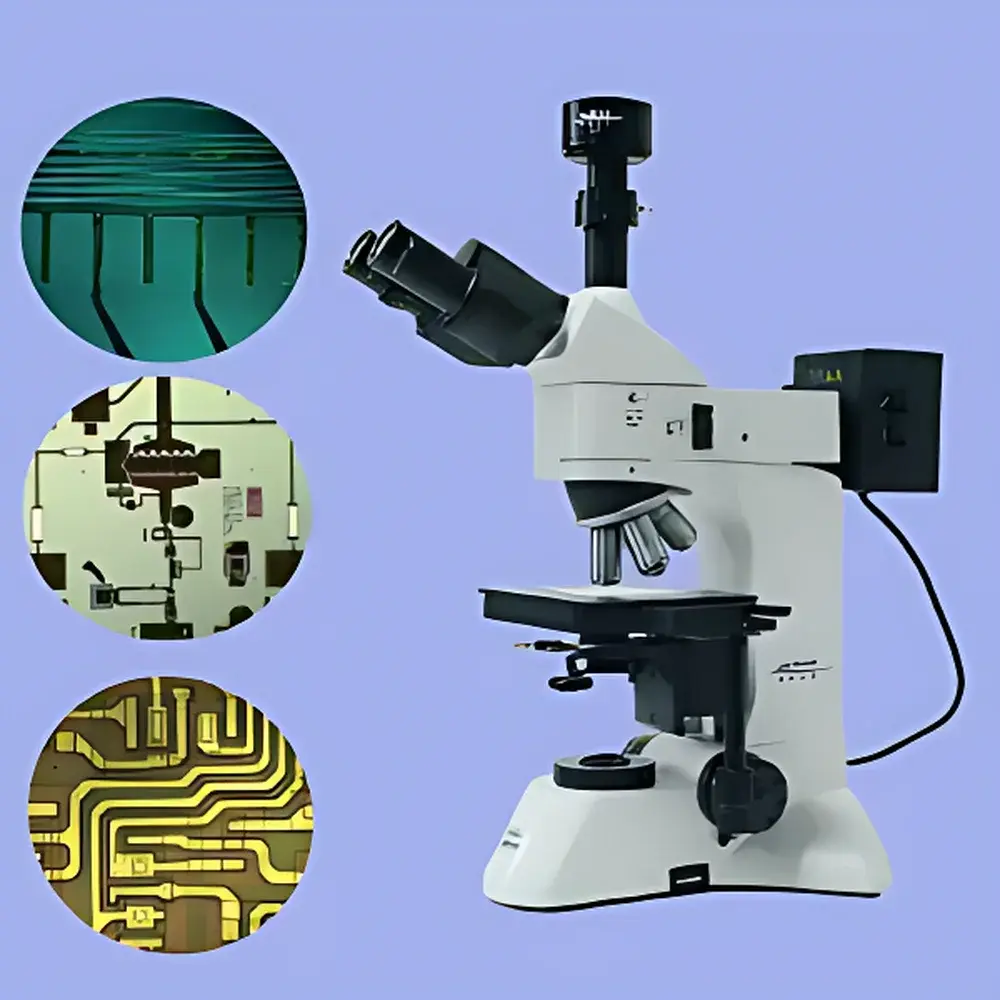
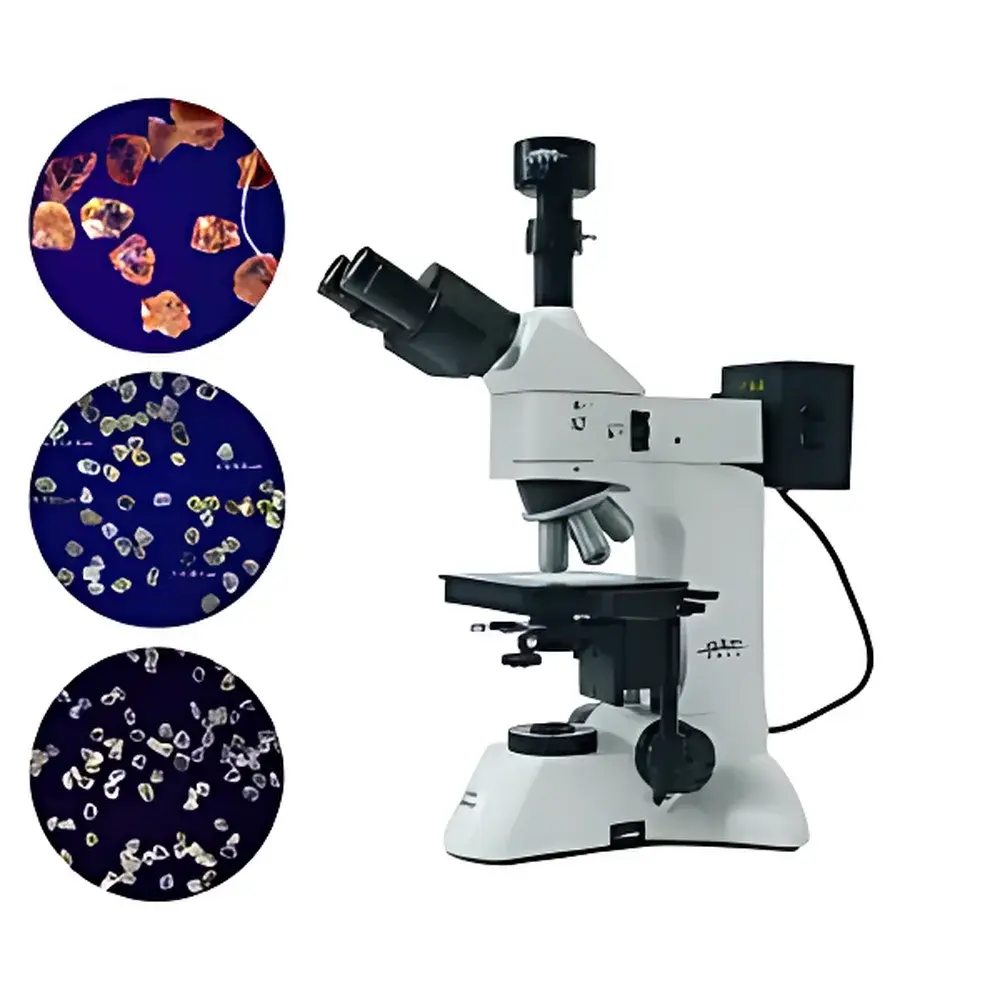
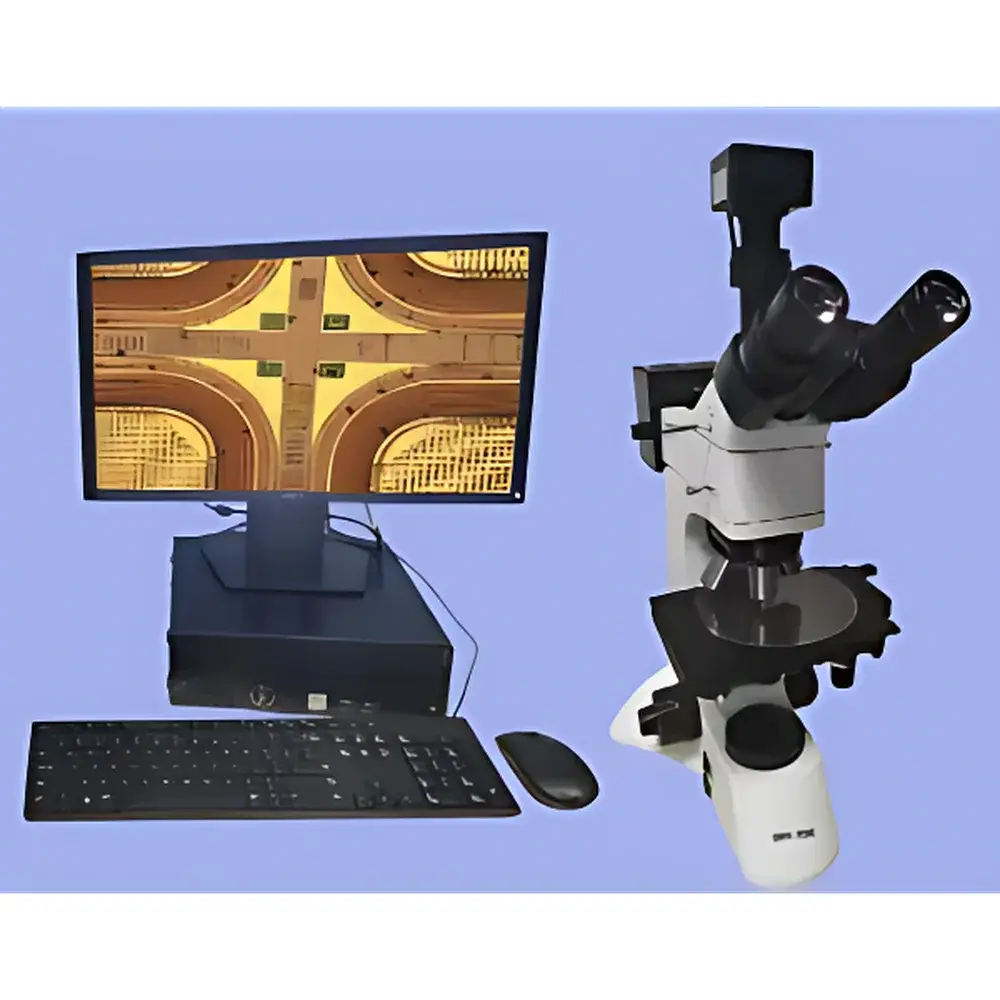
Caikon DMM-900C Inverted-Style Upright Reflected/Transmitted Light Metallurgical Microscope with Integrated 5-MP Digital Imaging System
| Brand | Caikon Optical |
|---|---|
| Origin | Shanghai, China |
| Manufacturer Type | Direct Manufacturer |
| Product Category | Upright Metallurgical Microscope |
| Equipped with Image Analysis Software | Yes |
| Total Optical Magnification | 50×–500× (up to 2000× with system magnification) |
| Eyepiece | Wide-Field 10× (Φ22 mm) |
| Objective Lenses | PL 5×/0.12, PL 10×/0.25, PL 40×/0.60 (spring-loaded), PL 60×/0.70 (spring-loaded) |
| Focusing Mechanism | Coaxial coarse/fine focus, fine adjustment graduation: 2 µm |
| Illumination | 6 V / 30 W halogen lamp (adjustable brightness, Köhler illumination for both epi- and trans-illumination) |
| Stage | Dual-layer mechanical stage (210 × 140 mm, travel range 75 × 50 mm) |
| Polarization System | Insertable polarizer/analyzer, 360° rotatable analyzer, removable from optical path |
| Camera | CK-500 Color CMOS Camera (2560 × 1920 resolution, 12-bit A/D, USB 2.0 interface, 22 fps at full resolution) |
| Software | Full-featured metallurgical image analysis suite supporting measurement (≥1 µm accuracy), annotation, report generation (PDF/CSV/XLS), GLP-compliant audit trail logging, and ISO 13079-compliant grain size evaluation |
Overview
The Caikon DMM-900C is an upright, dual-path (reflected and transmitted light) metallurgical microscope engineered for high-fidelity microstructural characterization of opaque, semi-transparent, and granular specimens—including metallographic sections, coated surfaces, powder aggregates, and electronic interconnects. Its infinity-corrected optical architecture incorporates plan achromatic objectives optimized for cover-slip-free observation, delivering flat-field imaging with minimal chromatic aberration across the full field of view. The instrument employs Köhler illumination for both incident (epi-) and transmitted light paths—ensuring uniform intensity distribution, precise contrast control via adjustable field and aperture diaphragms, and compatibility with quantitative brightfield, darkfield, and polarization contrast modes. Designed for laboratory-grade reproducibility, the DMM-900C conforms to core metrological principles outlined in ASTM E3-22 (Standard Guide for Preparation of Metallographic Specimens) and ISO 4967 (Steel—Determination of Content of Nonmetallic Inclusions—Micrographic Method Using Standard Diagrams). Its rigid mechanical platform, coaxial focusing with 2 µm fine-adjustment resolution, and ergonomic trinocular head support extended operator use while maintaining alignment stability under repeated thermal and mechanical loading.
Key Features
- Infinity-corrected plan achromatic objective lens set (PL 5×, 10×, 40×, 60×) with long working distances (3.18–26.1 mm) and spring-loaded front elements for safe contact with rough or coated samples.
- Trinocular observation tube with 30° inclination, interpupillary adjustment (55–75 mm), ±5 diopter eyepiece compensation, and integrated analyzer for rapid switching between standard and polarized light observation—100% beam-splitting capability enables simultaneous visual inspection and digital capture.
- Dual independent illumination systems: reflected-light Köhler optics with blue/yellow/green/frosted filter turret and adjustable filament positioning; transmitted-light Abbe condenser (NA 1.25) with centering and vertical height adjustment, enabling precise critical illumination for thin-sectioned or transparent specimens.
- Mechanically robust dual-layer mechanical stage (210 × 140 mm footprint, 75 × 50 mm travel range) with vernier scales and non-slip motion control—designed for repeatable coordinate referencing during serial sectioning or multi-site mapping workflows.
- Integrated CK-500 5-megapixel color imaging system featuring Sony 1/2.8″ CMOS sensor (2.0 µm pixel pitch), 12-bit analog-to-digital conversion, and USB 2.0 interface (480 Mbps)—delivering stable, low-noise acquisition at up to 22 fps (2560 × 1920) with hardware-level rolling shutter control and automatic/manual exposure tuning.
Sample Compatibility & Compliance
The DMM-900C accommodates a broad spectrum of metallurgical and materials science specimens: polished metallographic mounts (ferrous/non-ferrous alloys), electroplated cross-sections (e.g., Ni/Cu/Sn layers on PCBs), sintered ceramics, composite reinforcements, mineral thin sections, and particulate dispersions on conductive substrates. Its dual illumination mode supports ASTM B487 (coating thickness measurement by microscopy), ISO 643 (steel microstructure classification), and USP <788> (particulate matter testing in injectables) protocols. All optical components meet RoHS Directive 2011/65/EU material restrictions. The system’s software architecture supports FDA 21 CFR Part 11-compliant user authentication, electronic signatures, and immutable audit trails—enabling deployment in GMP-regulated QC laboratories and GLP-certified research facilities.
Software & Data Management
The bundled metallurgical image analysis software provides calibrated geometric measurement (point-to-point distance, angle, circle diameter, area, perimeter) with sub-micron precision (≤1 µm uncertainty traceable to NIST-traceable stage micrometers). Tools include dynamic ROI selection, background subtraction, histogram-based thresholding, multi-layer annotation (scale bars, text labels, arrows), and automated grain boundary detection per ASTM E112. Data export supports PDF reports (with embedded metadata), CSV tabular outputs for statistical process control (SPC), and XLSX-compatible structured datasets. Image archives are stored in lossless TIFF format with EXIF metadata (magnification, objective ID, exposure time, gain setting), ensuring full experimental traceability. Software updates are delivered via secure HTTPS channel with SHA-256 signature verification.
Applications
- Quantitative metallography: grain size analysis (ASTM E112, ISO 643), inclusion rating (ASTM E45), phase fraction determination (ferrite/austenite ratio in duplex stainless steels).
- Coating and plating metrology: thickness profiling of electroplated layers (Zn, Cr, Ni), adhesion failure analysis, porosity quantification in thermal spray coatings.
- Failure analysis: crack propagation mapping, void clustering assessment in castings, solder joint integrity evaluation in microelectronics packaging.
- Materials R&D: particle size distribution of metal powders (ISO 13322-1), dispersion homogeneity in metal matrix composites, oxide scale morphology on high-temperature alloys.
- Quality assurance: incoming raw material inspection (e.g., graphite nodule count in ductile iron), in-process verification of heat treatment cycles, final product release testing per customer specifications.
FAQ
What is the maximum usable magnification for quantitative measurements?
For reliable dimensional metrology, the recommended upper limit is 1000× system magnification (e.g., 10× eyepiece × 100× objective); beyond this, diffraction-limited resolution restricts meaningful feature discrimination.
Does the system support automated focus stacking?
Yes—the CK-500 camera and software support Z-stack acquisition with programmable step intervals (1–100 µm) and real-time focus map generation for extended depth-of-field reconstruction.
Can the microscope be integrated into a LIMS environment?
The software exports structured CSV and XML metadata files compatible with common LIMS APIs; custom database connectors (ODBC/JDBC) can be commissioned upon request.
Is calibration certification included with purchase?
A factory-issued certificate of conformance (including stage micrometer verification and illumination uniformity test report) is provided; optional UKAS-accredited calibration (ISO/IEC 17025) is available as a value-added service.
What maintenance intervals are recommended for halogen illumination?
Lamp replacement is advised every 1,200 operating hours; periodic cleaning of collector lenses and condenser optics (using lens-grade acetone and lint-free wipes) is recommended every 6 months under continuous use.




