
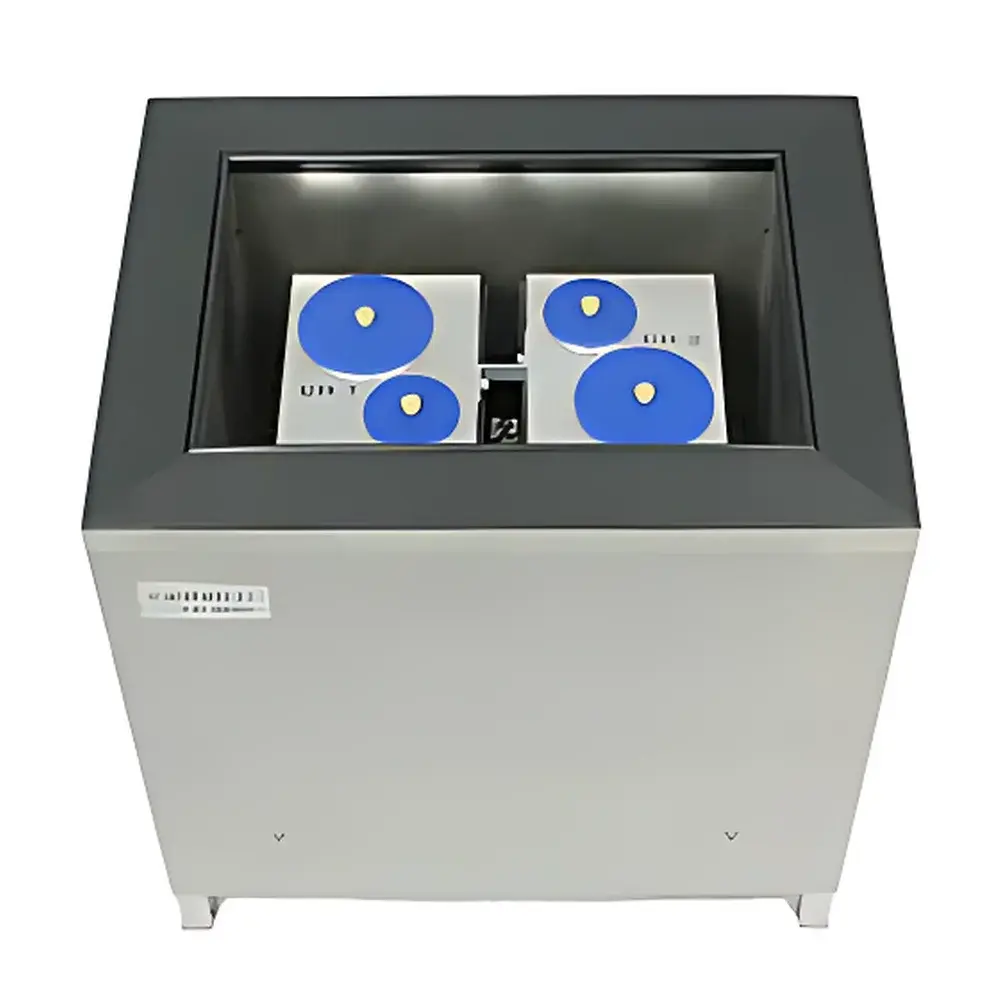
Calmetrix Biocal 2000 Isothermal Microcalorimeter
| Brand | Calmetrix |
|---|---|
| Origin | USA |
| Model | Biocal 2000 |
| Sample Volume Capacity | 125 mL per channel |
| Temperature Control Range | 5–70 °C |
| Temperature Stability | ±0.02 °C |
| Baseline Noise (24-h) | < ±100 µW |
| Detection Limit | 5 µW |
| Power Supply | 110–240 VAC, 50/60 Hz |
| Dimensions (L×W×H) | 43.2 × 41.9 × 55.9 cm |
| Weight | 47 kg |
| Channel Count | 2 |
| Compliance | Designed for GLP-compliant workflows |
Overview
The Calmetrix Biocal 2000 is a high-sensitivity, dual-channel isothermal microcalorimeter engineered for real-time, label-free quantification of heat flow from biological and chemical processes under constant-temperature conditions. Unlike optical or spectroscopic methods, isothermal microcalorimetry directly measures the total thermal power (in µW) generated or consumed by a sample—providing an integrative, thermodynamically grounded readout of metabolic activity, reaction kinetics, binding events, or degradation pathways. The instrument operates on the principle of heat conduction compensation: each sample cell (up to 125 mL volume) is housed in a thermally isolated, actively temperature-controlled chamber, where minute heat fluxes are detected via precision thermopile sensors. Its design eliminates cross-talk between channels and ensures full thermal independence—critical for comparative studies involving reference and test samples simultaneously.
Key Features
- Dual-channel architecture enabling parallel, fully independent calorimetric measurements with no thermal interference between cells
- Large-volume sample compatibility (up to 125 mL per cell), supporting heterogeneous, particulate, or gas-permeable specimens—including whole fruits, soil cores with macro-inclusions, intact seeds, and solid food matrices
- Precise, computer-controlled temperature regulation across 5–70 °C with stability of ±0.02 °C—validated for reproducible kinetic profiling across physiological and industrial temperature ranges
- Low-noise baseline performance (< ±100 µW over 24 h) and detection limit of 5 µW, suitable for low-activity systems such as slow microbial growth, seed dormancy release, or enzymatic catalysis in viscous media
- Modular hardware interface supporting user-defined experimental parameters—including variable reference cell configuration, custom ramp protocols, and external sensor integration (e.g., O2, CO2, pH)
- Robust mechanical construction with vibration-damped chassis and EMI-shielded electronics, optimized for long-duration unattended operation in shared laboratory environments
Sample Compatibility & Compliance
The Biocal 2000 accommodates diverse physical states—liquids, gels, suspensions, granular solids, and porous matrices—without requiring homogenization or labeling. Its large cell volume mitigates mass-transfer limitations in aerobic processes, ensuring sufficient headspace O2 for sustained respiration in soil microbiomes, compost assays, or meat spoilage modeling. In regulatory contexts, the system supports Good Laboratory Practice (GLP) and current Good Manufacturing Practice (cGMP) workflows when paired with validated software: raw heat-flow data are timestamped, digitally signed, and stored with full metadata (temperature setpoint, ambient drift, cell ID, operator log). Audit trails comply with FDA 21 CFR Part 11 requirements when deployed with appropriate access controls and electronic signature validation.
Software & Data Management
Instrument control and data acquisition are managed via Calmetrix’s proprietary CalView™ software, running on Windows-based host PCs. The platform provides real-time visualization of thermal power curves, automated baseline correction, and export of time-series data in CSV and HDF5 formats for downstream analysis in MATLAB, Python (SciPy/Pandas), or statistical packages. All measurement sessions include embedded calibration logs, environmental monitoring tags, and configurable alarm thresholds. Data integrity is reinforced through cyclic redundancy checks (CRC), automatic backup to network drives, and optional integration with LIMS systems via RESTful API endpoints. Software updates are distributed under controlled versioning with documented change logs and regression testing reports.
Applications
- Food Science: Shelf-life prediction via real-time spoilage thermograms; fermentation monitoring in dairy, meat, and plant-based products; ripening kinetics of fruits and vegetables
- Microbiology & Infectious Disease: Antibiotic susceptibility profiling through metabolic suppression signatures; virulence factor expression kinetics in pathogenic bacteria and fungi
- Agricultural & Soil Science: Decomposition thermodynamics of organic amendments; nitrification/denitrification rates in structured soils; rhizosphere microbiome activity under stress conditions
- Pharmaceutical Development: Excipient compatibility screening; protein aggregation kinetics; stability assessment of biologics under thermal stress
- Environmental Engineering: Biodegradation heat profiles of emerging contaminants; biofilm metabolic activity in wastewater treatment reactors
- Plant & Seed Physiology: Germination energetics under abiotic stress; dormancy break mechanisms; allelopathic compound effects on non-target species
FAQ
Is the Biocal 2000 suitable for clinical diagnostics?
No. The Biocal 2000 is intended for research and industrial process development only—not for in vitro diagnostic (IVD) use or human clinical testing.
Can I measure gas-evolving reactions?
Yes. The 125 mL cell design includes headspace volume sufficient for aerobic metabolism and allows passive gas exchange; for sealed anaerobic assays, custom septum-capped vials are supported.
What level of technical support is included with purchase?
Every Biocal 2000 includes lifetime access to Calmetrix’s application scientists for protocol optimization, data interpretation guidance, and troubleshooting—delivered via secure remote session or on-site visit (fees may apply beyond initial commissioning).
How does the Biocal 2000 differ from differential scanning calorimeters (DSC)?
DSC measures heat capacity changes during temperature ramps; the Biocal 2000 operates isothermally and detects absolute thermal power output over time—making it sensitive to slow, low-energy processes that DSC cannot resolve.
Is third-party software integration possible?
Yes. Raw data streams and metadata are accessible via documented DLL libraries and TCP/IP socket interface, enabling integration with LabVIEW, Python automation frameworks, or enterprise analytics platforms.



