
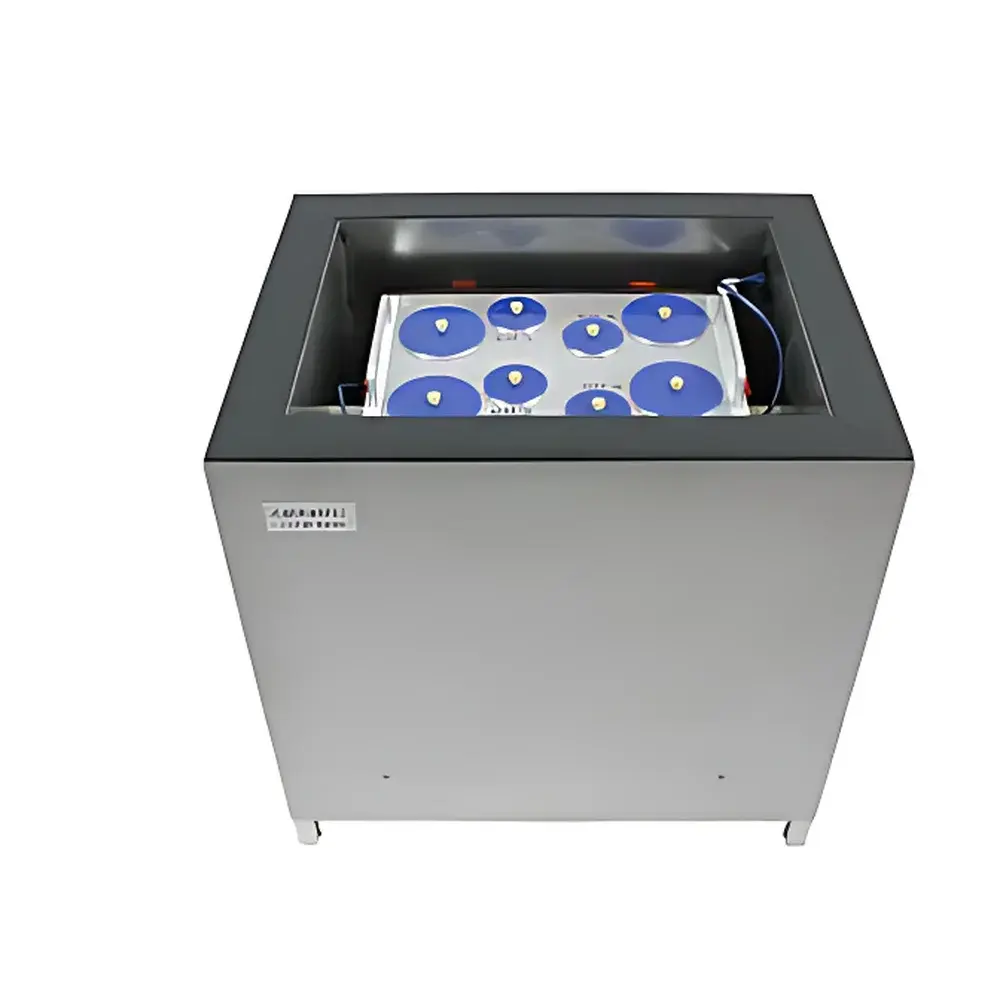
Calmetrix Biocal 4000 Isothermal Microcalorimeter
| Brand | Calmetrix |
|---|---|
| Origin | USA |
| Model | Biocal 4000 |
| Sample Vessel Capacity | 125 mL per channel |
| Number of Channels | 4 |
| Operating Temperature Range | 5–70 °C |
| Temperature Stability | ±0.02 °C |
| Baseline Noise (24 h) | < 20 µW |
| Sensitivity Limit | 5 µW |
| Accuracy | ±100 µW |
| Power Supply | 110–240 VAC, 50/60 Hz |
| Dimensions (L×W×H) | 54.6 × 41.9 × 55.9 cm |
| Weight | 47 kg |
Overview
The Calmetrix Biocal 4000 is a high-sensitivity, multi-channel isothermal microcalorimeter engineered for real-time, label-free measurement of heat flow from biological and chemical processes under tightly controlled thermal conditions. Unlike optical or spectroscopic techniques, microcalorimetry detects energy changes—specifically, the rate of heat production or consumption—as a direct thermodynamic signature of metabolic activity, reaction kinetics, or physicochemical interactions. The Biocal 4000 operates on the principle of heat conduction calorimetry, employing precision thermopile sensors to quantify minute thermal power (in microwatts) generated by samples housed in standardized 125 mL glass vials. Its isothermal design maintains sample and reference compartments at identical, user-defined temperatures across a broad range (5–70 °C), enabling studies of aerobic respiration, fermentation, enzymatic turnover, microbial growth, seed germination, and material degradation without perturbing system equilibrium. This makes it uniquely suited for applications where indirect proxies (e.g., CO2 evolution, pH shift, or optical density) are insufficient or introduce artifacts.
Key Features
- Four independent measurement channels: Enables parallel, time-synchronized calorimetric profiling of up to four samples—ideal for dose-response studies, replicate validation, or comparative assays.
- 125 mL sample capacity per vial: Accommodates heterogeneous, macro-scale specimens—including whole fruits, meat cuts, soil cores with gravel or biota, fermented dairy products, and sprouting seeds—without homogenization or dilution.
- Adjustable reference cell architecture: Each channel features a programmable, thermally matched reference vessel, minimizing baseline drift and enhancing signal-to-noise ratio during long-duration experiments (e.g., 72+ hour soil respiration or seed dormancy assays).
- High thermal stability: ±0.02 °C temperature control ensures reproducible kinetic data across extended runs; critical for detecting subtle metabolic shifts in low-activity systems such as aged spores or slow-degrading polymers.
- Low intrinsic noise floor: <20 µW RMS baseline fluctuation over 24 hours supports detection of weak exothermic/endothermic events—e.g., early-stage fungal colonization or low-concentration antimicrobial inhibition.
- Universal voltage compatibility: 110–240 VAC, 50/60 Hz operation allows deployment in global laboratories without external transformers or frequency converters.
Sample Compatibility & Compliance
The Biocal 4000 accepts both solid and liquid matrices without modification to standard vial geometry, supporting direct analysis of intact biological materials—whole grains, root tissues, cheese blocks, activated sludge, compost amendments, and biofilm-coated surfaces. Its open-vessel configuration permits gas exchange essential for aerobic metabolism studies, while optional sealed caps enable anaerobic or headspace-gas monitoring configurations. The instrument complies with foundational requirements for GLP-compliant thermal analysis workflows, including audit-trail-capable software logging (per FDA 21 CFR Part 11 Annex 11 guidelines), timestamped raw heat-flow data export, and calibration traceability to NIST-traceable thermal standards. While not intended for clinical diagnostics (per manufacturer specification), its performance aligns with ISO 13370 (thermal performance of building materials) and ASTM E1269 (heat capacity by DSC) principles adapted for isothermal biosystems.
Software & Data Management
Acquisition and analysis are managed via Calmetrix’s proprietary BioView™ software, which provides real-time visualization of thermal power (µW) vs. time, automated peak integration, baseline correction algorithms, and customizable event annotation. Data files are saved in vendor-neutral CSV and HDF5 formats, facilitating import into MATLAB, Python (NumPy/Pandas), or statistical platforms (R, JMP). Software supports batch processing for multi-experiment comparison, derivative analysis (dQ/dt), and conversion to metabolic rates (e.g., µmol O2/h/g dry weight) when coupled with concurrent O2 sensor data. All instrument operations—including temperature setpoint changes, channel activation, and calibration routines—are logged with user ID, timestamp, and parameter values, satisfying documentation requirements for internal QA audits and regulatory submissions.
Applications
- Food Science: Shelf-life prediction via real-time spoilage thermograms; fermentation kinetics of yogurt, kefir, and plant-based cheeses; thermal profiling of enzymatic browning in cut produce.
- Soil & Environmental Microbiology: Carbon mineralization assays in contaminated soils; nitrification/denitrification heat signatures; biodegradation thermodynamics of microplastics or pesticides.
- Agricultural & Seed Physiology: Quantification of respiratory burst during imbibition; dormancy release thresholds; stress-induced metabolic depression in drought- or salinity-exposed embryos.
- Industrial Biotechnology: Monitoring of yeast/bacterial culture viability in bioreactor inoculum trains; thermal fingerprinting of probiotic stability; exothermicity mapping of lyophilized enzyme reactivation.
- Materials Science: Hydration enthalpy of bio-based packaging films; curing kinetics of sustainable resins; oxidative stability of lipid-containing composites.
FAQ
Is the Biocal 4000 suitable for clinical diagnostic use?
No. The Biocal 4000 is designed exclusively for research and industrial quality control applications. It is not cleared or validated for human diagnostic testing.
Can I use non-standard vials or custom containers?
Yes—provided they maintain consistent thermal mass and geometry relative to the 125 mL reference vial. Calibration verification is recommended for any non-OEM vessel.
How is temperature uniformity verified across all four channels?
Each channel undergoes individual thermal mapping during factory calibration using embedded PT100 sensors; users receive a certificate documenting inter-channel deviation (<±0.015 °C at 37 °C).
What maintenance is required for long-term accuracy?
Annual recalibration against certified thermal standards is recommended. No consumables or routine sensor replacement is needed—the thermopile array is solid-state and sealed.
Does the system support remote monitoring?
Yes. BioView™ includes secure HTTP API access and optional VPN-configurable remote desktop capability for off-site experiment oversight and intervention.





