
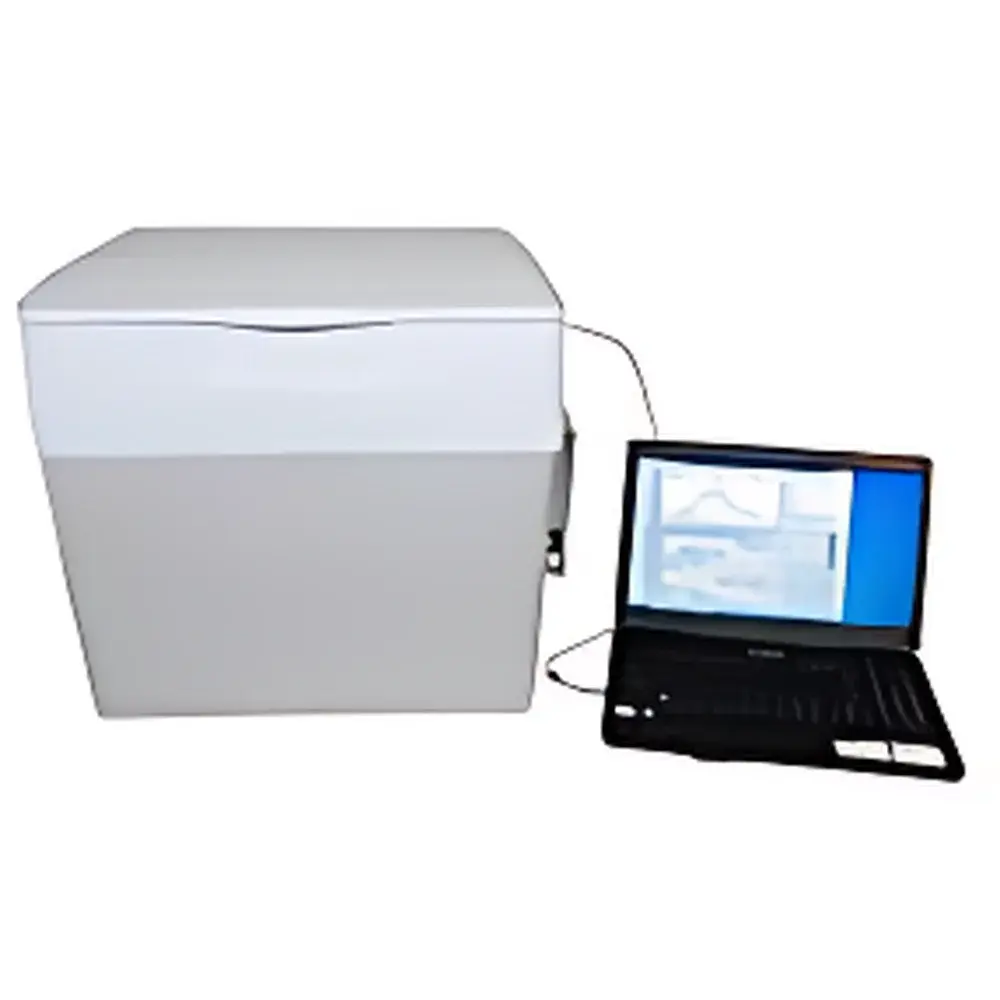
Calmetrix I-Cal 8000/4000 Isothermal Calorimeters for Cement and Concrete Hydration Analysis
| Brand | Calmetrix |
|---|---|
| Origin | USA |
| Model | I-Cal 8000 / I-Cal 4000 |
| Compliance | ASTM C1679, ASTM C1702 |
| Temperature Range | Up to 50 °C |
| Sample Volume | 125 mL per vial |
| Channel Capacity | 8 channels (I-Cal 8000), 4 channels (I-Cal 4000) |
| Reference Configuration | Internal fixed reference unit |
| Thermal Interference Mitigation | Individual heat sink per sample (I-Cal 4000) |
| Test Duration | Standardized 72-hour hydration monitoring |
Overview
The Calmetrix I-Cal 8000 and I-Cal 4000 are high-precision isothermal conduction calorimeters engineered specifically for quantitative measurement of heat flow during the early-age hydration of hydraulic cements, mortars, and concrete mixtures. Operating on the principle of heat conduction calorimetry, these instruments maintain a highly stable isothermal environment—typically at controlled temperatures up to 50 °C—and detect minute thermal power changes (µW to mW range) emitted by exothermic cement hydration reactions. Unlike adiabatic or differential scanning approaches, isothermal conduction calorimetry provides continuous, real-time thermal output with exceptional baseline stability and long-term drift control—critical for capturing low-magnitude, time-dependent heat evolution profiles over extended durations (e.g., 72 hours or longer). The systems comply fully with ASTM C1679 (“Standard Test Method for Determining the Heat of Hydration of Hydraulic Cement”) and, in the case of the I-Cal 4000, also meet ASTM C1702 (“Standard Test Method for Measuring the Heat of Hydration of Hydraulic Cementitious Materials Using Isothermal Conduction Calorimetry”). Designed for laboratory-based quality control, formulation development, and fundamental research in cement chemistry, both models deliver reproducible, traceable thermal data essential for optimizing admixture performance, evaluating low-carbon binders (e.g., slag, fly ash, calcined clays), and validating predictive hydration models.
Key Features
- Stable isothermal operation with active temperature control (±0.01 °C) across the full 5–50 °C range, ensuring minimal thermal gradient-induced artifacts.
- Dual-channel architecture: Each sample vial (125 mL capacity) is thermally isolated and coupled to its own precision thermopile sensor; the I-Cal 8000 supports eight parallel measurements, while the I-Cal 4000 supports four.
- Integrated fixed internal reference unit eliminates external reference drift and reduces calibration dependency between runs.
- I-Cal 4000 incorporates individual aluminum heat sinks per channel to minimize cross-talk and ambient thermal interference—particularly beneficial in non-vibration-isolated or variable-temperature lab environments.
- Robust mechanical design with stainless-steel sample chamber, low-noise electronics, and EMI-shielded signal paths to ensure micro-watt-level sensitivity and signal-to-noise ratios >60 dB.
- Modular firmware architecture supporting user-defined test protocols, including multi-step temperature ramps (for activation energy studies) and automated start/stop triggers based on thermal thresholds.
Sample Compatibility & Compliance
The I-Cal systems accept standard 125 mL cylindrical glass or polypropylene vials—compatible with common cement paste, mortar, and self-consolidating concrete (SCC) suspensions. Samples may include Portland cements, blended cements (CEM II–V), alkali-activated materials (AAMs), and supplementary cementitious materials (SCMs) such as ground granulated blast-furnace slag (GGBS), silica fume, and limestone powder. All hardware and measurement methodology conform to ASTM C1679 for single-point heat-of-hydration determination and ASTM C1702 for time-resolved heat flow profiling. Data acquisition and reporting workflows support GLP-compliant documentation, including electronic signatures, audit trails, and raw-data export in CSV and HDF5 formats—facilitating alignment with FDA 21 CFR Part 11 requirements where applicable in regulated R&D settings.
Software & Data Management
Calmetrix ThermalSuite™ software provides native control, real-time visualization, and post-acquisition analysis. It enables simultaneous monitoring of all channels with configurable time-axis scaling (seconds to days), automatic baseline subtraction, integration of heat flow to cumulative heat (J/g), and derivative analysis for peak identification (e.g., C₃S vs. C₂S reaction onset). Export options include timestamped, metadata-embedded datasets compatible with MATLAB, Python (Pandas/NumPy), and industry-standard statistical packages. Software logs include operator ID, environmental conditions (ambient T/RH), instrument calibration status, and version-controlled firmware identifiers—ensuring full traceability per ISO/IEC 17025 and ASTM E2500 guidelines.
Applications
- Quantitative evaluation of hydration kinetics for novel cement formulations and low-clinker systems.
- Admixture efficacy screening (e.g., retarders, accelerators, set controllers) under standardized thermal conditions.
- Validation of thermodynamic models (e.g., BASS, HYMOSTRUC) and microstructural simulation inputs.
- Quality assurance of batch-to-batch consistency in industrial cement production.
- Research into carbonation-influenced hydration and early-age cracking mechanisms.
- Supporting sustainability assessments via heat release profiling correlated with CO₂-equivalent embodied energy metrics.
FAQ
What is the minimum detectable heat flow resolution?
The system achieves a typical thermal noise floor of ≤0.5 µW per channel under standard operating conditions (23 °C ambient, stable power supply).
Can the I-Cal accommodate larger sample volumes?
No—the platform is optimized for 125 mL vials to ensure uniform thermal equilibration and signal linearity; custom vial adapters are not supported.
Is remote monitoring supported?
Yes—ThermalSuite™ includes secure TCP/IP connectivity and optional TLS-encrypted web dashboard access for off-site supervision and alarm notifications.
How often does the system require recalibration?
Annual calibration is recommended; built-in reference checks using certified thermal resistors allow daily verification without external standards.
Does Calmetrix provide application support for ASTM-compliant reporting?
Yes—application scientists supply validated report templates aligned with ASTM C1679 Annex A1 and C1702 Section 9, including uncertainty budgeting per GUM (ISO/IEC Guide 98-3).






