
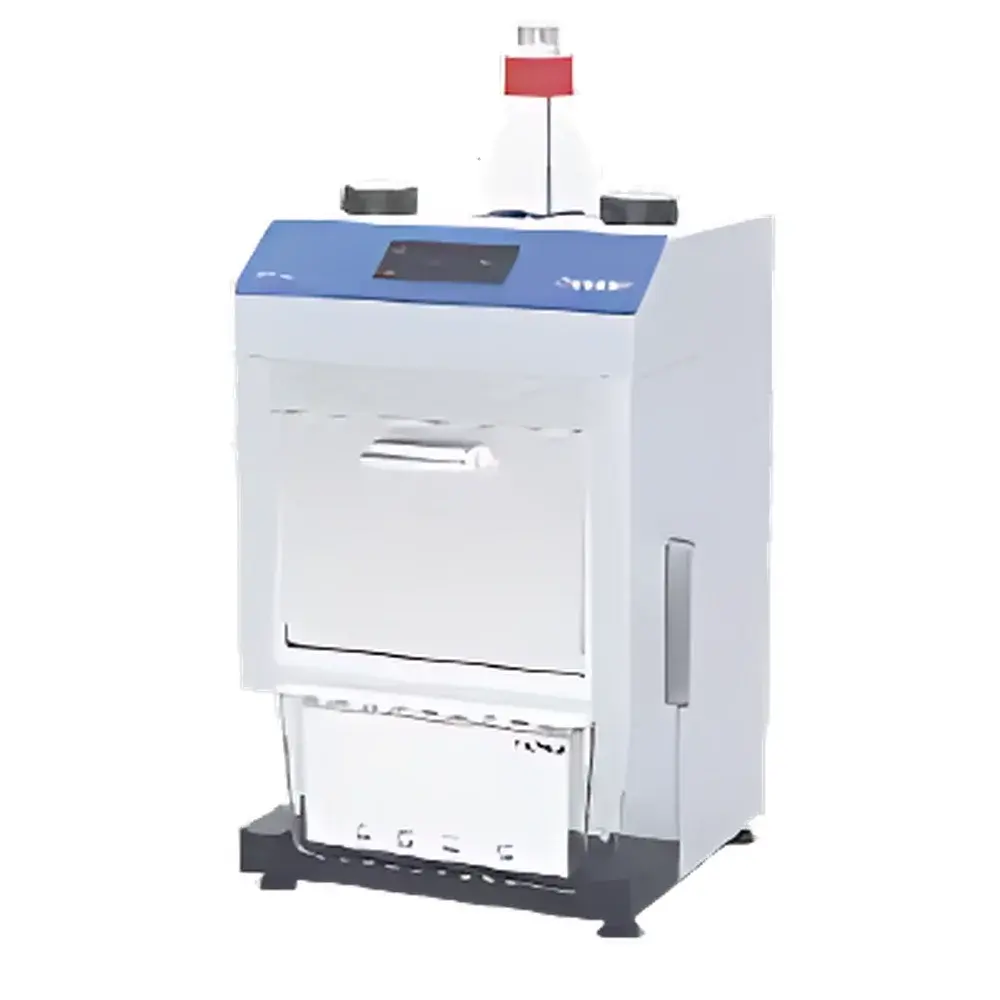
CAMAG ADC 3 Automatic Development Chamber
| Brand | CAMAG |
|---|---|
| Origin | Switzerland |
| Model | ADC 3 |
| Instrument Type | Automatic Thin-Layer Chromatography (TLC) Development System |
| Operation Mode | Fully Automated |
| Sample Format | HPTLC plates up to 20 × 10 cm |
| Chamber Configuration | Dual-saturation chambers with integrated RH control |
| Compliance | cGMP/GLP, FDA 21 CFR Part 11 compliant |
| Software Control | visionCATS v3.x or later |
Overview
The CAMAG ADC 3 Automatic Development Chamber is an engineered solution for high-precision, fully automated thin-layer chromatographic (TLC) and high-performance thin-layer chromatographic (HPTLC) development. Based on the principle of controlled solvent vapor saturation and gravity-driven mobile phase migration under reproducible environmental conditions, the ADC 3 eliminates manual intervention in all critical development steps—including pre-saturation, plate activation, chamber equilibration, solvent front migration, and post-development drying. Designed specifically for HPTLC plates sized up to 20 × 10 cm, it operates within a dual-chamber architecture that isolates each plate in its own thermally and humidity-stabilized microenvironment. This architecture minimizes inter-plate variability and ensures consistent retention factor (Rf) values across batches—essential for quantitative densitometric analysis and method validation in regulated environments.
Key Features
- Fully automated sequence execution: saturation → activation → pre-equilibration → development → drying—all initiated with a single software command
- Dual independent development chambers (20 × 10 cm each), enabling parallel processing of two plates under identical, isolated atmospheric conditions
- Integrated relative humidity (RH) control module (range: 10–90% RH, ±2% accuracy), allowing precise modulation of silica gel activity prior to development
- Programmable solvent selection from up to four reservoirs, supporting gradient and multi-step elution protocols
- Temperature-stabilized chamber housing (±0.5 °C stability) to suppress thermal drift during long saturation cycles
- Sealed chamber design with inert gas purge option (N2) for oxygen-sensitive separations
- Real-time monitoring of RH, temperature, solvent level, and process stage via visionCATS interface
Sample Compatibility & Compliance
The ADC 3 accommodates standard HPTLC plates (e.g., silica gel 60 F254, amino, cyano, C18, and chiral layers) in formats up to 20 × 10 cm. Its closed-loop environmental control ensures compatibility with moisture-sensitive stationary phases and volatile solvent systems (e.g., ethyl acetate/hexane, chloroform/methanol, or acetonitrile/water mixtures). The system conforms to international regulatory expectations for analytical instrumentation used in pharmaceutical quality control and R&D. It supports audit-ready operation per ICH Q2(R2), USP , and Ph. Eur. 2.2.27, and provides full electronic records with user authentication, change history, and immutable audit trails as required by FDA 21 CFR Part 11 and EU Annex 11. All hardware and firmware are validated per GAMP 5 principles, and IQ/OQ documentation packages are available upon request.
Software & Data Management
Control and monitoring are performed exclusively through visionCATS software (v3.5 or higher), CAMAG’s validated chromatography data system. visionCATS offers intuitive method setup wizards, drag-and-drop protocol sequencing, and real-time visualization of chamber status (RH%, temperature, elapsed time, solvent consumption). Each development run generates a timestamped, digitally signed metadata file containing instrument configuration, environmental logs, operator ID, and version-controlled method parameters. Raw data—including chamber sensor outputs and step-by-step execution logs—are stored in vendor-neutral XML format and can be exported for LIMS integration or third-party statistical analysis. Electronic signatures, role-based access control, and automatic backup to network drives ensure ALCOA+ (Attributable, Legible, Contemporaneous, Original, Accurate, Complete, Consistent, Enduring, Available) data integrity.
Applications
- Pharmaceutical impurity profiling and stability-indicating method development
- Natural product fingerprinting and marker compound quantification (e.g., flavonoids, alkaloids, terpenes)
- Food authenticity testing (e.g., adulteration detection in olive oil, honey, or spices)
- Forensic toxicology screening for drugs of abuse and metabolites
- Environmental analysis of pesticides and PAHs in soil and water extracts
- Method robustness studies evaluating humidity, temperature, and solvent composition effects on Rf and resolution
FAQ
Can the ADC 3 handle multiple solvent systems in a single run?
Yes—up to four solvent reservoirs can be preloaded, and the system supports sequential or gradient elution by automatically switching between them during development.
Is visionCATS software included with the ADC 3 purchase?
Yes—visionCATS Basic is supplied standard; visionCATS Pro with advanced reporting, statistical tools, and 21 CFR Part 11 modules is available as an optional upgrade.
What maintenance is required for the RH control module?
The humidity sensor is factory-calibrated and requires no routine recalibration; periodic verification using NIST-traceable hygrometric standards is recommended annually.
Does the ADC 3 support unattended overnight operation?
Yes—the system includes safety interlocks, solvent leak detection, and automatic shutdown on error, making it suitable for extended unattended runs.
How is plate positioning accuracy ensured across repeated runs?
A motorized, optically referenced stage with repeatable ±0.1 mm positioning guarantees identical placement relative to solvent meniscus height and chamber geometry—critical for Rf reproducibility.





