
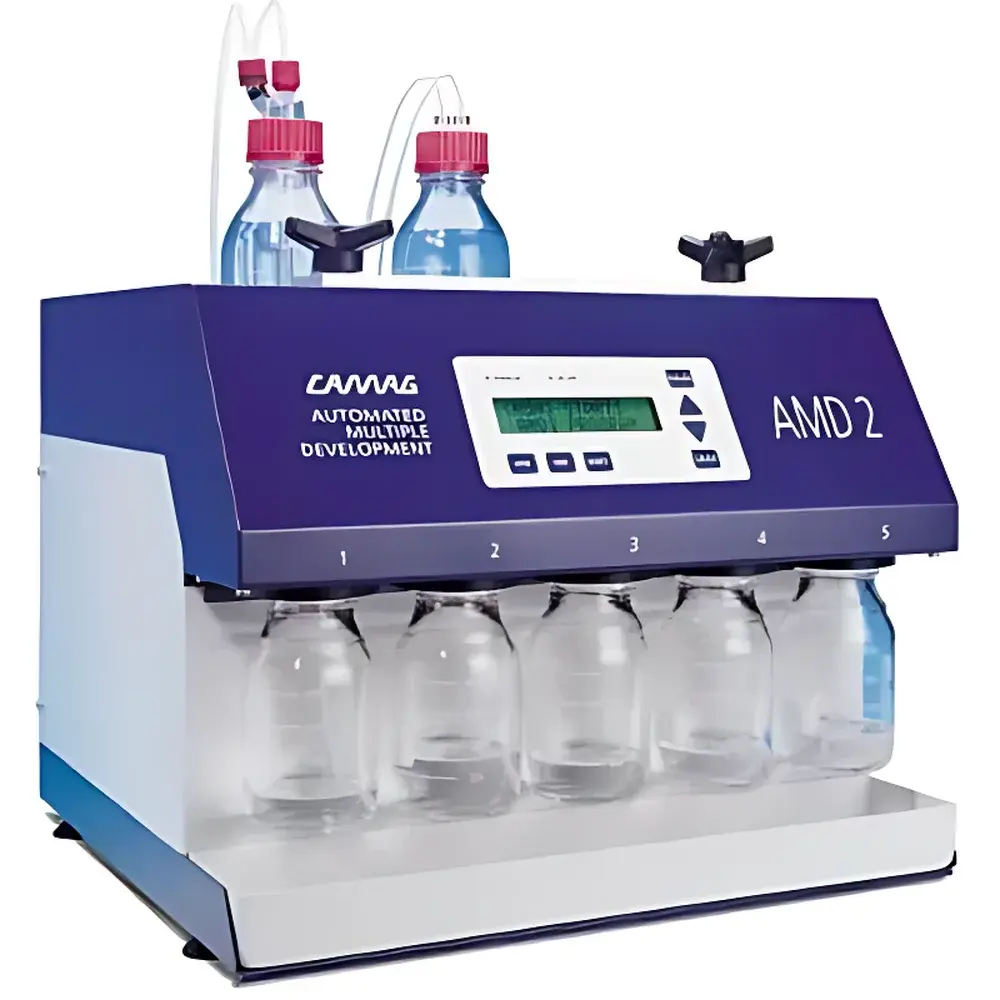
CAMAG AMD 2 Automated Multiple Development Instrument
| Brand | CAMAG |
|---|---|
| Origin | Switzerland |
| Model | AMD 2 |
| Instrument Type | Thin-Layer Chromatography (TLC) Multiple Development System |
| Compliance | GLP/GMP-Compliant |
| Control | Programmable, CCD-Monitored |
| Solvent Capacity | Up to 5 solvents |
| Development Stages | Multi-step, Gradient Elution Capable |
| Max. Separation Density | ~40 components within 80 mm |
| Automation Level | Fully Automated Pre-saturation, Development, Drying |
Overview
The CAMAG AMD 2 Automated Multiple Development Instrument is a precision-engineered platform for advanced thin-layer chromatography (TLC), specifically designed to execute programmed, multi-stage solvent development under strictly controlled environmental and temporal parameters. Unlike conventional single-development TLC systems, the AMD 2 implements multiple development cycles—including gradient, stepwise, and repeated elution protocols—enabling enhanced resolution of complex mixtures through controlled solvent strength modulation. Its operational principle relies on precise robotic dispensing of sequential solvent systems onto pre-equilibrated silica or other stationary-phase plates, followed by programmable migration distance control, vapor-phase pre-saturation, and post-development drying—all synchronized via an integrated real-time CCD imaging module. This architecture supports reproducible separation of closely eluting compounds, making it particularly suitable for natural product profiling, pharmaceutical impurity mapping, and stability-indicating method development where resolution and trace-level detection are critical.
Key Features
- Fully automated multi-step development with up to five distinct solvent systems per run, each independently programmable for volume, application position, and dwell time
- Integrated CCD sensor system continuously monitors solvent front progression in real time, logging both development distance and elapsed time with sub-millimeter spatial resolution
- Programmable pre-saturation chamber with adjustable saturation time and solvent vapor concentration control to ensure consistent plate equilibration
- Precise motorized stage movement enables repeatable, user-defined development distances (e.g., 10–80 mm) with ±0.2 mm positional accuracy
- Automated post-development drying cycle with regulated airflow and temperature profile, minimizing edge effects and solvent residue interference
- GLP/GMP-compliant architecture featuring full audit trail, electronic signatures, and secure user access levels aligned with FDA 21 CFR Part 11 requirements
Sample Compatibility & Compliance
The AMD 2 accommodates standard TLC plates (e.g., 20 × 20 cm or 10 × 20 cm silica gel 60 F254, aluminum-backed or glass-supported), as well as specialized layers including reversed-phase C18, amino, cyano, and chiral stationary phases. It supports both analytical- and preparative-scale separations without hardware modification. All operational parameters—including solvent sequence, development height, saturation duration, and drying conditions—are stored as validated methods, enabling full traceability and re-execution across laboratories. The system complies with ICH Q5A, USP , and Ph. Eur. 2.2.27 guidelines for chromatographic method development and validation. Its software environment supports IQ/OQ/PQ documentation templates and integrates seamlessly with CAMAG’s visionCATS software for regulatory submission-ready reporting.
Software & Data Management
Controlled via CAMAG’s visionCATS software (v3.0 or later), the AMD 2 operates within a secure, role-based workflow environment. Method creation includes graphical timeline editors for solvent application, saturation, development, and drying phases; all parameters are digitally signed and version-controlled. Raw CCD image logs, development metadata (timestamp, operator ID, plate ID, ambient RH/temperature), and method execution logs are archived in encrypted SQLite databases. Data export conforms to ASTM E1990-21 and ISO/IEC 17025:2017 requirements, supporting CSV, PDF, and XML formats for LIMS integration. Audit trails record every parameter change, user login/logout event, and instrument status transition—retained for ≥36 months per internal SOPs and external inspection readiness.
Applications
- High-resolution fingerprinting of herbal extracts and traditional medicines, resolving >40 co-eluting markers within an 80 mm migration zone
- Forced degradation studies in pharmaceutical development, where gradient multiple development isolates hydrolytic, oxidative, and photolytic degradants with improved peak capacity
- Method scouting for HPTLC-based quantitation workflows, accelerating optimization of mobile phase composition and development geometry
- Stability-indicating assay development compliant with ICH Q1–Q5 guidelines, especially for biologics and peptide therapeutics
- Forensic toxicology screening where multi-solvent development enhances selectivity among structurally analogous alkaloids or synthetic cannabinoids
FAQ
Can the AMD 2 perform gradient elution using more than two solvents in a single development sequence?
Yes—the system supports up to five discrete solvents per development program, with programmable switching points based on solvent front position or elapsed time.
Is visionCATS software validated for use in regulated GMP environments?
Yes—visionCATS v3.x includes built-in 21 CFR Part 11 compliance features, including electronic signatures, audit trail generation, and secure database encryption.
Does the AMD 2 require external humidity or temperature control for GLP-compliant operation?
No—the instrument maintains internal environmental control during pre-saturation and development; however, laboratory ambient conditions should remain within 15–25°C and 30–60% RH for optimal reproducibility.
How is plate identification managed during high-throughput runs?
Each plate may be assigned a unique barcode or alphanumeric ID; visionCATS links this identifier to all associated method data, CCD logs, and result files.
Can the AMD 2 be integrated into a fully automated HPTLC workflow including derivatization and densitometric scanning?
Yes—it is fully compatible with CAMAG’s TLC Scanner 4 and derivatization devices (e.g., CD 60), enabling end-to-end unattended analysis when configured within a visionCATS-controlled sequence.




