
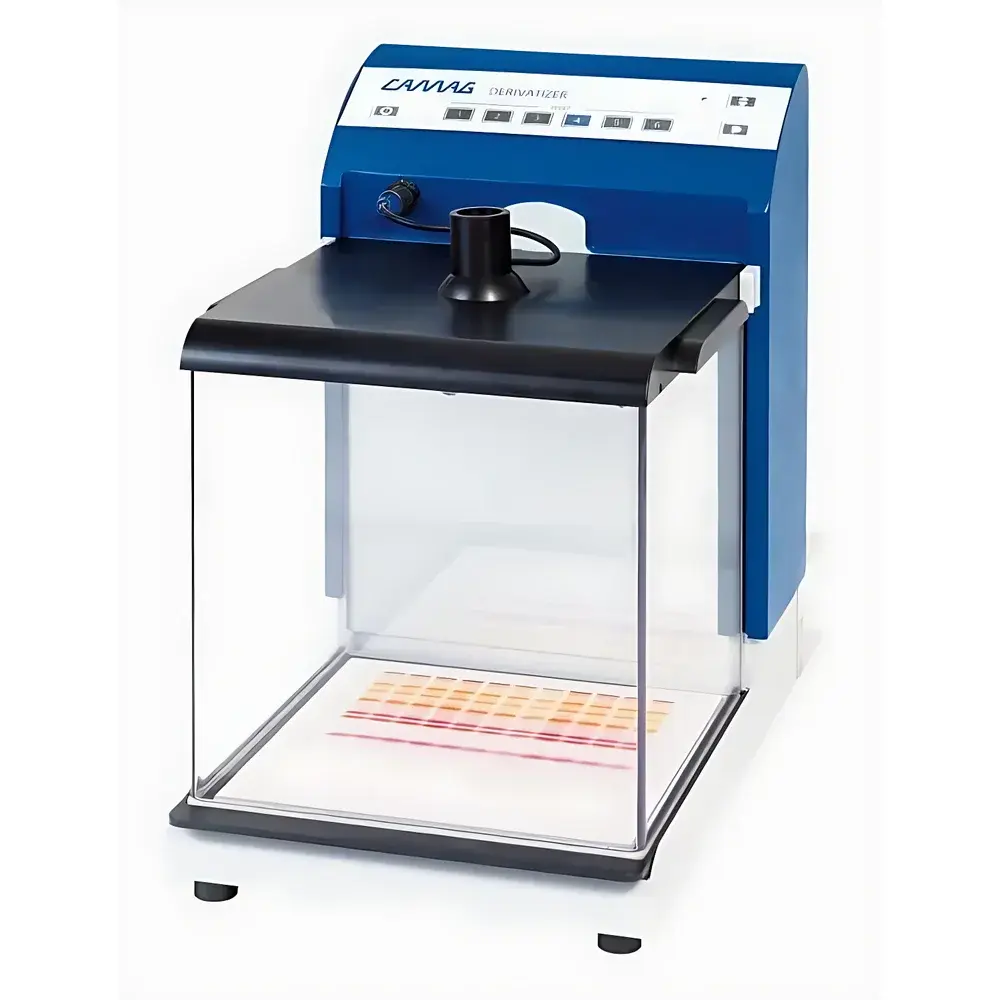
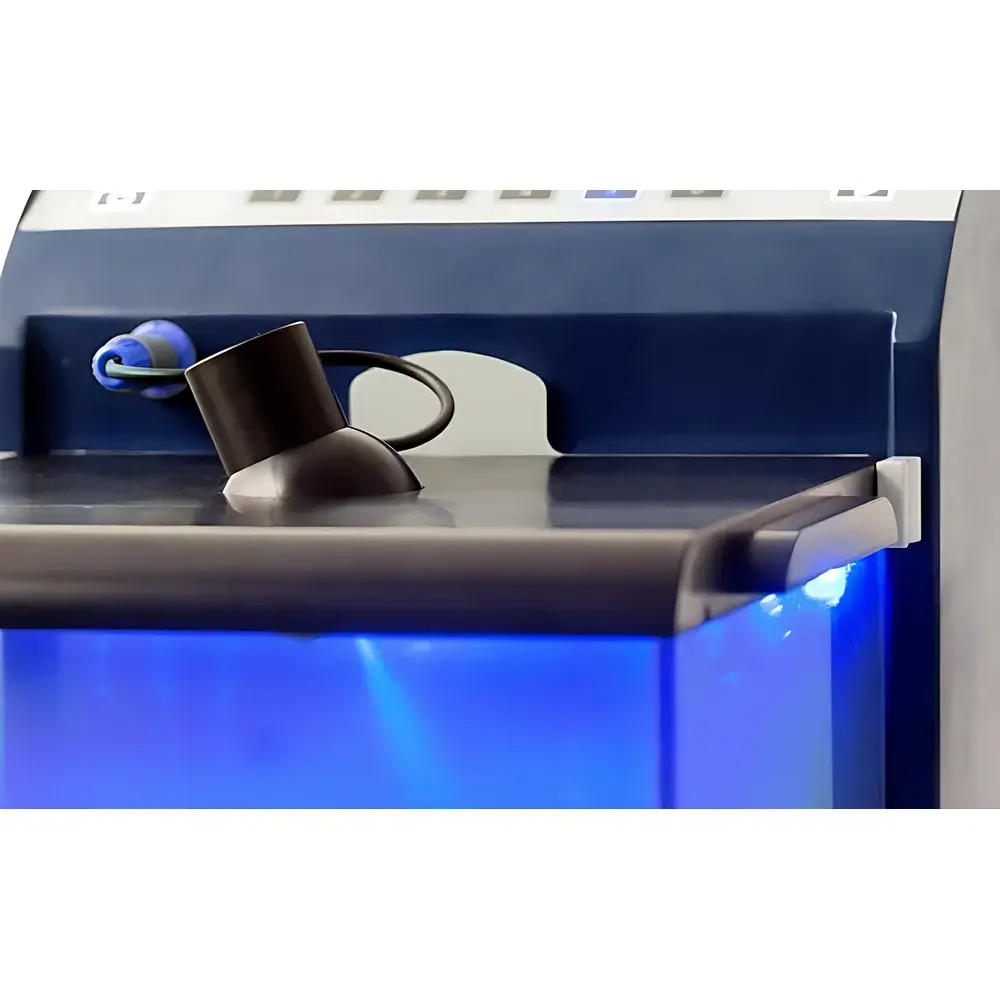
CAMAG Derivatizer Automated Spray Chamber for Thin-Layer Chromatography
| Brand | CAMAG |
|---|---|
| Origin | Switzerland |
| Model | Derivatizer |
| Operation Mode | Automatic |
| Instrument Type | Preparative Thin-Layer Chromatography System |
| Compliance | Designed for GLP-compliant laboratories |
| Solvent Compatibility | All conventional organic and aqueous solvents |
| Reagent Consumption | ~3 mL for 20 × 10 cm plates, ~4 mL for 20 × 20 cm plates |
| Enclosure | Sealed, fume-controlled chamber |
Overview
The CAMAG Derivatizer is a fully automated, sealed-spray derivatization system engineered specifically for high-performance thin-layer chromatography (HPTLC) and conventional thin-layer chromatography (TLC). It operates on the principle of precision pneumatic micro-spraying—utilizing calibrated nozzle arrays and controlled aerosol generation—to deliver highly uniform, reproducible reagent deposition across the entire surface of TLC/HPTLC plates. Unlike manual spraying or immersion-based derivatization methods, the Derivatizer eliminates operator-induced variability in droplet size, spray velocity, dwell time, and coverage homogeneity—critical parameters affecting reaction kinetics, detection sensitivity, and quantitative accuracy in post-chromatographic derivatization. Its design adheres to fundamental requirements of analytical traceability and method robustness, making it suitable for regulated environments where documentation, repeatability, and audit readiness are mandatory.
Key Features
- Sealed, ventilated chamber with integrated fume extraction—ensures operator safety and complies with OSHA and EU Directive 2004/40/EC on electromagnetic fields and occupational exposure limits.
- Automated, programmable spray sequence with adjustable parameters: spray duration, pause intervals, nozzle translation speed, and number of passes—enabling method optimization for diverse derivatization chemistries (e.g., anisaldehyde/H2SO4, ninhydrin, p-anisaldehyde, Dragendorff’s reagent).
- Minimal reagent consumption: validated usage of only 3 mL for standard 20 × 10 cm plates and 4 mL for 20 × 20 cm plates—reducing solvent waste and lowering operational costs without compromising derivatization efficiency.
- Nozzle and chamber geometry optimized for laminar airflow and uniform aerosol dispersion—preventing edge pooling, streaking, or localized over-saturation that may distort Rf values or cause analyte degradation.
- Stainless-steel and chemically resistant polymer construction—compatible with aggressive solvents including chloroform, methanol, acetic acid, and sulfuric acid–ethanol mixtures.
- Tool-free disassembly of spray head and chamber base—facilitating rapid cleaning and cross-contamination prevention between batches or methods.
Sample Compatibility & Compliance
The Derivatizer accommodates all standard commercial TLC and HPTLC plates—including silica gel 60 F254, aluminum-backed, glass-backed, and flexible polyester substrates—up to 20 × 20 cm dimensions. Its closed-system architecture supports compliance with Good Laboratory Practice (GLP) and current Good Manufacturing Practice (cGMP) frameworks by enabling full traceability of derivatization conditions. While the instrument itself does not generate electronic records, its operation can be documented within CAMAG’s visionCATS™ software environment (when integrated with TLC Visualizer or Scanner 4), supporting 21 CFR Part 11–compliant audit trails when deployed with appropriate IT infrastructure and user access controls. The system meets ISO/IEC 17025 requirements for method validation in accredited testing laboratories performing qualitative and semi-quantitative analysis per pharmacopoeial monographs (e.g., USP , Ph. Eur. 2.2.27, JP 6.03).
Software & Data Management
The Derivatizer operates as a standalone hardware module but is fully interoperable with CAMAG’s visionCATS™ software suite. Through digital I/O integration, visionCATS can trigger spray sequences synchronized with plate imaging or scanning workflows—ensuring chronological alignment between derivatization, heating (when used with CAMAG Chromatogram Heating Plate), and densitometric evaluation. All spray parameters (e.g., cycle count, dwell time, nozzle position) are logged in visionCATS’ method files and retained in the electronic laboratory notebook (ELN) export format. For laboratories requiring electronic signature capability and change control, visionCATS v3.5+ supports role-based permissions, electronic signatures, and immutable audit logs—aligned with FDA expectations for computerized systems used in pharmaceutical quality control.
Applications
- Phytochemical profiling of herbal extracts (e.g., flavonoids, alkaloids, terpenoids) using specific chromogenic reagents.
- Residue analysis in food safety testing—including pesticide metabolites and veterinary drug residues on silica or amino-modified layers.
- Stability-indicating assays for pharmaceutical intermediates and APIs under ICH Q5C guidelines.
- Forensic toxicology screening—visualizing amphetamines, opioids, and benzodiazepines via iodoplatinate or Marquis reagents.
- Quality control of traditional Chinese medicine (TCM) preparations per Chinese Pharmacopoeia Chapter 0502.
- Method development for forced degradation studies where consistent, low-variability derivatization is essential for degradation product identification.
FAQ
Is the Derivatizer compatible with HPTLC plates from other manufacturers?
Yes—provided plate dimensions and backing material meet standard specifications (e.g., 10 × 10 cm, 20 × 10 cm, 20 × 20 cm; rigid or flexible support). No proprietary plate locking mechanism is required.
Can the spray parameters be validated and requalified?
Yes—CAMAG provides qualification protocols (IQ/OQ) aligned with ASTM E2500 and ISO/IEC 17025. Users may perform performance verification using dye solutions and densitometric uniformity mapping.
Does the system require compressed air or external gas supply?
Yes—a clean, oil-free, dry compressed air source (4–6 bar) is required for pneumatic actuation and aerosol generation. Optional nitrogen purge mode is available for oxygen-sensitive derivatizations.
How is residual solvent removed after spraying?
The Derivatizer does not include integrated drying; post-spray plate drying is performed externally using CAMAG’s Chromatogram Heating Plate or a certified laboratory oven under defined temperature/time profiles.
Is service and technical support available outside Europe?
CAMAG maintains authorized service partners in North America, Asia-Pacific, and Latin America. Remote diagnostics and on-site calibration services are offered under annual maintenance agreements.






