
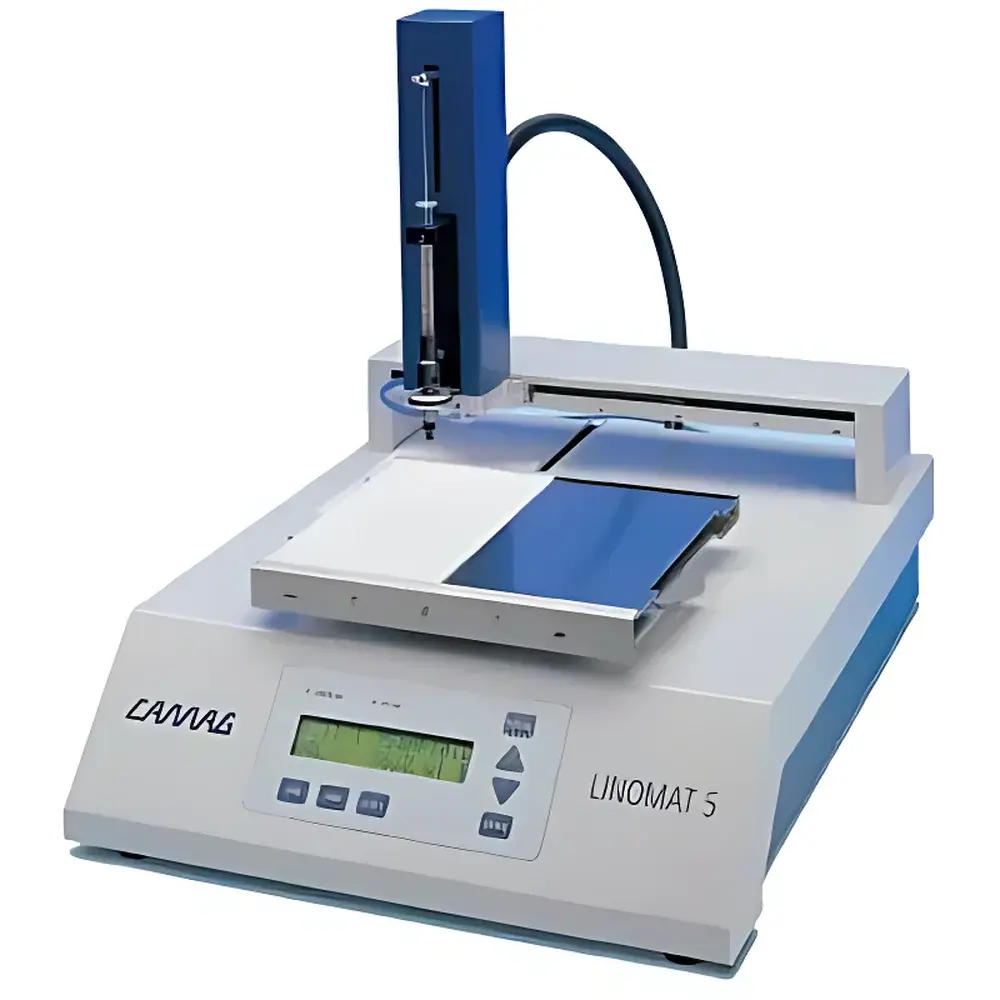
CAMAG Linomat 5 Semi-Automatic TLC Sample Spotter
| Brand | CAMAG |
|---|---|
| Origin | Switzerland |
| Model | Linomat 5 |
| Instrument Type | Thin-Layer Chromatography (TLC) Sample Spotter |
| Regulatory Compliance | IQ/OQ Qualified |
| Software Integration | visionCATS v3.x or later |
| Application Environment | GLP/GMP-Compliant Laboratories |
Overview
The CAMAG Linomat 5 is a precision-engineered semi-automatic sample applicator designed exclusively for thin-layer chromatography (TLC) and high-performance thin-layer chromatography (HPTLC) workflows. It operates on the principle of contactless, pneumatic-controlled sample deposition via a calibrated capillary nozzle, delivering reproducible linear bands—rather than discrete spots—onto pre-coated silica gel, aluminum oxide, or cellulose plates. This band-oriented application mode enhances separation efficiency, detection sensitivity, and quantitative accuracy by minimizing edge effects and enabling uniform solvent front migration across the entire development zone. The Linomat 5 is not a standalone analytical instrument but a critical pre-analytical module that directly influences chromatographic resolution, peak shape, and inter-plate reproducibility—key performance indicators in method validation and routine quality control.
Key Features
- Programmable band deposition with adjustable band length (1–20 mm), width (0.2–4.0 mm), and spacing (1–50 mm) to accommodate standard TLC (20 × 20 cm) and HPTLC (10 × 10 cm, 20 × 20 cm) plate formats.
- Integrated pneumatic dosing system with volume calibration traceable to NIST-certified standards; supports sample volumes from 0.1 µL to 200 µL per band with ±1.5% volumetric repeatability (CV ≤ 2.0% under controlled humidity and temperature).
- Motorized X-Y stage with optical position feedback ensures sub-millimeter positioning accuracy (±0.1 mm) across the full plate surface, eliminating manual alignment errors.
- Modular design compatible with CAMAG’s UV cabinet, TLC Scanner 4, and Reprostar 3 for seamless integration into end-to-end HPTLC workflows.
- IQ/OQ documentation package provided as standard, including test protocols, acceptance criteria, and completed verification records aligned with ISO/IEC 17025 and EU GMP Annex 15 requirements.
Sample Compatibility & Compliance
The Linomat 5 accepts a broad range of sample matrices—including aqueous solutions, organic solvents (e.g., chloroform, methanol, ethyl acetate), and viscous extracts—without clogging, thanks to its chemically resistant PTFE-lined capillary and programmable rinse cycles between samples. It accommodates all commercially available pre-coated TLC/HPTLC plates (glass, aluminum, or plastic-backed), with automatic plate size recognition via optical sensors. The instrument meets essential regulatory expectations for use in GLP-compliant laboratories (OECD Principles of GLP) and GMP environments supporting pharmaceutical stability testing, impurity profiling, and herbal product authentication. Its operational parameters are fully auditable and exportable—supporting data integrity principles outlined in FDA 21 CFR Part 11 when used with validated visionCATS software configurations.
Software & Data Management
Controlled exclusively via CAMAG’s visionCATS software (v3.4 or higher), the Linomat 5 enables comprehensive method definition, plate layout configuration, and electronic batch record generation. Users define plate dimensions, number of tracks, inter-track distance, sample names, dilution factors, and individual band volumes—all stored as encrypted, time-stamped method files. visionCATS enforces user access levels (administrator, analyst, reviewer), maintains full audit trails of all parameter changes, and logs instrument status (pressure, temperature, nozzle status) during each run. Raw application metadata—including date/time stamps, operator ID, and plate barcode (if scanned)—is embedded in the resulting HPTLC image file (.cst), ensuring full traceability from sample application to densitometric quantification.
Applications
- Pharmaceutical QC: Uniform band application for assay of active pharmaceutical ingredients (APIs), related substances, and degradation products per USP , EP 2.2.27, and ICH Q2(R2) guidelines.
- Natural product analysis: Simultaneous multi-component profiling of plant extracts, essential oils, and traditional medicines using derivatization-compatible band geometry.
- Fatty acid and lipid analysis: High-resolution separation of saturated/unsaturated fatty acid methyl esters (FAMEs) on reversed-phase HPTLC plates.
- Food safety screening: Rapid detection of mycotoxins (aflatoxins, ochratoxin A), pesticides, and adulterants with integrated densitometric calibration curves.
- Academic research: Method development for novel stationary phases, mobile phase optimization, and hyphenated techniques such as TLC–MS coupling via direct elution interfaces.
FAQ
Is the Linomat 5 compliant with 21 CFR Part 11 for electronic records and signatures?
Yes—when operated with visionCATS software configured in “validated mode” and deployed within a documented IT infrastructure, the system supports audit trail retention, electronic signatures, and role-based access control required under FDA 21 CFR Part 11.
Can the Linomat 5 apply samples to multiple plates without manual intervention?
No—it is semi-automatic and requires operator loading/unloading of each plate; however, up to 99 methods can be queued and executed sequentially on individual plates with no reprogramming.
What maintenance is required to ensure long-term accuracy?
Daily capillary rinsing with appropriate solvents, monthly calibration verification using certified volume standards, and annual preventive maintenance by CAMAG-certified service engineers are recommended per the manufacturer’s Technical Service Manual.
Does it support variable-speed band deposition for volatile or heat-sensitive compounds?
Yes—the pneumatic drive allows adjustable deposition speed (0.1–5.0 mm/s), reducing solvent evaporation artifacts and improving band homogeneity for low-boiling-point analytes.
Is plate barcode scanning integrated natively?
Barcode reading is supported via optional USB-connected industrial scanners; visionCATS automatically links scanned IDs to corresponding application methods and raw data files.





