
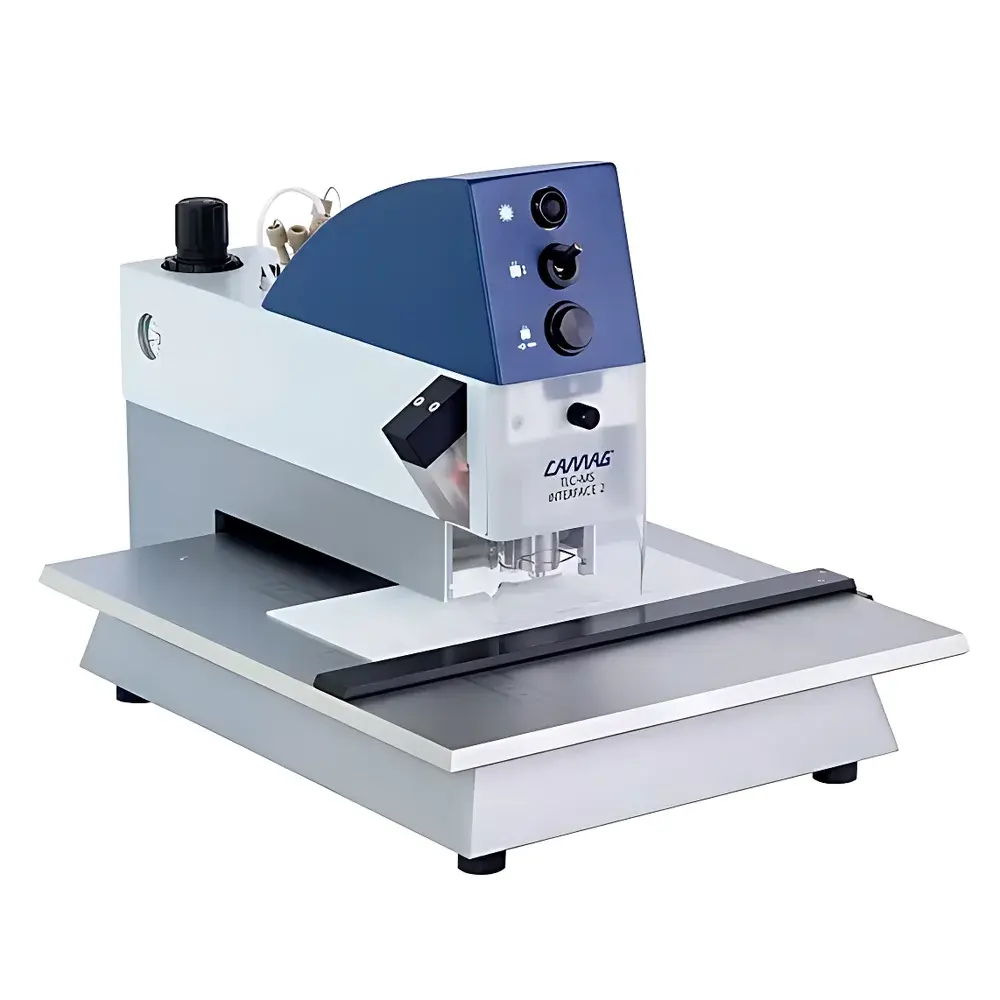
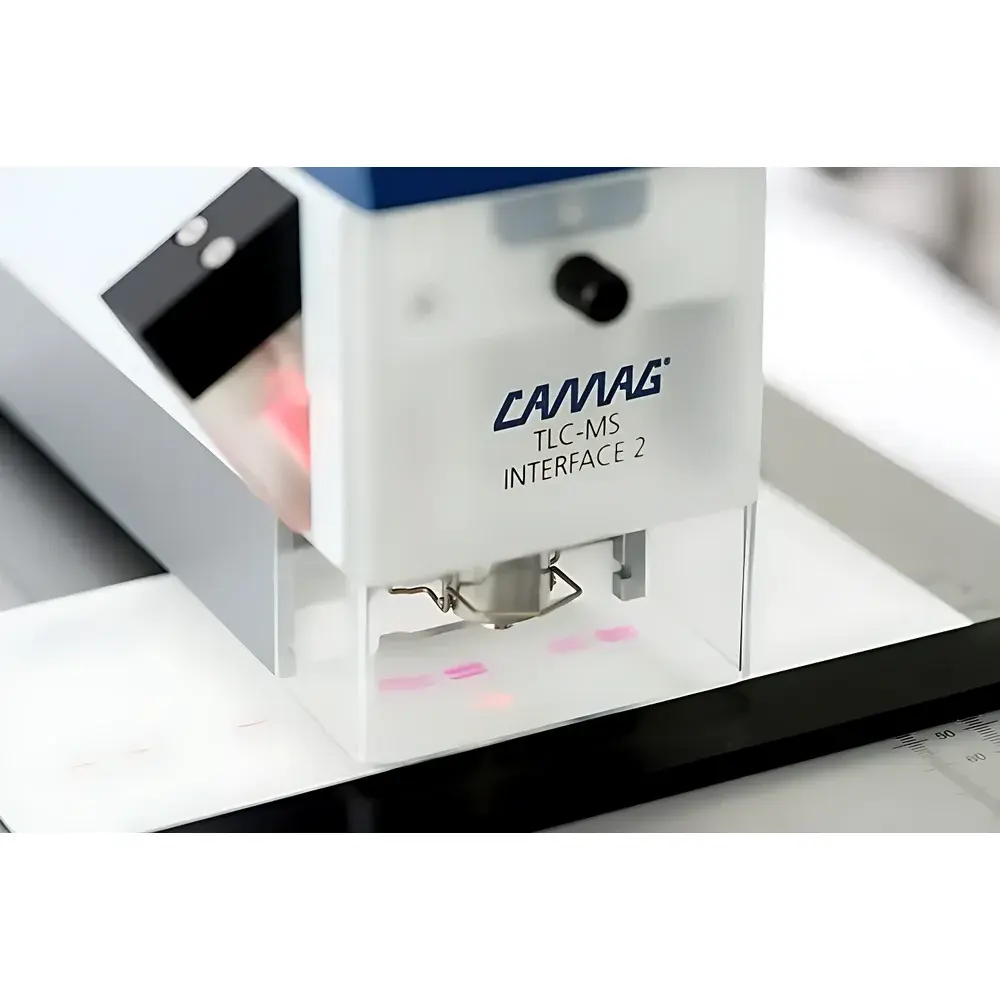
CAMAG TLC-MS Interface 2
| Brand | CAMAG |
|---|---|
| Origin | Switzerland |
| Model | TLC-MS Interface 2 |
| Instrument Type | TLC–MS Coupling Interface |
| Compatibility | Universal LC-MS Systems (ESI, APCI, MALDI sources) |
| Operation Mode | Online and Offline Elution |
| Solvent Consumption | Low (≤ 200 µL per band) |
| Positioning Accuracy | ≤ ±50 µm |
| Washout Function | Integrated reverse-flow purge to prevent channel clogging |
| Sample Recovery | Direct collection into vials (1.5 mL or 2 mL) for downstream analysis (NMR, FTIR, ESI-MS, MALDI-MS) |
Overview
The CAMAG TLC-MS Interface 2 is a precision-engineered coupling device designed to bridge high-performance thin-layer chromatography (HPTLC) with mass spectrometry (MS) detection. Unlike conventional offline scraping or solvent extraction methods, this interface employs a contactless, automated elution principle based on controlled micro-volume solvent delivery and vacuum-assisted transfer. It operates by precisely positioning the HPTLC plate under an optical detection system, identifying target bands via UV/Vis densitometry (integrated with CAMAG’s visionCATS software), and then applying a defined solvent pulse directly onto the resolved zone. The eluate is immediately drawn through a PTFE capillary into a transfer line connected to the ion source of any commercially available LC-MS system—without requiring hardware modification, source reconfiguration, or flow-rate recalibration. This enables real-time, unambiguous compound identification directly from the chromatographic surface, preserving spatial integrity and minimizing analyte degradation or cross-contamination.
Key Features
- Universal plug-and-play compatibility with ESI, APCI, and MALDI ion sources across major LC-MS platforms (e.g., Thermo Orbitrap, Waters Xevo, Agilent Q-TOF, Bruker timsTOF)
- Sub-50 µm XY-stage positioning accuracy ensures reproducible targeting of bands as narrow as 2 mm, critical for complex natural product or metabolite profiling
- Integrated reverse-flow washout mechanism clears residual matrix components between runs, eliminating carryover and maintaining long-term channel integrity
- Low solvent consumption (typically 100–200 µL per band) reduces chemical waste and improves ionization efficiency in ESI-MS
- Dual-mode operation: online MS coupling for immediate structural confirmation, or offline fraction collection into standard autosampler vials for orthogonal characterization (e.g., NMR, ATR-FTIR, high-resolution MS)
- Fully programmable via CAMAG’s visionCATS software, supporting batch processing, spectral library matching, and GLP-compliant audit trails
Sample Compatibility & Compliance
The TLC-MS Interface 2 supports all standard HPTLC plates—including silica gel 60 F254, RP-18 W, amino, diol, and chiral stationary phases—as well as custom-coated layers used in pharmaceutical stability testing or forensic toxicology. It accommodates plate dimensions up to 20 × 20 cm and tolerates common mobile phases (e.g., ethyl acetate/hexane, methanol/water/acetic acid). The system complies with ISO/IEC 17025 requirements for analytical method validation and supports 21 CFR Part 11–compliant electronic records when configured with visionCATS’ optional security module. All fluidic pathways are constructed from inert, low-binding materials (PTFE, fused silica, stainless steel) to ensure compatibility with acidic, basic, and thermally labile compounds—essential for applications in natural product chemistry, impurity profiling, and botanical extract analysis.
Software & Data Management
Control and data acquisition are fully integrated within CAMAG’s visionCATS software platform, which provides synchronized operation of the TLC scanner, derivatization unit (if used), and the TLC-MS Interface 2. Users define elution parameters—including solvent type, volume, dwell time, and collection mode—via intuitive graphical workflows. Each run generates a timestamped, metadata-rich file containing plate image, densitogram, elution coordinates, MS acquisition trigger log, and raw spectral data links. Audit trails record operator ID, parameter changes, and instrument status, fulfilling GLP/GMP documentation requirements. Export formats include mzML, CSV, and PDF reports compatible with LIMS integration and regulatory submissions.
Applications
- Rapid identification of unknown spots in herbal medicine QC, including adulterants and marker compounds
- Impurity tracking in forced degradation studies per ICH Q1–Q5 guidelines
- Metabolite mapping in plant extracts without prior isolation
- Forensic screening of seized drugs on HPTLC plates followed by confirmatory MS/MS
- Reaction monitoring: on-plate detection of intermediates and side products during synthetic optimization
- Supporting USP <720> and Ph. Eur. 2.2.29 methods for identity testing of APIs and excipients
FAQ
Does the TLC-MS Interface 2 require modification of my existing LC-MS system?
No. It connects externally to the MS ion source via standard ESI or APCI inlet tubing and requires no firmware updates, hardware alterations, or flow-splitting devices.
Can it be used with non-CAMAG HPTLC scanners?
Yes—provided the scanner outputs XY coordinate data in a format readable by visionCATS (e.g., CSV or proprietary .tlc files); third-party plate imaging systems may require minor configuration.
What is the typical turnaround time from band selection to MS spectrum acquisition?
Under standard conditions, the full sequence—including optical localization, solvent delivery, transfer, and ionization—takes less than 60 seconds per band.
Is quantitative analysis supported?
While primarily designed for qualitative identification, semi-quantitative correlation can be established using internal standards spotted alongside samples and normalized against densitometric response.
How is system performance verified?
CAMAG supplies NIST-traceable calibration kits containing reference compounds (e.g., caffeine, reserpine) for routine verification of elution recovery, positional accuracy, and MS signal stability.
Related Products






