
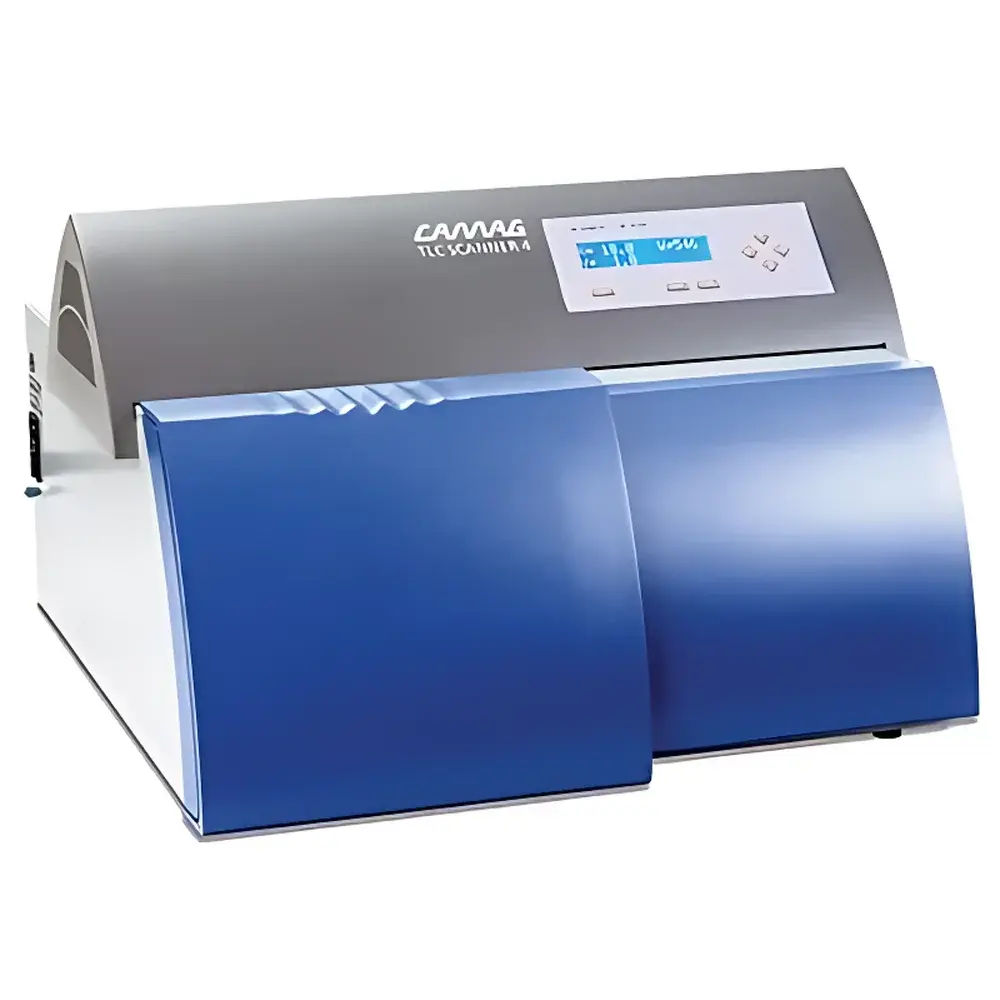
CAMAG TLC Scanner 4 Thin Layer Chromatography Densitometer
| Brand | CAMAG |
|---|---|
| Origin | Switzerland |
| Model | TLC Scanner 4 |
| Measurement Modes | Reflectance Absorption, Reflectance Fluorescence, Transmission Absorption, Transmission Fluorescence |
| Wavelength Range | 190–900 nm |
| Light Sources | Deuterium Lamp, Tungsten-Halogen Lamp, High-Pressure Mercury Lamp (automatically switchable) |
| Wavelength Reproducibility | < 0.2 nm |
| Minimum Spatial Resolution | 25 µm |
| Sample Stage Dimensions | 200 × 200 mm |
| Scanning Speed | 1–100 mm/s |
| Regulatory Compliance | Fully compliant with FDA 21 CFR Part 11 for electronic records and signatures |
Overview
The CAMAG TLC Scanner 4 is a high-precision, modular thin-layer chromatography (TLC) densitometer engineered for quantitative and qualitative analysis of planar chromatographic separations. Operating on the principle of scanning densitometry, it measures optical density (absorbance or fluorescence intensity) across stationary-phase plates—such as silica gel, aluminum oxide, or cellulose—by rastering a focused light beam in precise, motorized X–Y motion. Unlike conventional visual or photographic assessment, the TLC Scanner 4 delivers traceable, calibrated, and statistically robust quantification based on Beer–Lambert law correlations and fluorescence quantum yield calibration. Its dual-beam optical architecture minimizes drift and enhances signal stability during extended measurement sequences. Designed and manufactured in Switzerland, the instrument integrates seamlessly into regulated laboratory environments where data integrity, auditability, and method reproducibility are non-negotiable requirements.
Key Features
- Four measurement modalities: reflectance absorption, reflectance fluorescence, transmission absorption, and transmission fluorescence—enabling flexibility across diverse analyte classes (e.g., UV-absorbing aromatics, fluorescent alkaloids, or phosphomolybdic acid–stained lipids).
- Triple-light-source system (deuterium, tungsten-halogen, and high-pressure mercury lamp) with automatic spectral switching ensures optimal excitation and detection across the full 190–900 nm range—critical for multi-wavelength ratioing and spectral deconvolution.
- Sub-25 µm spatial resolution supports accurate peak integration even for tightly spaced or overlapping bands; combined with < 0.2 nm wavelength reproducibility, it guarantees inter-instrument comparability in multi-site studies.
- High-speed scanning at up to 100 mm/s—without sacrificing signal-to-noise ratio—reduces total assay time while maintaining linearity over four orders of magnitude (0.001–3.0 AU).
- Automated baseline correction algorithms (linear, polynomial, or manual point selection) and interactive peak editing tools allow rigorous validation of integration boundaries per track—essential for GLP/GMP-compliant reporting.
- Full-spectrum acquisition mode enables spectral library matching and peak purity assessment by capturing absorbance/fluorescence spectra at every pixel position across all tracks simultaneously.
Sample Compatibility & Compliance
The TLC Scanner 4 accommodates standard TLC plates (20 × 20 cm), HPTLC plates, and custom planar substrates—including glass, aluminum, or polyester-backed layers—within its motorized 200 × 200 mm stage. It supports both pre-coated and self-prepared plates, with optional plate coding via barcode or RFID for sample traceability. All firmware, software modules, and audit trail functions comply with FDA 21 CFR Part 11, including role-based user access control, electronic signatures with biometric or token authentication, immutable audit logs, and secure electronic record storage. The system meets ISO/IEC 17025 requirements for testing laboratories and supports validation documentation packages aligned with ICH Q2(R2) guidelines for analytical procedure verification.
Software & Data Management
Operation is managed through CAMAG’s winCATS software—a validated, Windows-based platform supporting method development, instrument control, data acquisition, and report generation. winCATS includes embedded tools for multi-track calibration curves (linear, quadratic, or log-log), limit-of-detection/quantitation estimation, forced baseline alignment, and peak symmetry analysis. Raw data (intensity vs. position, spectral stacks) are stored in vendor-neutral .csv and .tif formats alongside metadata-rich .cat files. The software supports automated export to LIMS, ELN, and statistical analysis platforms (e.g., JMP, R, or Python via API). All processing steps—including background subtraction, smoothing, and integration—are fully documented in the electronic audit trail, with timestamped operator attribution and change justification fields.
Applications
The TLC Scanner 4 serves as a core analytical tool in pharmaceutical quality control (e.g., assay of active pharmaceutical ingredients, degradation product profiling per ICH Q1–Q5), natural product research (e.g., fingerprinting of herbal extracts, marker compound quantification), food safety (e.g., pesticide residue screening, mycotoxin detection), and forensic toxicology (e.g., rapid identification of controlled substances). Its ability to perform dual-wavelength ratiometric scanning enables selective quantification in complex matrices—such as plant extracts containing co-eluting chlorophyll and flavonoid bands—while full-spectrum acquisition supports spectral confirmation against reference libraries (e.g., CAMAG Spectral Database or USP Reference Standards). Method transfer between TLC and HPLC is facilitated by retention parameter correlation (RF vs. k′) and spectral cross-validation.
FAQ
What regulatory standards does the TLC Scanner 4 support?
It is fully compliant with FDA 21 CFR Part 11, EU Annex 11, and ISO/IEC 17025 for data integrity, electronic signatures, and laboratory accreditation.
Can the instrument scan multiple plates without manual intervention?
No—the TLC Scanner 4 processes one plate per run; however, automated plate handling modules (e.g., CAMAG ADC 2) can be integrated for unattended sequential scanning of up to 20 plates.
Is spectral library matching included in the base software?
Yes—winCATS includes a built-in spectral database and supports import of user-defined reference spectra in common formats (.jdx, .spc, .csv).
How is calibration verified during routine use?
Certified NIST-traceable neutral density filters and fluorescent reference standards (e.g., quinine sulfate) are used for photometric and wavelength calibration; procedures are documented in the system’s IQ/OQ/PQ validation kit.
Does the system support GMP-compliant report generation?
Yes—all reports include header metadata (operator, date/time, instrument ID, method version), raw data plots, integration tables, and digital signatures—exportable as PDF/A-1b for long-term archival.



