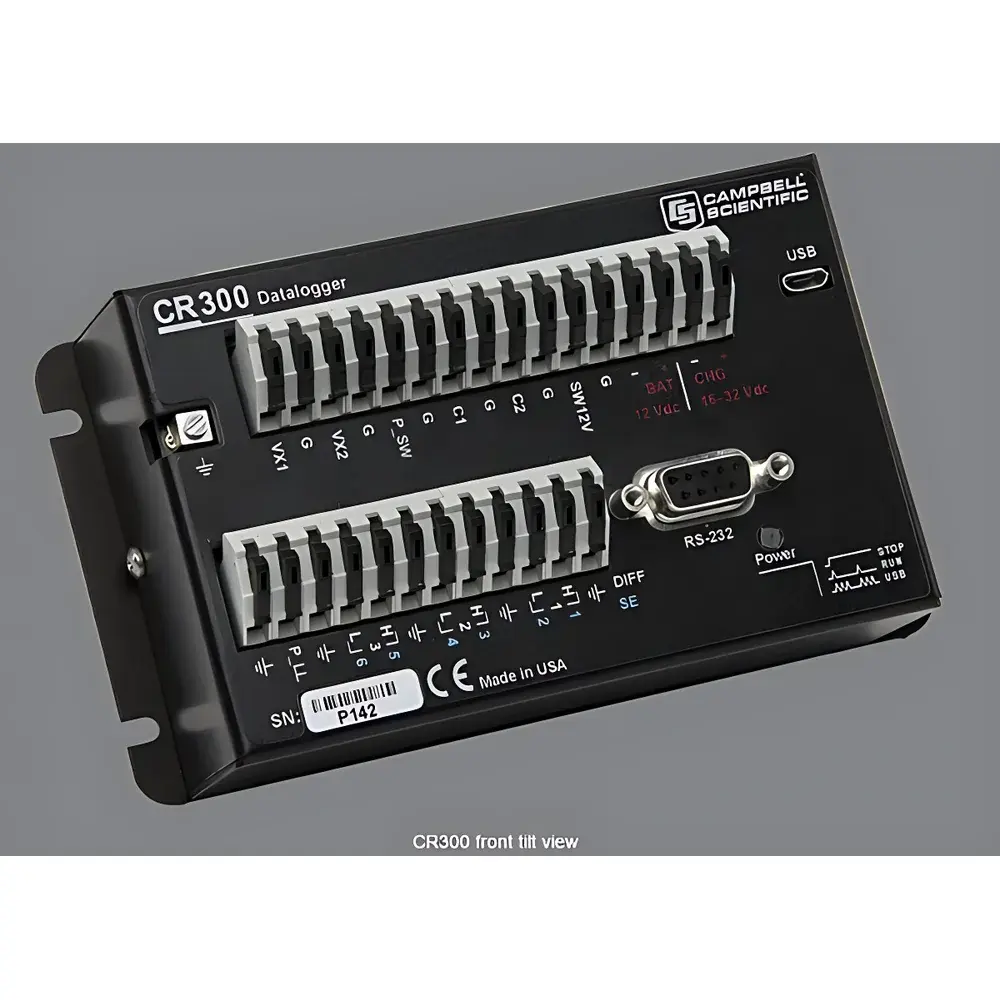
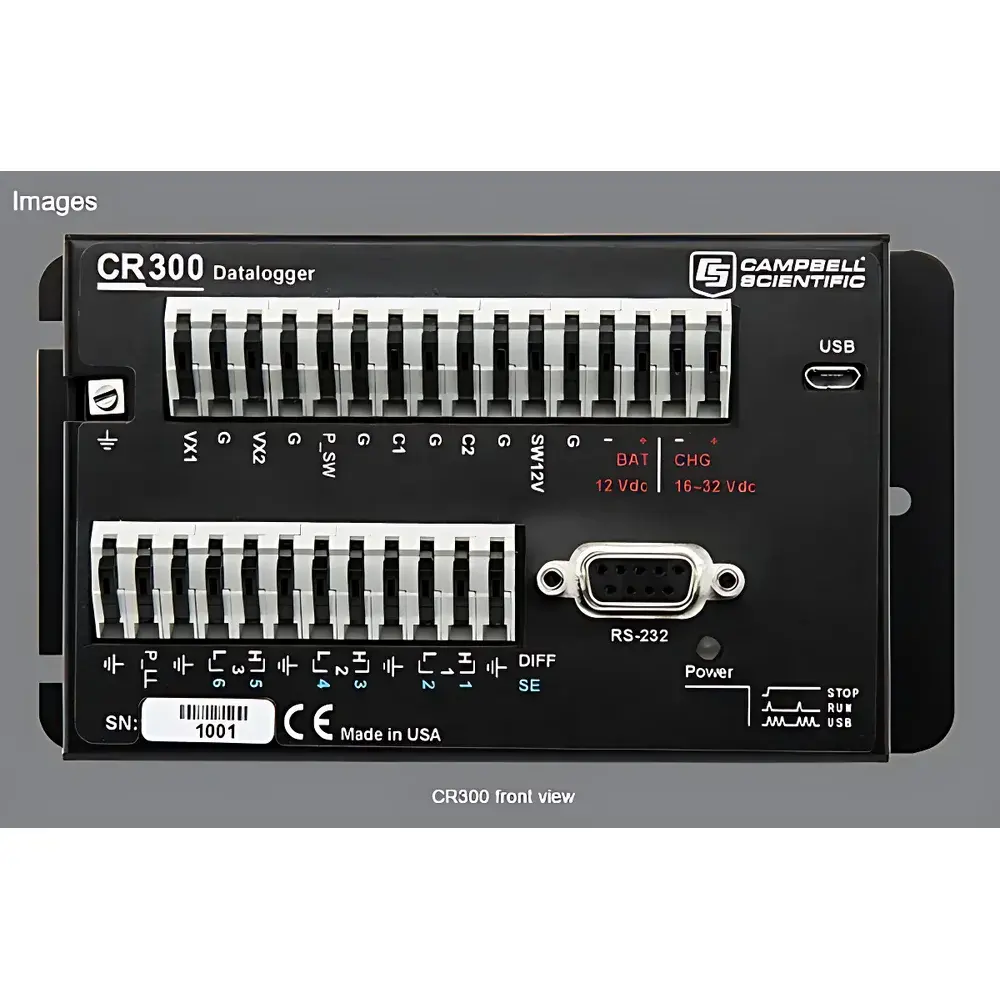
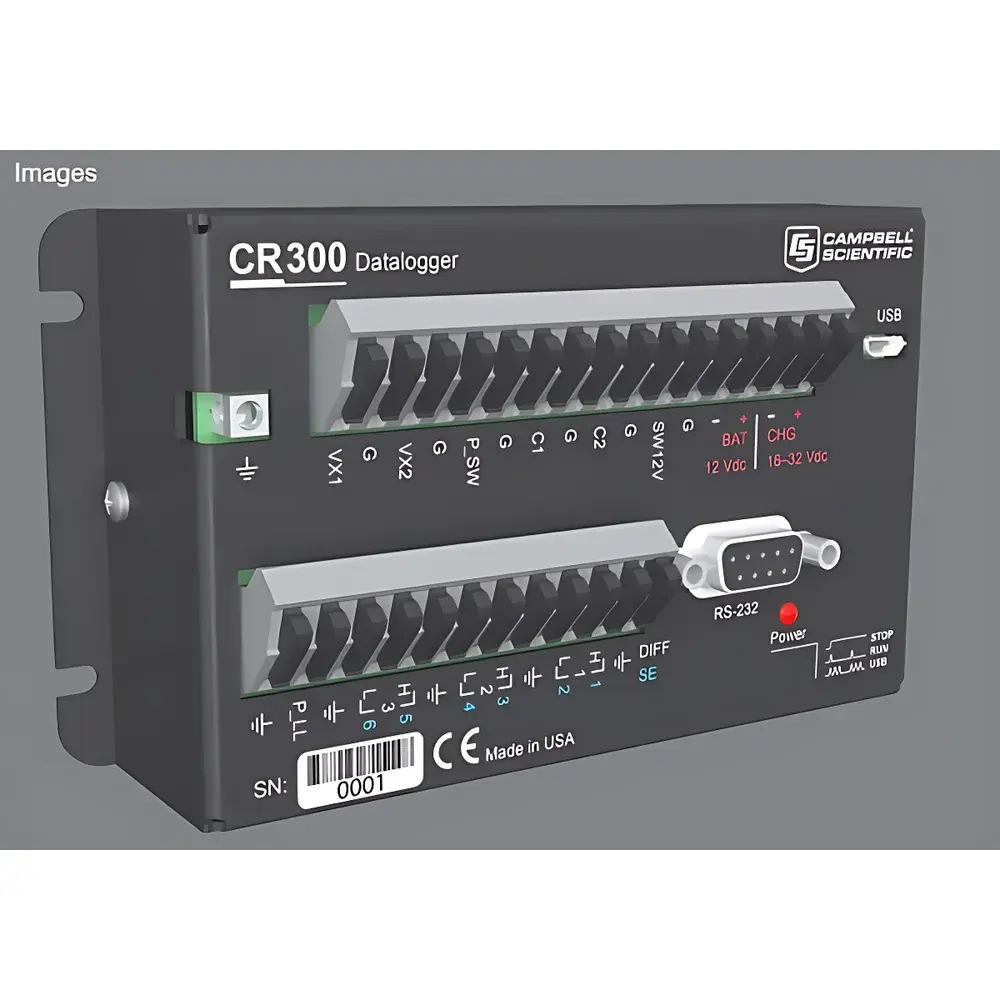
Campbell CR300 Data Acquisition Unit
| Brand | Campbell |
|---|---|
| Origin | USA |
| Model | CR300 |
| CPU | ARM Cortex-M4 @ 144 MHz |
| Internal Memory | 80 MB data storage, 5 MB program storage, 2 MB OS storage |
| Clock Accuracy | ±1 minute/month |
| USB Interface | Micro-B, USB 2.0 Full-Speed (12 Mbps) |
| Power Input | 12 V terminal or 12 V battery/UPS |
| Excitation Output | 1 × switched 12 V (500 mA @ 20°C) |
| Analog Inputs | Differential, ±34 mV range, 230 nV resolution, accuracy ±(0.04% of reading ± 6 µV) at 0°–40°C |
| Operating Temperature | –40° to +70°C |
| Dimensions | 14 × 7.6 × 5.1 cm |
| Weight | 242 g |
| Communication Protocols | PPP, ICMP/Ping, Auto-IP (APIPA), IPv6, UDP, TCP, TLS, DHCP Client, SLAAC, DNS Client, Telnet, PakBus, SDI-12, Modbus RTU/ASCII/TCP, DNP3 |
| Environmental Protection | High-level surge and ESD protection |
| Data Transmission | Encrypted email & alarm notifications via TLS |
| Configuration | USB direct-to-PC |
| Compliance | Designed for long-term unattended field deployment in hydrological, meteorological, environmental, and industrial monitoring applications |
Overview
The Campbell CR300 Data Acquisition Unit is an entry-level, compact, and cost-optimized measurement and control system engineered for reliable, long-term field deployment in remote and resource-constrained environments. Built around a high-efficiency ARM Cortex-M4 processor running at 144 MHz, the CR300 delivers deterministic real-time performance while maintaining ultra-low power consumption—critical for solar-powered or battery-backed installations operating autonomously for months without maintenance. Its architecture follows industry-standard embedded design principles for environmental monitoring systems, supporting precise analog voltage/current measurements, pulse counting, serial sensor interfacing (SDI-12, RS-232/485), and digital I/O control. Unlike general-purpose DAQs, the CR300 is purpose-built for geophysical and ecological observatories where robustness, protocol interoperability, and field-configurability are non-negotiable requirements.
Key Features
- Integrated solar charge controller with 16–32 V DC input range—enables direct connection to 12 V or 24 V photovoltaic panels without external regulators
- Dual-role 12 V switched excitation output (500 mA @ 20°C) for powering high-current sensors or communication modems on demand
- High-fidelity differential analog inputs with 230 nV resolution (±34 mV range) and calibrated accuracy of ±(0.04% of reading ± 6 µV) across 0°–40°C—meeting traceable calibration requirements for ISO/IEC 17025-compliant environmental labs
- Native support for TLS 1.2–1.3 encryption for secure email alerts and data transmission—essential for regulatory compliance in EPA, USGS, and EU WFD reporting frameworks
- Comprehensive communications stack: dual-stack IPv4/IPv6, PPP over cellular/GSM, Auto-IP fallback, and full implementation of PakBus (Campbell’s proprietary mesh networking protocol), Modbus RTU/ASCII/TCP, DNP3, and SDI-12—all configurable without firmware modification
- Industrial-grade transient protection: integrated TVS diodes and ESD shielding compliant with IEC 61000-4-2 (±8 kV contact, ±15 kV air) and IEC 61000-4-5 (surge immunity up to 2 kV line-to-ground)
Sample Compatibility & Compliance
The CR300 interfaces seamlessly with a broad spectrum of analog, digital, and serial sensors used in hydrology (e.g., pressure transducers, tipping-bucket rain gauges), meteorology (anemometers, pyranometers), soil science (TDR probes, tensiometers), and industrial process monitoring (4–20 mA loop devices, thermocouples, RTDs). Its SDI-12 and Modbus support ensures compatibility with third-party OEM sensors certified to ASTM D4253 (soil density), ASTM E1918 (solar irradiance), and IEC 61724-1 (PV system monitoring). The unit operates within the extended industrial temperature range of –40° to +70°C and is rated for continuous outdoor exposure per NEMA 4X guidelines when housed in appropriate enclosures. All firmware and configuration tools comply with GLP audit trail requirements, including timestamped change logs and user-accessible configuration revision history.
Software & Data Management
Configuration and data retrieval are performed via PC-connected USB using Campbell’s LoggerNet software—a Windows-based application validated for FDA 21 CFR Part 11 compliance (electronic signatures, audit trails, role-based access control). Raw binary data files (TOB1 format) can be exported to CSV, Excel, or NetCDF for integration into GIS platforms (ArcGIS, QGIS) or time-series databases (InfluxDB, TimescaleDB). The CR300 supports scheduled data uploads via FTPS, HTTP(S), or PakBus-to-PakBus relay networks, enabling hierarchical telemetry architectures scalable from single-node deployments to regional sensor meshes. Firmware updates are delivered over-the-air (OTA) via signed binary packages, ensuring cryptographic integrity verification prior to installation.
Applications
- Remote watershed monitoring networks requiring low-bandwidth, high-reliability telemetry via cellular or satellite modems
- Automated weather stations (AWS) deployed under NOAA/NWS cooperative observer programs
- Soil moisture and groundwater level monitoring for USDA NRCS SNOTEL and SCAN networks
- Small-scale industrial SCADA edge nodes performing local logic control (e.g., pump start/stop based on tank level thresholds)
- Educational field labs where students require hands-on experience with programmable DAQ systems adhering to IEEE 1451.2 transducer interface standards
- Environmental impact assessment (EIA) baseline studies requiring NIST-traceable sensor logging over multi-year periods
FAQ
Can the CR300 operate independently without a PC after initial setup?
Yes—the CR300 executes user-defined measurement programs stored in non-volatile memory and requires no host PC for routine operation. All scheduling, conditional logic, and data transmission are handled autonomously.
Does the CR300 support Modbus TCP/IP over Ethernet?
No—the CR300 lacks an onboard Ethernet port. Modbus TCP/IP functionality is only available when connected via a compatible external Ethernet-to-serial gateway or cellular modem with built-in TCP/IP bridging.
Is firmware source code available for customization?
No—Campbell does not release firmware source code. However, all operational behavior is fully configurable via LoggerNet or PakBus utilities, and custom measurement routines can be written in CRBasic, Campbell’s ANSI C–derived programming language.
What is the maximum recommended cable length for analog sensor connections?
For optimal noise immunity, shielded twisted-pair cabling is required. With proper grounding and filtering, analog signals remain stable up to 100 meters at 1 Hz sampling; lengths exceeding 30 meters should include local signal conditioning or use of 4–20 mA transmitters.
How is time synchronization maintained during extended cellular outages?
The internal RTC maintains ±1 minute/month accuracy. When connectivity resumes, the CR300 automatically synchronizes time via NTP (if configured) or through PakBus time broadcast from a master datalogger in mesh networks.