
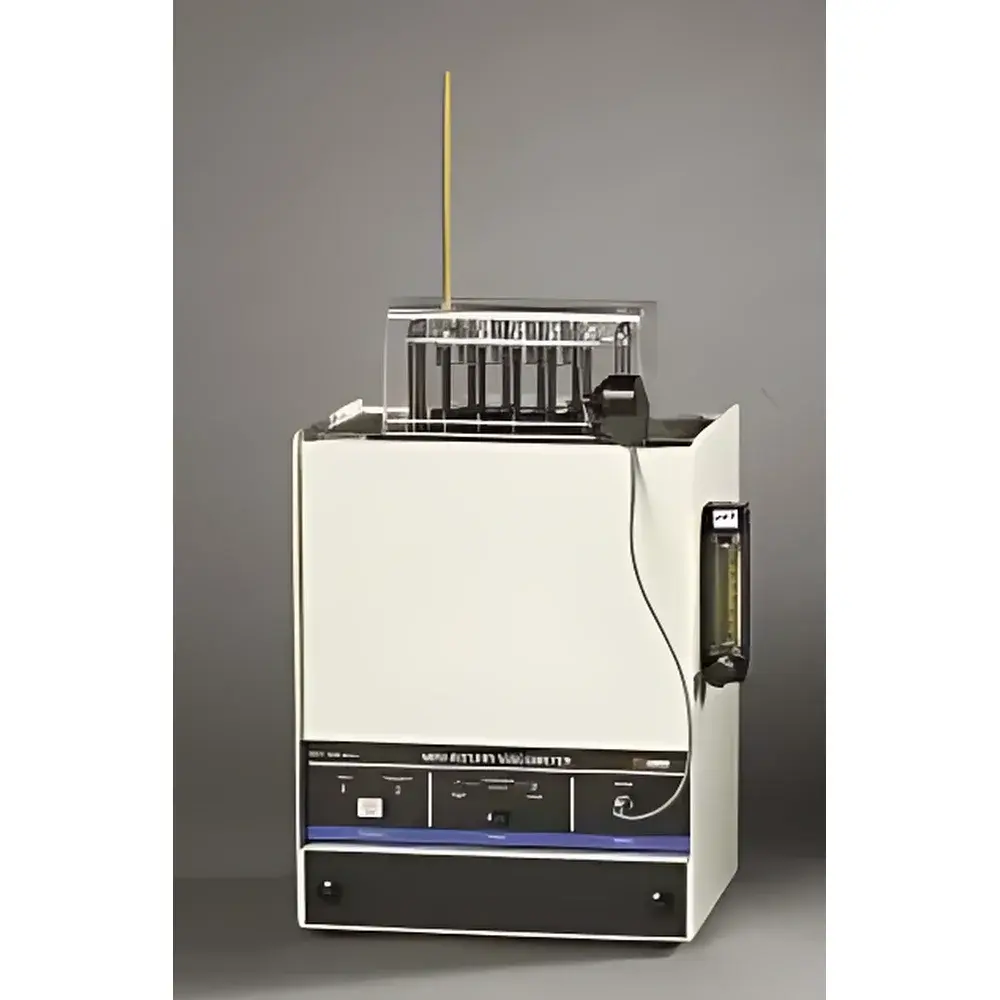
CANNON CMRV-4500F Engine Oil Borderline Pumping Temperature Tester
| Brand | CANNON |
|---|---|
| Origin | USA |
| Model | CMRV-4500F |
| Instrument Type | Rotational Viscometer (Fixed-Mount) |
| Temperature Range | –5 °C to –40 °C |
| Temperature Resolution | ±0.1 °C |
| Temperature Accuracy | ±0.1 °C |
| Cooling Method | Thermoelectric (Peltier) with Fluorine-Free Coolant Circulation |
| Compliance | ASTM D3829, D4684, D6896, D6821, SAE J300, GB/T 9171, SH/T 0562 |
| Software Platform | Windows 98/NT/XP Compatible Control System |
| Optional Accessory | Dedicated Rotor Kit for ASTM D6821 |
Overview
The CANNON CMRV-4500F Engine Oil Borderline Pumping Temperature Tester is a precision-engineered rotational viscometer designed specifically for evaluating the low-temperature flow behavior of engine oils under conditions simulating cold-start and cranking scenarios. It operates on the principle of torque-based rheological measurement in a controlled thermal environment, where a calibrated rotor rotates within the test sample while subjected to precisely ramped cooling profiles. The instrument determines the borderline pumping temperature (BPT)—the lowest temperature at which an engine oil can be pumped by the engine’s oil pump without cavitation—as well as apparent viscosity and yield stress at sub-zero temperatures. Its thermoelectric (Peltier) cooling architecture eliminates reliance on flammable organic coolants (e.g., methanol), offering intrinsic safety, environmental compliance (CFC/HCFC-free operation), and long-term system stability. Unlike conventional mechanical refrigeration units, the CMRV-4500F achieves rapid thermal equilibration and eliminates pre-cooling delays—enabling immediate test initiation upon sample loading.
Key Features
- Thermoelectric cooling system with fluorine-free coolant circulation, ensuring ISO 14001-aligned environmental stewardship and operational safety in laboratory environments.
- High-stability temperature control across –5 °C to –40 °C, with resolution and accuracy both maintained at ±0.1 °C—critical for reproducible BPT determination per ASTM D4684 Annex A1.
- Computer-controlled thermal profiling: users define custom cooling ramps (e.g., linear, stepwise, or dwell-based) to support advanced low-temperature performance research beyond standard method requirements.
- Integrated nitrogen purge functionality minimizes frost formation on rotor and sensor surfaces, significantly improving measurement fidelity for yield stress and apparent viscosity at extreme low temperatures.
- Enhanced alloy rotor assembly—lightweight, corrosion-resistant, and geometrically optimized—with reinforced conical tip geometry to withstand repeated thermal cycling and mechanical loading without deformation.
- Patented insulated rotor sleeve design prevents condensation and ice accumulation during prolonged sub-zero operation, preserving rotational symmetry and torque signal integrity.
- Upgraded pulley mechanism delivers improved mechanical responsiveness and reduced hysteresis, enabling accurate detection of the onset of flow cessation (i.e., yield point transition) during D4684 testing.
- Unattended delayed-start capability supports extended-duration protocols—including ASTM D4684’s 48–53 hour continuous cooling cycles—without operator intervention or real-time monitoring.
Sample Compatibility & Compliance
The CMRV-4500F accommodates standard 400-mL API engine oil samples in ASTM D3829-compliant containers and is validated for use with mineral, synthetic, and semi-synthetic formulations. Its mechanical and thermal architecture meets the dimensional, torque sensitivity, and thermal uniformity criteria specified in ASTM D3829 (Standard Test Method for Predicting the Borderline Pumping Temperature of Engine Oils), D4684 (Standard Test Method for Determination of Yield Stress and Apparent Viscosity of Engine Oils at Low Temperature), D6896 (Standard Test Method for Determination of Low-Temperature Viscosity of Engine Oils Using a Controlled-Stress Rheometer), and D6821 (Standard Test Method for Determination of Low-Temperature Viscosity of Engine Oils Using a Controlled-Strain Rheometer). It also satisfies SAE J300 viscosity classification requirements for winter-grade oils (e.g., 0W, 5W, 10W), as well as Chinese national standards GB/T 9171 and industry standard SH/T 0562. For D6821 implementation, a separately ordered specialized rotor kit is required. All calibration traceability is supported via NIST-traceable viscosity reference oil (N105B), supplied with certificate of calibration.
Software & Data Management
The instrument is operated via a dedicated Windows 98/NT/XP-compatible control application that provides full automation of temperature sequencing, rotor actuation, torque acquisition, and endpoint detection. Real-time graphical display of temperature vs. time, torque vs. time, and apparent viscosity evolution enables immediate visual verification of test progression. Raw data files are exported in ASCII format for downstream analysis in third-party statistical or rheological modeling software. Audit trails—including operator ID, timestamped parameter changes, and thermal profile logs—are retained locally and comply with GLP documentation practices. While native 21 CFR Part 11 electronic signature and audit trail enhancements require external LIMS integration, the system’s deterministic execution logic and hardware-level temperature logging ensure full method traceability for internal QA/QC and regulatory review purposes.
Applications
- Determination of borderline pumping temperature (BPT) for OEM engine oil qualification per OEM engineering specifications.
- Low-temperature yield stress evaluation for formulation development of high-performance synthetic lubricants.
- Apparent viscosity profiling to support SAE J300 winter-grade certification (e.g., 0W-20, 5W-30).
- Comparative assessment of pour point depressants and viscosity index improvers under realistic cold-cranking thermal gradients.
- Research into non-Newtonian flow behavior of modern low-SAPS (Sulfated Ash, Phosphorus, Sulfur) engine oils at sub-zero conditions.
- Validation of cold-flow performance for bio-derived and alternative base stock blends intended for electrified powertrain applications.
FAQ
Is the CMRV-4500F compliant with ASTM D4684 for yield stress measurement?
Yes—the instrument meets all mechanical, thermal, and data acquisition requirements outlined in ASTM D4684, including specified rotor geometry, cooling rate tolerances, and torque resolution thresholds. It is explicitly cited in the standard’s normative references (Section 2, ASTM D4684–23, p.2).
What is required to run ASTM D6821 on this instrument?
A dedicated rotor kit (sold separately) must be installed to satisfy D6821’s controlled-strain rheometry configuration. The base CMRV-4500F platform supports all thermal and timing parameters of the method.
Does the system support 21 CFR Part 11 compliance?
The embedded software does not include built-in electronic signatures or role-based access control; however, raw data logs and thermal profiles are fully timestamped and immutable during acquisition—enabling integration with validated LIMS or ELN platforms for full Part 11 adherence.
Can the CMRV-4500F operate without pre-cooling?
Yes—its thermoelectric architecture enables direct initiation of thermal ramping upon sample loading, eliminating the 2–4 hour pre-chill delay typical of compressor-based systems.
Is NIST-traceable calibration material included?
One vial of N105B certified reference oil (with NIST-traceable viscosity certificate) is supplied as standard equipment for routine performance verification and calibration validation.



